yusha

(6 june 2011)

i’m sitting in a concrete garden between two skyscrapers when i listen to the message from the stepbrother—my hand held to my heart in shock as a voice that, thanks to two decades of jackie o documentaries, i would have recognized anywhere, comes out of my very own phone.

it is a 3 ½ minute display of old world graciousness that was, due to a bad connection, punctuated by loud bursts that i would have interpreted as gunfire had i not known he was calling from a castle in rhode island.

this was last august. way before the whole 9/20/13 plan.

we talked three more times and then i dumped him. i didn’t call, didn’t write, didn’t do anything. because i didn’t know what to do with him. i didn’t know where he fit in the story i was trying to tell.

that hasn’t changed. i’ve still no idea. but i’ve given myself a year. i’m throwing spaghetti at the wall and seeing what sticks.

in that spirit, i’m meeting the stepbrother in newport this weekend.

there won’t even be an attempt to play it cool here so just know: everything about that sentence is scary. that is why i have put this off for so very very long.

calling the step-brother on the phone is an ordeal so awful that i dally for whole weeks at a time before ringing him back.

our phone calls, thus far, have been epically bad. like, horrendously, hilarifyingly bad. in the made-for-tv movie treatment of Jackie: The True Story Of The (un)Making of A Book That Never Was, the scenes comprised of these phone calls are going to earn jennifer love hewitt her biggest laughs.

i speak too softly and too fast. the step-brother appears to be calling me on a walkie-talkie from the middle of an airfield that has come under enemy fire. we speak to one another as victorians not yet familiar with the cutting-edge technology of the telephone.

there’s obviously enormous room for improvement here so i’m holding out hope that it’ll be me and jackie’s stepbrother kicking it at the castle and that we’re going to be, like, totally steller communicators when we meet face-to-face.

minimal hope, mind you. but hope nonetheless.

the dream

(6 june 2011)

i’ve dreamed about her just once. once in all these years. and this was very, very early on. maybe ’94 or ’95. back when it was all much much simpler and she was just an interesting story rather than one i had to tell.

we were backstage at something in some dressing room that looked exactly like the vintage clothing booth in the back left corner of the battleground antique mall in franklin, tennessee off harpeth road.

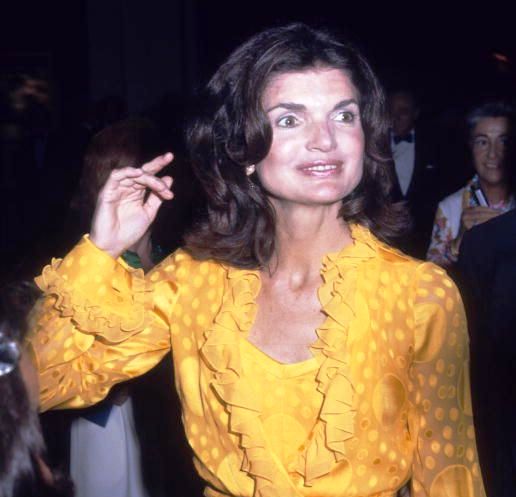
we were not alone. we did not speak. i was wearing yellow chiffon.

she looked me in the eye and she nodded.

i remember this when i wear yellow.

running v. standing still

(31 may 2011)

there’s a jackie relative who’s willing to talk to me. when we spoke on the phone last august, he said, well, you know, jackie loved parades and, as well as i think i know her, i did not know that.

i’ve not met with this man for a million reasons. because i didn’t have the money, i didn’t have the technology, i didn’t have any questions and i didn’t have the emotional wherewithal to arrange for a rental car in a city whose website explicitly warns that there is no available parking and it is stupid to drive.

but mostly i have not met with this man because there’s a fool voice in the back of my head that says that meeting with him would somehow expose the severity of my limitations. this is the same voice that says my work should unfold in a neat and tidy way, that all risks are inadvisable and standing still is by far for the best.

i’m fairly certain that voice is a vile bitch.

because neat and tidy isn’t the answer. quite often you have to make a big old mess.

if you know exactly what you’re doing, where you’re headed and how, you will likely get there, but you might also miss out. because it’s by taking the risks and the paths you never planned to go down that you wind up doing the really really interesting things. the things beyond what you can dream.

there’s a jackie relative who’s willing to talk to me. i’m likely imperilling his life by admitting it, but, all these months later, i am finally ready for him.

book ’em

(27 april 2011)

i’m sitting in riverside center room 12 listening to this guy wax on about how the male youths of the 60s were pivotally influenced by the depictions of manhood in john wayne’s the sands of iwo jima when i realize that i am maybe writing two books. three if you count that other book that i’ve not really written but about the writing of which i’m writing in that additional book.

so, four.

four books.

i am writing four books.

but what i’m really doing is not writing any of them.

one of the four is done. except that it isn’t because i’m pretty sure now that it may need to become two. if not, it sure as hell needs to become a better one because it’s maybe a half at present. and a crap half at that.

so what we have is this:

jackie: the definitive biography
jackie: the tabloid years
jackie in paris: the biography
jackie in paris: the novel of the failed attempt to write the biography

none of them written. none of them being written.

there’s this phase of writing we don’t talk about much. the phase where you’re writing nothing.

this tends to look like laziness. i would argue it isn’t. but then, maybe i’d think that precisely because it’s the stage i’m in. it’s easier to justify the notion that i’m mentally arranging pieces and plotting course than to admit i’m stewing in a pit of ideas from which i cannot crawl out.

in high school, due to my great fear of tardiness and inability to master a combination lock, i never used my locker but, instead, lugged 30 pounds of textbooks around every day.

that is how writing sometimes feels. all those books and projects and pieces crammed into your skull. you carry them around with you, because it’s a frightening process to get them out and because you do not yet have the key.

jackie why?

(29 march 2011)

jackie and i’ve been together for 18 years. since the badly xeroxed women’s history handout in mrs. pavlick’s 6th grade english class.

18 years and i never once thought to ask “why jackie?” now, i can’t stop wondering.

because i have no answer. i’ve had 18 years, a book and two big projects to come up with one and i’ve got nothing.

well, that isn’t entirely true. i’ve staked 3/4s of everything i’ve ever written on the theory that she is the twentieth century’s archetypal female, a tabula rosa onto which, even after her death, we can still project our own experiences to find meaning.

but that’s the pretentious, academic answer. i was only twelve when i met her. back then, i would’ve mispronounced tabula rosa as tabitha rose and mistakenly believed the concept to be a transfer student of european descent.

if we examine the fact that what i remember most about that handout through which i met her is that it was badly xeroxed, we might conclude that i wasn’t so much captivated by jackie’s story as impressed by the poor quality of the page middle school duplicating equipment.

but there’s more to it. the other thing i remember about the women’s history handout packet is that jackie was clearly a last minute addition. the pages on florence nightingale, madame curie and sacajawea were all stapled together and bound in a folder. jackie was a separate sheet, as though she were tossed in at the last minute. as though there were a question of whether she really belonged.

in the pyramid of powerful women jackie stood out because the paper on which her story was printed was physically separate from the others, but she seemed set apart in time and space as well.

with their ruffled blouses and bunsen burners, these other women belonged on badly xeroxed handouts, but jackie’s feathered bouffant bespoke a modernity uncharacteristic of historical heroines. she was clearly a renegade.

the sketch of her that appeared on that handout was from a period that i would later know to identify as “the onassis years.” why jackie? because her earrings were enormous.

shots in the dark

(24 march 2011)

i wrote the sister again.

yes, the sister has already informed me she does not give interviews about jackie, but considering i have very little to lose beyond pride and dignity and all that shit that i’m pretty sure i shouldn’t value quite so much as i do, i wrote her again.

this brings me the closest to groveling that i have thus far come. and i can proudly say with some dignity, i don’t feel the least bit bad about it.

money makes the world go round

(18 february 2011)

if it is challenging to explain why one is good at what one does, it’s nearly impossible to put a price on it.

i have been asked to establish my fee.

this is a process enormously complicated by the fact that my fee has, thus far, been in the very wee digits. but i’m trying to be a biographer. like, for real. and i know the very wee digits do not help me do that.

so i am sitting on the fainting couch that is symbolic of my adulthood trying to solve a problem i’ve wrestled with since i began baby-sitting in middle school, when i took whatever they gave me at the end of the night and sacrificed many a friday evening for $5.95.

please note: the national minimum wage was $4.75 per hour. mine was $1.98.

that’s a monumental gap. as is the distance between $13.75 per hour and $75.

and while i know, in reality, i’m just determining the financial value of my hours, it feels like i’m being called upon to do so much more than that.

i’ve been asked to establish my fee. in doing so, i’m defining my value.

i’m sitting on the fainting couch that symbolizes my adulthood facing that girl who gave up her friday nights for $5.95.

it takes tremendous effort to not sell myself short. to admit what i think i’m worth.

adventureland

(16 february 2011)

we have reached a point where i am, for the first time, facing the very great financial cost of what i want to do.

in a perfect world, jackie would pay for herself. in reality, it is unlikely she ever will.

this isn’t entirely unexpected. you don’t spend a small fortune to get a degree in writing and imagine yourself rolling in millions. so long as i can afford a bottle of andré and the occasional betsy johnson from the resale shop, i’m truly more than pleased.

but this goes against pretty much most everything everyone will ever tell you. this idea that it is better to do what you love than what you should and what is safe. in talking about jackie with people, i am repeatedly reminded that, despite my “romantic” notions of being a writer, i still have to eat. and have a home. and “settle down.”

i had a friend once, who began nearly every discussion we ever had with the question, where do you see yourself in five years?

at the time, i found this terribly daunting. i think it downright foolish now.

we, as a culture, put so much stock in having an end point- some mystical time in which our lives will fall together and look exactly as we want them to be. i detest this. i struggle with it daily, but i detest it all the same.

because there is no end point. no job or marriage or baby or home that’s going to make you a better you. there is simply life. we none of us know where we’re going and, in thinking we do, we miss so very much along the way.

i am writing a jackie book about the jackie book that i am trying to write but likely never will because it is becoming increasingly apparent that there is simply no there there.

which brings us to my mother. who, in the middle of a prolonged discussion of the benefits of organic, grass-fed meats, says the most maudlin thing ever, which is, nonetheless, the exact thing i needed to hear. she pauses, inhales and says: you know something’s going to come of this right? this jackie stuff? you’ll get there when you get there, but until then, God, what an adventure you’ve got.

just like us

At the advent of the 1960 presidential campaign, Norman Mailer prophesied that if John Kennedy was elected, “myth would emerge once more, because America’s politics would now also be America’s favorite movie, America’s first soap opera, America’s best seller.” He was eerily accurate.

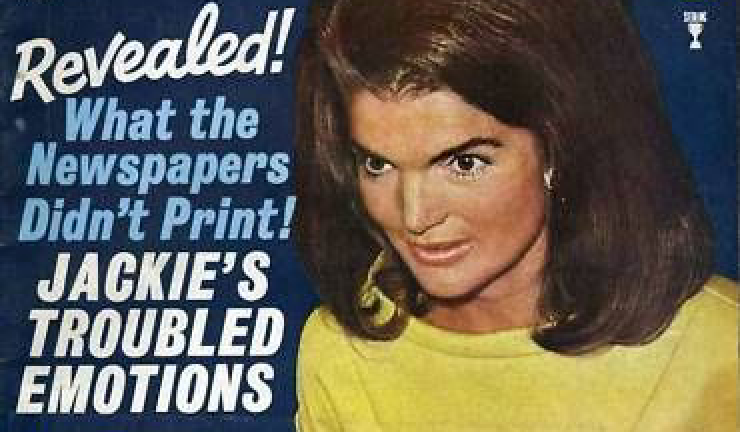
As long as they have been in public life, the Kennedys have been associated with the press, making their first fan movie magazine appearance in the September 1927 issue of Photoplay. By the early 1960s, there were upwards of forty fan magazines, including Photoplay, Motion Picture, Modern Screen, and TV Radio Screen. The forerunners of the modern “celebrity magazines” such as Us Weekly and In Touch, the movie magazines covered the misadventures, tribulations and lifestyles of television and film stars, as well as lesser known celebrities. By the early 1960s, the top two dozen publications had a collective circulation of 8,000,000.

In the wake of the Red Scare and the advent of television, movie admissions and, thus, the movie magazines’ revenue from advertising had dramatically decreased. In response, tabloid editors used “Jackie’s” image with unabashed frequency.  Much as popcorn kept movie theaters afloat, so “Jackie” stories salvaged the movie magazines: “the appearance of a beautiful and personable First Lady, who could have been a movie star, offered the ailing fan magazines a two-pronged editorial policy certain to keep them solvent and profitable. The fan magazines would concentrate on Mrs. Kennedy, featuring her regularly on their covers.” As sociologist Irving Schulman notes of the movie magazines, circa 1961: “It had at last come to pass that the world’s longest and most exciting movie was being performed every hour of every day at the White House and in locales throughout the world related to this master set. To record this living movie and assure its proper critical place in American and international history was the contemporary historic dedication of the fan magazines.”

In recording this living movie, the fan magazines were chronicling a lifestyle that held great allure for readers. Sociologist Irving Schulman begs us to remember the “tired housewife who fell into bed after she had done the evening’s dishes, put out the pets and garbage, got the children to their rooms, and left her husband [ . . . ] snoring before the television set, six-pack at his feet– [who] envied the lovely woman in the White House.” This was, from the very beginning, a fairy tale as vividly drawn as any by Disney. As Paris Match’s Washington D.C. correspondent, Phillipe de Bausset, later reflected: “The public expected a dream story, so this is what we gave them.”

“Jackie’s” life would become the world’s first reality show. It would play out weekly on newsstands across the country, and even just by reading the headlines- much less the stories- it was possibly to keep abreast of everything happening in “Jackie’s” magical movie magazine world. Her reign as movie magazine queen would be so successful that in 1962, after just one year as First Lady, Variety hailed her as the “world’s top Box Office femme.” Never mind that she had never been in a movie.

Later that same year, the editors of TV Radio Album came closest to explaining this fixation when they attempted to justify use of the word “star” in relation to Mrs. Kennedy: “The word is used in show business to describe a personality so warm and vital that we forget we know it only as a picture on a TV screen or a name in newsprint. We feel that we know the actual person, as someone close to us. And certainly Jacqueline Kennedy is all that!”

Though she closely guarded her privacy, small details seeped out. Jackie ate grilled cheese for lunch. She napped. She jumped on a trampoline. She did the twist.

She was just like us. Except when she wasn’t.

When she read Saint-Simon and went to India. When she spoke French. When she said clever things and made it obvious that she was insanely smart.

While her popularity was bolstered by a sense of likeness—the notion that she was “just like us”— a significant part of her appeal also lay in the nagging sense of her otherness; the idea that she was more cultured, more intelligent than ordinary women could ever be. It was these two sensations in tandem—her plainness and exoticism— that increased her marketability.

It was astonishing, the ease with which she could be integrated into everyday life. There were “Jackie” vases, “Jackie” dolls, and “Jackie” salt and pepper shakers. By July 1961, two million copies of a biography—a “paperback romance of her life”— had been sold. Plastic surgeons reported an increase in requests for nose bobs and low-priced clothing lines offered affordable knock-offs so everyone could sport the “Jackie look.” For the Midwestern housewife who knew nothing of Saint-Simon, fine art, or French and lacked Mrs. Kennedy’s je ne sai quoi, copying the First Lady’s hair, clothes and lifestyle provided an easy means of evoking her sophistication.

After the TV program A Tour of the White House with Mrs. John F. Kennedy aired in 1962, yard sales and antique stores did booming business as women began foraging with near maniacal vigor in a quest to decorate their homes à la “Jackie.” Nearly every aspect of Mrs. Kennedy’s life– what she said, what she wore, where she went and what she did– was marketed.

Even the movie magazines exploited her as a commodity, using her image to boost readership and, accordingly, advertising revenue. She generated good sales in an industry that depended upon the newsstand to an extraordinary extent. In the early 1960s, Photoplay, the most dominant movie magazine, sold half its copies through the newsstand. The welfare of smaller magazines depended even more heavily upon the newsstand. For example, in August 1964, Movie TV Secrets’ monthly circulation through paid subscribers was an astounding fifty copies, and even when a cover was wildly successful, the fan publications struggled to break even. For the movie magazines, “Jackie” represented a goldmine of possibilities.

It has been suggested that “Jackie’s” narrative and the advertisements that appeared alongside it are intertwined. Thus, when in December 1964‘s TV Radio Mirror, the article “As I Still See Him,” which was subtitled ANNIVERSARY OF TERROR and detailed how John Kennedy’s life “was violently, horribly, against his will, taken from him,” was flanked by advertising that implored “DON’T BE FAT,” “KILL THE HAIR ROOT,” and banish “OLD LEG SORES,” “Jackie’s” heroism casts our petty concerns in a proper light.

Pop-culture philosopher Wayne Koestenbaum argues that these juxtapositions were not alarming to contemporary readers because “Jackie” “is not just next to ads, she herself functions as an ad [ . . . ] For miraculous change of life [ . . . ] Jackie advertises the transformation.” It was not a giant leap to assume that if “Jackie’s” story could share a page with a particular product, she might purchase the product as well. The ads kept “Jackie” human; she was beautiful and glamorous, but she was mortal and busy– waxing, bleaching, dieting. But they also pushed readers towards betterment by establishing a paradigm of “what would Jackie do?” in which being fat was not an option.

In the coming years, the connection between the stories and the ads would only become more obvious, with the ads growing increasingly smutty as the “Jackie” character herself sustained a moral plunge. Not ten years later, “Jackie’s” story would be flanked by advertisements for vibrators and birth control.

The movie magazines had begun as an advertising vehicle for motion picture stars, but “Jackie’s” very appearance in their pages suggested a sea change. Whereas celebrities like the Beatles, Frank Sinatra and Elizabeth Taylor were, in fact, selling a product– themselves and their movies or music, Jacqueline Kennedy had nothing to hawk. And so, her life itself was turned into a movie for the public’s entertainment. By the early-1960s, “the tabloid newspaper was almost exactly analogous to a movie theater,” and “Jackie’s” life was the feature presentation, played out on newsstands across the country. Within the tabloid culture, she heralded a new age—one in which an ordinary housewife could become a lifestyle star.

In Life the Movie, cultural historian Neil Gabler observed that “Every celebrity worth the designation had to have some ready referent, whether a physical characteristic or a signature expression or a distinctive vocal inflection or a style of dress, in order to claim his space in the crowded celebrity universe.” “Jackie” has referents in spades– sunglasses, the bouffant, pearl necklaces, shift dresses, pillbox hats, printed scarves, kid gloves, jodhpurs, the breathy voice, and that wide-eyed look, to name just a few. Through these artifacts, as if blessed by “Jackie” herself, the icon endures. Yet, “Jackie” gains tribute not simply through the classy, but the kitschy as well. Her image is featured on coloring books, as paper-dolls and collector figurines, on vases, salt-and-pepper shakers, plates, cups, spoons, calendars, purses, t-shirts, and stamps.

The “Jackie” captivation endures precisely because she has “lasted as ephemera.” Despite Mrs. Onassis’ death, “Jackie” still has the power to mesmerize and perplex. Writing in the Washington Post shortly after the former First Lady’s death, Henry Allan extended the most succinct articulation of her unrelenting hold over the American imagination: “[ . . . ] like all useful goddesses, she was a mystery . . . She rose above, and for a woman of her time, and maybe for a woman of any time, this was a supreme act. She was silent. She was beautiful. She was ours and she was us.”
all wrong

(17 january 2011)

i wonder sometimes if i’ve got it all wrong. made up a series of elaborate meanings where there are, in fact, none.

these are the scary days.

on the good days, it makes perfect sense and most days are good days.

gossip is a socially useful device. other people have proven that.

human beings are naturally self-centered. people have proven that as well.

and so, on the good days, it doesn’t seem such a leap to say that human beings take in gossip and apply it to their own lives. it’s only on the bad days that i realize this leap is enormous.

i am standing on a mountain of proven facts shouting something no one else has said. at least not in writing.

i would argue jackie’s was the most significant female life of the 20th century. i would argue the 1970s were the most important years of that life. i would argue that for reasons no one would ever guess and most everything ever published would argue that my argument is wrong.

i don’t really know what to do with that. except maybe shout a bit louder.