heaven tonight

(11 october 2006)

a friend and i are writing a play. tonight this play took us where we inevitably knew it would. but that doesn’t mean we were prepared. that we weren’t both rather stunned when the friend dunked her chocolate chip cookie, leaned back and declared, so i guess at this point we must ask ourselves how marilyn would greet jackie in heaven.

blindsided by the fact that we would have to ask ourselves such a thing- though i must have always known we would- i abruptly leaned forward, my hair sweeping up the pile of pumpkin bread crumbs that i would spend the remainder of the evening shaking from it.

i was a mess. i wasn’t ready. had i known we were going to heaven tonight, i would’ve at least shaved my legs.

by now, we’re pretty certain this play is unspeakably awesome. we read it and we laugh and cry. as though this weren’t actually our play. as though elves were writing furiously in the night to produce theatrical brilliance for us.

our ladies are surprising. these ladies we know so well. we read that jackie ashed her cigarette on marilyn’s carpet and we jumped back in shock. jackie! we gasped. what a bitch! as though we hadn’t been sitting in panera a month ago cackling about how hysterical it would be for jackie to do precisely that. as though she were no longer our jackie. as though she had become her own.

so tonight the play made it to heaven. and we sat in starbucks trying to figure out what jackie and marilyn would say in heaven. we, of course, knew what they would be wearing, but what would they be like? would they be funny in heaven? or serious? would smoking be allowed in the afterlife? we had no idea. we didn’t know where to begin. we were lost. we could not go on.

until the friend dunked her chocolate chip cookie, leaned back and astutely observed, we’ve got to assume they’d have all sorts of wisdom and shit because they’re, like, dead. and with that we had our motivation. and our subtitle.

decline + fall

(21 april 2007)


2007 began with one resolution. i was going to read books i already own, most especially the 500+ pagers. way back in january, this seemed like a very exciting madcap sort of literary la adventura. ultimately, it’s kind of sucked.

i read one book at a time. i have always done this. i have never not done this and i never thought i would be the kind of person who doesn’t do this. but, at the moment, i am not doing this- a fact that has mildly unhinged my sense of self. every morning my eyes open to a pile of books on a nightstand and i fear that i have wandered into the bed of some unfocused person with curiously similar literary taste.

then i remember. this is who i am now. a girl with a commitment problem.

it seems increasingly likely that i may be a girl who lives a very very long life only to die with that damn shelby foote, the memoirs of the duc de saint-simon, and michael bellesiles’ arming america still unfinished, still piled on the bedside table, still bookmarked at pages 425, 364, and 243 respectively. and this simply will not do.

yet, how to put a stop to it? over the years, i have come to avoid bookstores like the plague, because they get me in trouble. it would be like an alcoholic hanging out at a liquor store- a plainly unwise move. but a literary rut demands desperate measures, and what better way to resolve a handful of languishing reading relationships than a book-buying rampage?

because book-buying can sometimes be a rather difficult thing to avoid when one is a lover of books, i’ve developed an array of emotional armament to protect myself from flagrant biblioindulgence. a bookstore trip should always be a group activity, because in company one is less likely to throw down the credit card with reckless abandonment and walk out with the collected works of anna maxted and the marquis de sade.

when a solo bookstore encounter cannot be prevented, a pen and paper are vital because one can then peruse the shelves jotting down titles, which creates a sense of interactivity without actual purchase. these titles can then be added to a 34-page amazon wish list, creating the illusion that they are at least members of one’s virtual library if not the real thing.

i honestly can’t remember when i last went to a corporate chain bookstore by myself. but today- defenses down, pen and paper at home, caution thrown to the pleasantly warm wind- i fell, exhausted, humbled, and literarily broken-down, into the loving arms of borders. two and a half hours and three wildly different books later, i left him and walked home in the sunny saturday afternoon, grinning like a fool because all is again well in my written world.

heydays are passing

(7 march 2008)

i had high hopes for kurt andersen’s heyday. over-inflated, fool-heartedly high hopes, largely based upon a catchy cover. in this i greatly erred. it was supposed to be a “joyful, wild gallop through a joyful, wild time.” “a thrilling voyage.” “a dickensian calliope.” “fiction at its finest.” and yet, heyday was neither joyful nor wild. it was ponderous. it was wearisome. it was there will be blood minus the milkshake. in essence, it was beyond boring as dirt.

in the weeks since i finished it- as i went on a restorative gallop of my own through classic fiction- i’ve wrestled with what exactly was wrong with heyday. why didn’t it work? what was wrong with me that i thought it didn’t work when every critic from baltimore to banff alleged that it did? i think i’ve finally nailed it. and i think it has a lot to do with there will be blood.

perhaps this is naive, but i think a novel and/or a movie has to build up to something. it has to be going somewhere, no matter where and no matter how seemingly inconsequential. and it can’t just show you where it’s going- it has to take you along. this doesn’t mean there must be some great societal point (though if it’s trying to make one, it sure as hell better), but there does have to be an engaging element beyond a lone oil rig explosion or sending an arrow through the antagonist’s eye on the final page. and, for me, that’s what that film and this book came down to. those were the moments where i sat up and thought, at last! maybe we’re going somewhere! alas, we didn’t.

for a book trying to capture the frenetic energy of 1848 new york and a film trying to the depict the internal unrest of an admitedly deplorable character, both were oddly stagnant. as though andersen and anderson simply forgot to instill their work with the movement and agitation that should have been at the very heart of what they were trying to do. there was tension, yes. tension restrained to the extreme. and exhaustion. but no energy.

if there will be blood had ended at the scene in the church where daniel is baptized, i would have been a believer. i would have walked out of there blabbing on and on about what an unbelieveably incredible film that was. but it didn’t end there. it went on and on and on. and yet, it went nowhere. the same with heyday. collectively, the pair of them were the very definition of running to stand still. and i guess what we learn here is that does not work for me. i have to go places. i have no patience for standing still.

*sigh*

(14 october 2006)

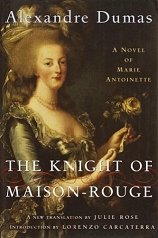
i love france, marie antoinette, and swashbuckling. thus, i’m rather ashamed to admit it took me twenty-five years to discover a french novel about swashbucklers rescuing marie.

for weeks i’ve wanted to articulate the terrible beauty that is alexandre dumas’ the knight of maison-rouge, but there are no words. so i loaned it to a friend in the hope that she would be able to express it. but the words failed her as well and we were reduced to swapping emails of *sigh* and oh! the lovely.

KMR is the literary equivalent of tilapia. try it. it will blow you away. but beware, its charms are subtle. this is not the greatest novel in the world. there’s some plodding. some really, alexandre, where are we going here? moments. and since it involves the french revolution and miss marie, there’s a nagging sense that the majority of the characters are going to lose their heads. but the final pages. The Final Pages.

the first time a book made me cry was the third grade. sweet valley high #40, ON THE EDGE. regina (the deaf one, no less) got mad at her jock boyfriend, went to a crazy party, took a line of cocaine and died. at sweet valley high, we had battled steroid addiction with regina’s jock boyfriend and covered reckless partying with jessica wakefield, but no one had died. the moral “deaf girls gone wild wind up dead” did not escape me. it was shocking. nightmarish. i wept for three days.

i can’t remember the last time a novel has affected me quite so much as #40. where i put it down and was left in a funk by fictional characters. biography bowls me over almost without fail, and KMR is historical fiction so perhaps the history lent it some added emotional thrust. but whatever it was, KMR is the new #40.

regina died in a coked-out haze of juvenile prose that had me sobbing about the unfairness of mortality. KMR left me wide awake, repeatedly turning on the light, wiping away the tears, and taking in the terrible beauty again. reading them again. The Final Pages. words- i have none.

i have no point

(13 january 2008)

in grad school, there was this overriding philosophy that every piece of writing had to have a point. not just a central thesis, mind you, but an assertion that spoke to the condition of life in the modern world.

presumably without this people would not be interested. because, presumably, people are very dumb.

so you couldn’t just say, “a rose for emily” and the virgin suicides employ startlingly similar narrative devices. isn’t that neat? or hey, jackie was totally a groundbreaking fictional character! rather, you had to say, the modern voyeurism frequently found in the life of the fast-vanishing interconnectivity of small communities such as starkville, mississippi, circa 1999, is conveyed through the startlingly similar first personal plural narratives of both stories or my friend dana reads celebrity magazines on the way home from work because jackie as fictional character irrevocably altered the course of contemporary media, thus rendering tabloids ubiquitous in the modern world.

i never liked this. which is why i did a creative thesis and why i prefer biography. in biography, the convenient conclusion is death. it’s not we’ve almost reached the end of what i’ve got to write, so i am now going to sum up the many things i think i was trying to say in case you cannot discern them yourself.

maybe this is advantageous for some. maybe there are people who genuinely need a convenient conclusion. i think it gets writers in trouble. it leads to mind-wander and it screws things up.

a few months ago, croftie and i went to see a production of sarah ruhl’s passion play. it was a long play, but at the first two intermissions, we were really enjoying it. it was clever and brilliantly staged. there were elements we did not love (fish periodically, inexplicably paraded across the stage), but we liked it overall.

then came the end.

in the final six minutes of a 4-hour play, we were given five different conclusions. one would have sufficed. five was downright indulgent. croftie and i spent the entire rest of the week puzzling over that play, and it always came back to the end- to the points- which is where it all went wrong. ultimately, we would’ve gladly taken pointless over a hodge-podge.

in the end, the story should hold the point. if something is well-researched and well-written, it has a point by default. yes, you can tell a story without a point (an “empty story”), but if it’s a good story, it’s got one. it may be subtle, but that doesn’t mean it isn’t there. it doesn’t mean we need the writer to tack on fifty pages of point-making to be sure we didn’t miss it.

to make all this rambling applicable to the modern world- lest anyone lose interest- i finished the ghost map yesterday. i loved the ghost map, pages 1-228. i did not, however, love the end. because suddenly, a story that elegantly twisted and turned its way through the streets and sewers of london became a clunky, heavy-handed treatise on nuclear terrorism and the avian flu.

i felt betrayed, because that was not the point i had imagined we were making. we were talking about how cholera had changed science, cities and the modern world. we were tracing the footprint of an epidemic from one single baby’s dirty linens to the contamination of a well to the intestines of hundreds upon hundreds of people. “the nuclear problem” never entered that picture. and it need not have.

that was my only point. there is no convenient conclusion.