showtime

(26 june 2009)

in 1993, josh pateet was quite possibly the coolest kid in page middle school, if not the world. at the time, i wasn’t aware of having a crush on him. i was all consumed with unexpressed love for tony cromierr but looking back now, i think maybe i was a little in love with josh pateet as well. in that way that middle school girls can be in love with eleven boys at once.

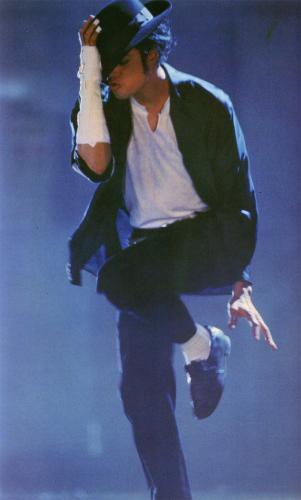
because josh pateet was hot. an undeveloped yet dangerous, skinny sixth grade boy type of hot. he had a cowlick. he wore white button-downs and black pants. and he had a michael jackson impersonation.

a white button-down and pop music. this is all a girl needs.

josh pateet was semi-famous school-wide for this michael jackson impersonation. we’re talking winter of 1993, so michael jackson was everywhere. he’d not yet been accused of molesting little boys. he’d just married lisa marie. their joint barbara walters interview was so significant that josh pateet brought in a VHS that we watched in mr. adams’ history class as an example of “seeing history unfold.”

josh pateet. the page middle school talent show seemed to have been invented just for him.

we’re talking about a school that was literally situated between two cow farms. for a month out of every year, the whole place smelled like manure. it was a setting in which a michael jackson impersonation seemed the height of glamor and we reacted accordingly.

every year of those three years, when talent show time rolled around, josh pateet’s performance was held to the last, presumably so he wouldn’t shame the other acts. when the lights were dimmed and “beat it” came pounding over a sound-system so out-dated it seemed the music was thrashing inside to fight its way out, we cheered for josh pateet as though this were a once-in-a-lifetime sight rather than a spectacle we were treated to whenever a teacher finished early in class and had nothing else with which to fill the time.

i often wonder what happened to him. he seemed awfully big for a school so small. is he married? is he gay? has he gone on to do great things or did he peak at page middle?

but mostly i wonder if he remembers those days– those moments, innocent in their showiness, that have flickered through my mind every time i’ve seen anything to do with michael jackson ever since– when a boy with a cowlick moonwalked across the cougar painted on the polished floor, reveling in being someone he wasn’t as 250 preteens cheered for him in a darkened gym as if he were the real thing.

Stars, Tabloids, + Sex Taboggons

(16 may 2006/23 september 2010)
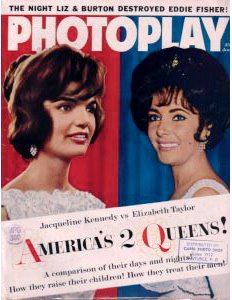
Long, long ago, back in the dark ages before US Weekly, the movie magazines reigned supreme. A special breed of tabloid that the film studios cunningly created in the 1920s as a publicity tool,  the movie mags spent their first 40 years offering puff pieces on everyone’s favorite stars. But, because it is often hard to make money being nice, in the late 1950s, the tone of their coverage took a salacious turn and veered towards the tantalizing cocktail of glamorous lives, naughty headlines and provocative photographs that beckons to us from newstands to this very day.

Tabloids, as a genre, engender little loyalty, so the industry has always depended upon newsstand sales to an extraordinary extent. To this end, movie magazine editors rushed to find celebrities who exercised broad appeal and would hold the public’s interest over long periods of time. Three months was considered an eternity. Thirty years had never before been done.

Much as popcorn kept movie theaters afloat after the advent of television, so Jackie Kennedy salvaged the movie magazines. She never starred in a movie but she featured in the movie magazines to such an extent that  in 1962, Variety enthusiastically hailed her as the “world’s top box office femme.” The prevailing editorial policy of all of the 40+ movie magazines then became this: to regularly feature the First Lady alongside “any lady or gentleman of the screen and television who misbehaved.”

Among the ladies and gentlemen misbehaving at the time, Liz Taylor was queen bee. Thus, despite the absence of any legitimate connection, Liz and her then-husband Richard Burton would become Jackie’s “magazine relatives.” Ultimately, the Jackie-Burton-Liz tabloid triangle pervaded the national consciousness to such an extent that it created among magazine readers a Pavlovian response to the three principle players. According to sociologist Irving Schulman:

If new photographs worthy of inclusion at deadline were not to be had, art directors arranged jigsaw cutouts for Jackie-Burton-Liz, and in a very short time indeed a national conditioned response was established. Purchasers who saw a photograph of Jacqueline Kennedy would think immediately of Elizabeth Taylor and what she was doing; conversely a photograph of [ . . . ] Elizabeth Taylor would conjure up an image of Mrs. Kennedy.

The Jackie-Liz connection would become so integrated into the popular culture that in the Hollywood treatment of the Jackie story, The Greek Tycoon, the lead female character was named “Liz.”
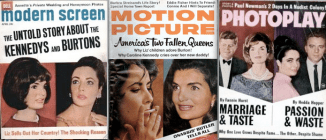
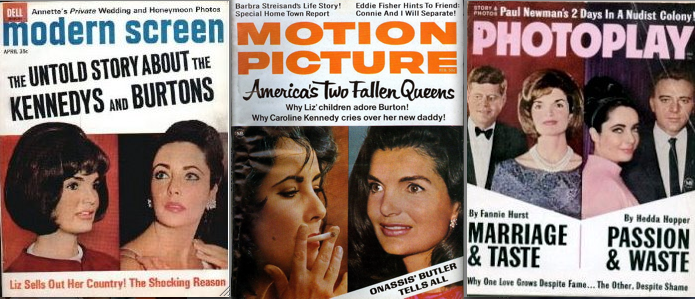
In the beginning, particularly during the Kennedy administration, the movie magazine coverage remained somewhat circumspect. The couples served as simple foils for one another; the Burtons’ racy exploits emphasized the Kennedys’ elegance while Jack and Jackie’s élan exaggerated Burton and Liz’s decadence. In the fall of 1963,  the question of the Kennedys’ “Marriage & Taste” versus the Burtons’ “Passion & Waste” was of such critical social import that  Photoplay gave it major coverage.

In retrospect, it is not surprising that this circumspection ceased with the death of JFK. As Jackie marched into single womanhood, the tabloids switched course and focused on the remaining threesome- cropping cover photos and manipulating gossip to suggest romantic intrigues, clandestine meetings, and unorthodox sexual proclivities. Richard Burton and Jackie Kennedy may never have held hands, but thanks to clever editors and decoupage, on countless magazine covers they did.

The tabloids intentions here were completely pure: they sought to unite “Jackie” with the Burtons because “It would truly be a new, fun, fun world for Jackie– for the Burtons are fun, fun people.” And, really, who didn’t want Jackie to have fun?

Editors could not have created more different and more profitable characters to mash-up. Women loved to hate “Liz,” an actress who seemed constantly on the brink of personal disaster; they simply loved Mrs. Kennedy. In the words of pop-philosopher Wayne Koestenbaum, “Liz was trash; Jackie was royalty.” It was the perfect mix.

In the American consciousness, Jackie and Liz presented two entirely different versions of femininity in practice. What this translated into was Jackie being the woman everyone should aspire to be and Liz being the woman no woman would want to become (never mind that Liz seemed to always be having a hell of a lot more fun).

This dichotomy is nowhere more vividly exemplified than in the 1962 magazine, JACKIE and LIZ. The commemorative opens with a page that explains the editors’ reasons for comparing Jackie and Liz: “They shine in completely different constellations and exert a completely different emotional and moral effect upon us… To compare them [ . . . is] a way for us to examine the natures of the stars we create, and in the process discover something about ourselves.”

What we, the reader, should discover is clarified in a simple headline on the same page: “LIZ TAYLOR: A Warning To American Women; JACKIE KENNEDY: An Inspiration to American Youth.” Jackie was “WOMAN OF THE YEAR,” “Mistress of the Washington Merry Go-Round,” and “First in the Hearts of Her Countrymen.” She “KEEPS HER MAN HAPPY,” is “SURROUNDED BY LOVE” and only “Leaves Her Home For Service.”

In very stark contrast, “Liz” was the “SENSATION OF THE YEAR” and “STAR OF THE ROMAN SCANDALS.” “A Woman Without a Country” who was “Caught in the mad Marriage-Go-Round” and “SURROUNDED BY FEAR,” she faced “A THREATENING TOMORROW.”

I know no women who would welcome a threatening tomorrow. Life is hard enough as it is.

In JACKIE and LIZ, Jackie was lifted up as a shining paragon of virtue and good. To gossip columnist Fanny Hurst, her place in people’s affections was a barometer of the national well-being. So long as we all loved Jackie, the world would be ok.

In contrast, through “unsavory Taylor-Burton headlines, the shabby stories of shabby lies, of multiple marriages, infidelities, divorces, broken homes, displaced children,” Liz- heaven help her- had “steered her sex toboggan down a dangerous run.” A message that was, no doubt, not lost on readers whose own marriages might be lacking “the fire of passion” and women who might be tempted to follow Liz’s less traditionally feminine example by steering their own toboggans along her perilous path. Let there be no doubt, “Roman Scandals” were not welcome here.

Collectively, the tabloid narrative implies a sexual rivalry between the two women. When Jackie, allegedly rankled by Liz’s affair on the Cleopatra set, didn’t attend the movie’s Washington premier, TV Radio Mirror rushed to declare it: THE DAY JACKIE ‘SLAPPED’ LIZ! In the article, prudish Jackie frowns upon Liz’s amorous exploits and Liz’s doings appear spectacularly more whorish when on parade before Jackie’s puritanical restraint. Yes, Liz’s indiscretions were startling by contemporary standards, but she appears downright depraved beside Jackie’s sanctity.

In later years, all this would change.  With“Jackie’s” slide toward Greek decadance, the rivalry would continue to dominate newsstands but the headlines would grow increasingly sexual and provocative: AMERICA’S TWO FALLEN QUEENSONE NIGHT WITH JACKIE’S HUSBAND MAKES LIZ’ DREAM COME TRUETHE NIGHT ONASSIS TURNED TO LIZJACKIE DISGRACED AS ARI BOOZES IT UP WITH LIZ IN PUBLIC BARTWO DESPERATE WOMEN GAMBLE ALLLIZ’ PREMARITAL HONEYMOON PLANS INVOLVE JACKIE’S HUSBAND!
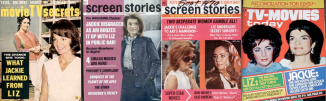

Jackie’s very appearance in the movie magazines suggested a massive shift from their original function as an advertising vehicle for motion picture stars. Both Liz and Jackie were exaggerated icons, however, Liz, an actress, was in fact selling a product– herself and her movies. Because Jackie had nothing to hawk, her life itself was turned into a movie for the public’s entertainment. By the early-1960s, it was playing out on newsstands all across the country.

In time, the differences in the unique relationships readers developed with both women would become more apparent. Liz’s connection to the public derived from total revelation. In Life the Movie, film and culture commentator Neal Gabler succinctly catalogs Liz’s shifting societal role:

Taylor’s early appeal as a life performer was her willingness to expose her private sexuality, first with [Eddie] Fisher and then with [Richard] Burton, and to provide a voyeuristic charge for those who read about her. Her later appeal, when she was no longer a sex symbol, was her willingness to expose her dysfunctions as melodramatic entertainment: her ballooning weight and subsequent diets, her drug problems, her vexed marriages and romances, her various illnesses.

In contrast, Jackie’s audience was tantalized by what she withheld. Her adamant refusal to reveal herself or her private life created a vast expanse of ignorance, which proved fertile ground for wildly speculative assertions and implausible fantasies. Because Jackie refused to participate in the tabloid pageant, the magazines reached out to readers—inviting them to select a wedding dress for Jackie’s remarriage, to suggest a hairstyle, and to pass judgment upon her hem lengths. In a manner eerily evocative of American Idol, the movie magazines fostered the public’s sense of interactivity in Mrs. Kennedy’s life. After her remarriage in 1968, Motion Picture even invited readers to vote to “BACK JACKIE,” as if their support would have a real effect upon the new Mrs. Onassis.

In American culture, Jackie acted as a tabula rasa, onto which everyone from little girls to frustrated housewives could project their fantasies of glamour and romance. As an Onassis acquaintance once said: “Jackie was nothing; an ordinary American woman with average tastes and some money. She was a creation of the American imagination.” Yet, within the tabloid culture, Jackie heralded a new age, in which “an ordinary housewife writ large” could become a star. And as that great arbiter of celebrity- and friend of both Jackie and Liz- Andy Warhol once said, “More than anything people just want stars.”

© faith e.
required writing

(4 march 2009)

there are times when i feel required to write about something.

for example, whenever a kennedy runs into a road block, runs for office, runs for… well, anything. it seems at those times, as the resident Group Keeper of All Kennedy-Related Things, i should have a rush of analysis at the ready. or whenever anyone in any way vaguely-related to the tv, film, or theater of my childhood, a first family, or tabloids dies. i’m there with the eugoogley. hell, i am the girl who has blogged about every email i’ve ever received regarding the dvd release of the mary tyler moore show. because these are terribly important things.

and the release of the new u2 album yesterday was a terribly important thing. but then, it really wasn’t.

i should preface this with the fact that i love u2. i counted down to every single/album/show, downloaded every findable bootleg, read every book, condemned every writer of a bad review, dissected every lyric. i believed the nonsense that all that you can’t leave behind was a step forward. i thought the endless stream of greatest hits drivel was a musical boon.

but, if we’re being honest, the only emotion i felt this past december upon hearing that u2 would finally be releasing a new album (their first in 5 years) was dread. unadulterated dread.

i didn’t really think about it much then. now, i think i didn’t think about it then because i was afraid i would wind up thinking what i’m thinking now.

which is that maybe u2 will never be u2 again. at least not my u2.

yes, they’ll be the big stadium act that puts on the same two-hour show night after night (a gimmick i’ve defended for years though deep in the pits of my heart it pisses me off). bono will keep running around the heart/circle/square during “streets.”

adam will always be stage left. edge will always be stage right. at one point during the evening, like foreign dignitaries deigning to visit the poorer nation next door, they will each saunter over and briefly acknowledge the fans on the opposite side of the stage before returning to their respective corners.

u2 will always do an encore. and in that encore, bono will always pull a girl up on the stage during “with or without you” and all us sad-saps in the audience will always be thinking, oh my God, bono just pulled that girl up ON THE STAGE and now he’s going to SING TO HER!!! to us, this will seem shocking though it is something he has done in every performance since 1989.

that is u2.

but that is not my u2. and, sadly, i’m fast coming to the realization that perhaps my u2 has died.

what we are left with is a sad, scared u2. a u2 that takes 5 years to produce an album that sounds curiously similar to the 2 albums they put out in the 5 years before that.

they have set up camp in a dead end.

this realization has left me strangely bereft. longing for the u2 that could form a band before they knew how to play their instruments. that could make four videos for a song called “one.” that could make “with or without you” run 10 minutes long. the u2 that could close an album with a song so against where they were that it could only be sung by johnny cash.

for the most part, everybody seems ok without all that, with this new u2. the guardian declared this their “greatest studio album ever.”

seriously. people. what the hell?

maybe everyone else reached the point of lowered expectations in advance of me.

or maybe this is just the normal process of realizing the heroes of your youth have become old men.

take this tangle of conversation and turn it into your own prayer

(22 january 2007)


in the midst of everything, there is u2. because there’s always u2. they’re my home base. we may go some days or months without each other, but i always come back.

recently, it has been nothing but pop, an album i’ve always appreciated for its jarring incompleteness. the band got rushed and didn’t have time to relentlessly perfect and dope it down. as a result, pop is a raw spiritual undoing splashed in enough glitter that it can almost masquerade as a party.

it’s an odd juxtaposition, and it can be hard to take it all in. u2 albums are legendary for their cohesiveness. listening to pop is like reading a book of short stories when you were expecting a novel.

it’s a tangle of chatter and tight spots and fast escapes and sudden shifts. the pop in the title isn’t just pop music. it’s the pop that comes after the exhilaration and freedom of achtung baby and zooropa. it’s the bubble’s burst.

to me, it’s as though the protagonist has found himself at a strip club in the middle of the day, and it suddenly hits home how far he’s wandered. in “mofo” he pleads with his dead mother to show him how to get out of the mess he’s in. and that’s pretty much the high point. you wind up with him on his knees, speaking directly to Jesus, pleading, wake up, dead man– with someone talking in the background all the while, as if to emphasize his insignificance.

this sounds terribly depressing, but i swear it’s not. because of all u2’s albums, i think this is the most honest. it captures them in a weird moment- on a bender in southern france struggling with the pressures of their art, their addictions, their women and their past. it’s not all pretty (“miami” is an ugly, ugly song), but it’s there. it’s their bullshit. it’s real.

this past week i listened to pop day and night, over and over. and for the first time, it wasn’t jarring or incomplete. it was just a glitzy little exhausted naughty mess. unapologetically so. and that’s rather beautiful. what a pity the boys have been apologizing for it ever since.

while you can stand there, you could move on this moment

(30 september 2006)

ie. reading u2


achtung baby has always been my favorite album and i didn’t ever really understand why. it’s not an unconditional affection. i would argue it hasn’t held up quite as well as the much-maligned pop, which- though it’s a far less solid album- has such an avant garde sound that it could be released tomorrow and floor everyone. am also not a fan of the album version of “who’s gonna ride your wild horses.” the temple bar remix was better. but narratively speaking, achtung baby is without flaw. and we know how i love to speak narratively.

as a writer, i have to “read” everything- music, novels, poems, etc. and i know we’re not supposed to read anything but biography as biography, but- and this could be why i’m a biographer- i think it all is. so while i can think of achtung baby as not necessarily being bono’s journey, i can’t see it as just a random collection of great songs. as with a book, there’s a cohesive plot. however unintentional or haphazard, there is a story.

as though it were sweet valley high, i can no longer read u2’s oeuvre as anything but a continual narrative. because it so obviously is a continual narrative. the continental american tour of the joshua tree and rattle & hum leaves the protagonist dazed and exhillarated, stumbling about the berlin subway system in the opener of achtung baby. he’s done with the past and he’s frantic for something new. he screws it up and it takes him thirty-four songs to recover. you could love “mysterious ways” without ever having that context. but, to me, u2 is an important band because of that context.

reading the complete u2- ie. playing their albums in a chronological cycle- my favorite chapter comes between pop and all that you can’t leave behind. when the page is turned from the defeated, exhausted plea of “wake up dead man,” where the protagonist is literally on his knees begging for the second coming, to the total euphoria of “beautiful day.” obviously to get to the beautiful day, you have to plod through a whole hell of crap. lyrically, u2 spent all of the 90s doing this and i’d never before realized how that pulled together to make a central point.

in the grim little trip of achtung baby, there’s infatuation, adultery, manipulation, desperation, treachery, forgiveness, euphoria, resignation, love, hope, and a phone call from hell. it’s about taking a risk and getting burned and wounding everyone around you. it’s no accident that the protagonist continues reassuring himself with the line “it’s alright.” the ticking bomb in “love is blindness” leaves him paralyzed, numbed- by images, the past, the future- in the hypnotic zooropa. for nine tracks, he is “faraway, so close!” yet he cannot let go. he wanders away and doesn’t even have the heart to sing the last song himself. instead he hands it over to johnny cash and winds up in the discotheque of pop, the glitzy tangle of conversational tidbits born from a month-long bender in the south of france.

the narrative cohesiveness between these albums has fascinated me ever since all that you can’t leave behind was released. all the critics said u2 were “getting back to their sound.” what resonated with me was that their protagonist, after falling and crawling and pleading and running and wandering, had finally dragged himself to the ledge and made the jump. the jump that is laid out in “zoo station” when he says he’s ready for what’s next. when he repeats that he’s ready for the push.

and we believe him and we think achtung baby is that jump but it isn’t. listen to “mysterious ways” and you hear the line while you can stand there, you could move on this moment, follow this feeling. he wasn’t ready for the push in track 1 and he stayed put through track 9. achtung baby and the two albums after are all the scary shit that happens when you don’t jump, when you hold back, when you run away, when you try to throw your arms around the world. it’s only with the final plea of “wake up dead man” that he at long last takes the leap (i swear he’s gliding through the air in the last 40 seconds). and it’s only in “beautiful day” that he realizes the leap wasn’t so scary after all. that after the flood, all the colors came out.

bird

(13 july 2007)

lady bird johnson died the other day. and i’m quite sure most of america’s response was: she was still alive??? and it’s hard to imagine that she really was. she and LBJ seem so long ago. so far away from when we were even born.

first ladies are important, people. i’ve had this argument time and again when some fool has gone off on a “what did jackie ever do?” tangent. i refuse to fold.

it has to be quite possibly the hardest thing in the world to be “the wife of…” of anyone- let alone a president. clearly, the entire status of a first lady derives from being “the wife of…” but there’s more to it than that. i’m pretty sure it’s a freakishly tough job.

let’s imagine being married to LBJ. a man most known for two things: 1) being incapable of cleaning up JFK’s mess in vietnam, and 2) showing his apendectomy scar to a roomful of reporters. privately, he was a bit of a douche. an aggressive politico, a brilliant legislator, an unfaithful husband, and an extremely insecure, proud man whose primary negotiating tactic was to bring someone into the bathroom and ask them incriminating questions while they were pissing. classy.

and let’s imagine being the followup act to jackie kennedy. fun times there.

so lady bird had a bit of a rough ride, as they probably all do. and yet, despite the rather demeaning nickname, she was tough stuff. she had her own money. she owned her own radio station. she was the main proponent of the highway beautification act and she won the congressional medal of honor. bravo.

yet, there she was the other day, passing into history with little more than a 15 second obit on CNN. which is both sobering and terribly inadequate.

i wrote lady bird johnson once. after jackie’s death, in that summer of 1994 when i was manically, unconsciously gathering information for the something i was going to do ten years down the road. liz carpenter, her press secretary of a bazillion years, wrote back. an ivory sheet of paper curiously scented of lilacs and that smell that paper gets when it sits out in the sun. it answered all my questions with only the occasional smudge of typewriter ink.

i like to think that the pair of them, little old ladies in their eighties by then, sat out in their lawn chairs amidst a field of wildflowers answering correspondence all day long under the texas sun. leaving the pages atop the buds waiting for the ink to dry.

oh jack kennedy, you cad you

(18 february 2010)

so let’s talk about “lot #1174: ‘Love, Jack’ – Senator John F. Kennedy’s Complete Correspondence with his Swedish Lover, Gunilla von Post.”

(no, i did not make that up. and to quickly answer some FAQs: yes, that is the actual entire subtitle. and yes, the words “swedish lover” were used. can’t you practically hear the little old ladies who lunch tittering in the back row?)

so… “lot #1174: ‘Love, Jack’ – Senator John F. Kennedy’s Complete Correspondence with his Swedish Lover, Gunilla von Post.” several things.

firstly, i should mention the auctioning of “Senator John F. Kennedy’s Complete Correspondence with his Swedish Lover” is being conducted by LEGENDARY AUCTIONS. so in case there was any doubt re: the historical significance here, people, beware, wait for it- it is LEGENDARY.

nextly, the copywriters for the aforementioned LEGENDARY AUCTIONS? freaking genius. seriously. amazing. for reals.

oh, but where to begin?

if you were beginning at the beginning, you would begin HERE. but don’t. you have me. i will spare you that.

so imagine, if you will, that we have somehow wandered into the highly specific realm of the LEGENDARY AUCTIONS auctions/history/presidential autographs/catalog/lot detail/lot #1174:” ‘Love, Jack’ – Senator John F. Kennedy’s Complete Correspondence with his Swedish Lover, Gunilla von Post” webpage with no prior knowledge of our 35th president. fear not! LEGENDARY AUCTIONS is there to inform us that our 35th president was beloved for his “sparkle of hope,” “not-so-rosy marriage,” and “‘ask not’ imperative.”

but this is irrelevant, because we already know all of this. according to LEGENDARY AUCTIONS, we already know everything there is to know about jfk. according to LEGENDARY AUCTIONS, “there is one stone left unturned.”

yep. you guessed it. ohmygod, letters to his swedish lover! (nevermind that this stone was, in fact, turned over repeatedly way back in 1997.) letters that allegedly reveal a whole new side of jfk, “a tender side, heartfelt and sincere, hopelessly romantic, naïve even, while his bright star was still on the rise and before universal fame came to dim and pollute, turning him callous and insatiable in his lust for conquests.”

i’m going to pause briefly here and let you digest. because that was some pretty rich stuff and i’m assuming everyone could use a moment to reflect on the beautiful bob ross-style word picture our friends at LEGENDARY AUCTIONS have just painted. dim, polluted, callous, lustful jfk. as conquistador. i imagine he is wearing boots. and tassels.

there is much much more- including transcripts of the letters themselves and an interactive timeline- but it all pales in comparison to the glutinous description of jfk and his swedish lover’s “one-week ‘brief, shining moment’ of smitten bliss,” which can only be quoted in full:

It all started in August 1953, just weeks before the 35-year-old Senator Kennedy’s wedding to Jacqueline Lee Bouvier. Vacationing on the French Riviera, he made the acquaintance of Gunilla von Post, a 21-year-old blonde siren with aristocratic roots, and he fell in love with her. They had eyes only for each other as they dined, danced and later kissed—fairy-tale-style—with the stars shimmering on the Mediterranean Sea. As far as von Post knew, she’d enjoyed a magical evening with a fun-loving American prince and would never see his tousled hair and jaunty smile again. But this Jack came calling … and writing. He pursued her despite the daily demands of public service and newlywed nesting, and even despite a near-death experience on the operating table. No obstacle was too great to bar the soon-to-be King Arthur from courting his beguiling Lady of the Lake.

and i leave you with one question:

who the heck wrote this?

(a) an old, old man.
(b) an old, old woman.
(c) a high schooler with a tenuous grasp of arthurian legend.

michael landon’s loins

(14 may 2009)

michael landon’s son died yesterday. which is in and of itself  kind of unextraordinary given michael landon’s son’s only apparent claim to fame was being michael landon’s son.

judging from the fact that it was repeated in every single obituary, the most significant moment in the life of michael landon’s son was that he and michael landon were about to make a made-for-tv-movie together before michael landon’s death in 1991 at the age of 54.

this revelation should probably force us to dwell upon the unpleasant sadness of anyone’s most significant life accomplishment being that they almost co-starred in something they ultimately did not.

but hey, lookie here: if michael landon was 54 when he died in 1991, that would make him 72 if he were alive today, the day after his son died at the age of 60.

which leads us to what in the hell was michael landon doing having sex when he was 12?

remember, this is michael landon. bastion of family values. head of the little house. leader of life on the prairie. this is sarah gilbert ingles wilder’s tv dad.

this isn’t just anybody. it’s freaking michael landon.

in our discussion of Michael Landon, Pre-Teen Father, a friend suggested that perhaps this child was not, in fact, the fruit of michael landon’s loins. perhaps he was adopted, an idea admittedly a bit more plausible than a 12-year-old having sex in 1949, though still rendered somewhat absurd given the timeline with which we were working. what 12-year-old adopts an infant? what 30-year-old adopts a teenager?

fortunately, wikipedia (where one would inevitably wind up when trying to untangle the tawdry sex life of michael landon) yielded an answer.

michael landon did not breed at 12. he did not adopt a 30-year-old when he was 42. no. apparently michael landon’s son is not actually, if we’re being biological, michael landon’s son.

so this kid, the kid who died yesterday, whose sole accomplishment in his entire life was having nearly starred in a made-for-tv-motion-picture with his father michael landon was, in reality, not the son of michael landon but rather the son of some other man who happened to have sex with a woman before she married michael landon. which, should probably make us more sad still as this only renders michael landon’s son’s only claim to fame more tenuous, seeing as he is not even michael landon’s son.

but, in the end, all i feel is relief. tremendous relief that i do not live in a world where michael landon has let me down.

elizabeth taylor has not yet died

(30 march 2009, 1 july 2010)

but, because elizabeth arden has started
exploring bereavement ad prices,
i think we are at liberty to reflect

Much as Dionne Warwick is famous for her psychic friends rather than her music career, so Elizabeth Taylor is remembered for everything but her acting. She may be best known for her perfume ads— the commercials that are pulled from the Elizabeth Arden vault like semi-precious brilliants to take their turn on TV every Christmas.  Suddenly, as dependable as Peanuts and eggnog, there she is, svelte and gorgeous, sporting that leonine hair all famous women seem to cultivate the minute they hit 52.

There is a jarring disconnect between the ageless Liz hawking sensual perfumes from a cabana overlooking the Aegean in footage that clearly hadn’t been reshot since 1989 and the elderly dame who had been wheeled out publicly every now and again since 2002.

Having first appeared in 1941, in an industry where many die young, Liz Taylor is one of those figures who seems to be stretched thin across far too many decades. Much like Churchill after WWII, she has outlived her use. We do not know what to do with her.

In their recently released Furious Love: Elizabeth Taylor, Richard Burton, & the Marriage of the Century, biographers Sam Kashner and Nancy Schoenberger attempt to figure that out. To find the proper box in which Liz Taylor will fit. And because there is nothing quite so convenient as the marriage box, they, like nearly all her biographers before them, examine her from that context rather than the context of her work. Never mind that amid all the marriages, her career was the only constant.

The first Liz Taylor movie I ever saw was Raintree County, which is essentially a Gone With the Wind knock-off wherein our southern belle imagines she is the love child of a slave and consequently torches Tara.

It’s a stirring mess to behold on its own, never mind the underlying real-life drama of Liz Taylor acting alongside Montgomery Clift, who was quite possibly the love of her life and was gay and would never love her as she needed to be loved and had just survived a horrifying, disfiguring automobile accident in the aftermath of which she knelt by his side in the road and held a severed chunk of his face onto his head.

When I first saw Raintree County, I knew none of this. I was twelve and back then it was all about the pretty lady in the pretty dresses. I didn’t know that the pretty lady in pretty dresses was one tough dame.

We overlook the fact that she has always worked, whether she had a husband or not. Her reasons may not have been noble—usually, just like us, she needed the cash. But even after Mike Todd died, there she was, back on the Cat On A Hot Tin Roof set. Back in front of the camera. Back to work.

Which is pretty admirable for someone primarily known for her breasts.

Liz Taylor is very much an acquired taste, like brandy or sushi or madras pants. She is scary. She is shrill. Whether she is young Liz, old Liz, thin Liz, fat Liz, hippie Liz, or ’80s Liz, she can be hard to watch. Still, when she’s onscreen, it’s hard to see anyone else.

I didn’t begin to appreciate Liz Taylor until I was in my mid-twenties. Hell, I would argue the world isn’t really old enough to fully appreciate her now. Her filmography is comme ci, comme ca— a grab-bag of minor frights studded with a handful of priceless gems. But those gems. Lord, do they sparkle.

The problem with Liz Taylor is that it’s always been assumed that she delivered more memorable performances in life than on film. That she was, in fact, not working but simply being Liz.

The most devastating aspect of her devastating performance in the devastating Who’s Afraid of Virginia Woolf? is that it plays as a Burton family home movie. We’re pretty sure she’s not acting. She couldn’t possibly be that good.

I’m pretty sure she was acting. I’m pretty sure she was that good. And the fact that we still overlook that is devastating.

in the beginning

(19 may 2008)

this friday, it will have been 14 years since seventh grade oline sat in mrs. watson’s science class in a pair of white shorts and a green shirtfreezing because the AC was on high and it was a bit too early for said white shortsstraining to hear anderson cooper’s mournful channel one report on the death of Jacqueline Kennedy Onassis over the gaggle of sunflowers-scented blathering cheerleaders at the back of the room.

try as i might, deafO that i was and am, i couldn’t hear a word. i could only sit and watch the photos flicker past, a lifetime condensed into an eleven minute montage.

i knew nothing about her beyond what had been captured in a two-paragraph blurb on a badly xeroxed women’s history month handout distributed in mrs. pavlick’s english class the year before. so i knew she was on par with florence nightingale and madame curie. but these gals, with their ruffled blouses and bunsen burners, seemed at home on badly xeroxed handouts. jackie’s feathered bouffant and onassis earrings bespoke a modernity uncharacteristic of historical heroines. she seemed epochs away.

i paid her no attention at the time. she meant nothing to me then.

actually, that’s kind of a lie. because this was back when i went to bed at 8:30 every night and woke up early enough to crawl into my parents’ bed and watch the headline news hollywood minute at the bottom of the half hour and eight minutes of the real news at the top. so i heard things. i knew she was sick.

and i knew who she was. i’d been playing with tom tierney paper dolls since i was old enough to wield my mum’s manicure scissors and the kennedys were the apex of the presidential families series. so i knew caroline kennedydoll had a pony named macaroni, that JFKdoll had by far the best underwear of the presidents, and somehow i discerned that jackiedoll would’ve dumped JFKdoll and pursued teddy roosevelt’s scandalously younger son kermit, the dreamboat of the presidential paper dolls.

but this was not reality. it was a world in which jackie could party with rhett butler and lady di. so we’re going to ignore that whole history because it isn’t really history.

dolls don’t count.

so my real introduction to jackie was that soundless channel one report. that night, a riveting tribute on hard copy with more pictures set to an off-the-wall remix of copland and ravel further piqued my interest. jackie smoking while pregnant. jackie in pink chanel. jackie at funerals. jackie in jeans. she seemed such a renegade, in much the manner of drew barrymore or dr. quinn. i vividly remember the jarring transition between the somber hard copy closing credits to the beverly hills: 90210 season four finale. the loss of david silver’s virginity seemed so trivial now jackie was dead. two days later, TIME magazine’s tribute landed in our mailbox and i sat on the front lawnreclining against my bookbag, feet propped up on the collie of my childhooddevouring it.

within a matter of four days, i had met my jackieand this makes sense of so muchthrough a silent movie, magazines and tabloid tv.

with her typically impeccable timing, mrs. onassis expired just as the eaton family became antique-crazed. suddenly car trips that, in the months before, had been interminably dull, punctuated by stops at road-side stores filled with other people’s discarded pee-wee herman dolls, became treasure hunts. places like chattanooga and danville rivaled alibaba’s cave.

the magazine madness began, simply enough, with LIFE magazine. this was back in the days before al gore invented the internet. later, i would be armed with vast bibliographies and spreadsheets and photographic archives and ebay. then i was winging it. i was trixie belden on the hunt for what my dear macabre family dubbed “the jackie mausoleum.”

early in that summer of 1994, LIFE was kind of enough to feature all their jackie covers on the back of their special edition. hunched over it with a magnifying glass pilfered from my father’s desk, i eventually made out all 16 dates. this triumph of deciphering insanely small type left me elated. it felt titanic. in reality, it was terribly small.

it’s hard to realize the scope of something until you’re in it. really really in it. like, mired for years and years and years. there were 16 covers of LIFE. that seemed a reasonable pursuit. a hobby containable in a lone grocery bag. it didn’t seem obsessive. it didn’t seem like an interest that would prompt future boyfriends to grimace in embarrassment and make movers cringe in horror. 16 was a reasonable number.

this is probably how those women wind up with 87 cats. i didn’t see it coming. things just spiraled out of control after the first dozen…

to strut my math skills a moment, imagine this: in the american, english language mainstream tabloid press alonethus, excluding every publication produced everywhere else in the world, “respectable” mainstream u.s. mags like LIFE, LOOK, mccall’s, and also the tabloid-sized fringe tabloids like the enquirerthere were approximately 40 movie magazines circulating in any given month during the ’60s and ’70s. during every month in those 20 years, jackie would cover on at least half.

4,800 issues. at 30 cents an issue, give or take 750,000 copies sold of each, during her heydayin movie magazine sales aloneshe brought in $1 billion.

$54 million per annum.

which is interesting because it’s freaking unbelievable.

so my hobby has wound up a math problem. who saw that coming?

everything works out in the end. i believe this. the magazines i bought in the summer of 1994 meant nothing beyond pretty pictures. i never dreamed they’d have a use. much less that i’d spend the majority of 2004 poring over them as though their stories contained the key to finding Christ. i could never have imagined i would wind up discovering entire publishing empires built upon a literary playtime that didn’t deviate too very far from my paperdoll world in which jackiedoll went to the movies with greta garbo and had a fling with errol flynn. you just don’t think of these things in the beginning.

i don’t know where all this started. but that’s a lie. it started in mrs. watson’s 7th grade science class as i sat there straining to hear anderson cooper’s mournful channel one report over the gaggle of blathering cheerleaders at the back of the room. but i don’t know why it stuck with me or why it mattered. or why it still matters. i just know she does.