process

(13 october 2010)

it’s amazing how easily people can be found. it’s easier than you’d probably ever imagine.

there is a biographer whom i need to ask a very important question. a rather famousy biographer whom i’ve admired since my mother wouldn’t let me read his marilyn monroe book because there was a nearly naked lady on the cover. thus, i had to buy it at walden’s during an unsupervised shopping trip at the cool springs galleria and read it secretly at school.

i have a very important question for this biographer but i have no idea where he is. thanks to wikipedia, i quickly establish that he is living with his husband in a small village an hour outside of copenhagen. by googling the hell out of his name coupled with danish villages i recalled from the regionstog, within 10 minutes i have not located the biographer but i have found the biographer’s husband’s work email address.

i promptly send the biographer’s husband a humble missive along the lines of “if you happen to know this biographer i am trying to reach could you please let me know how he might be contacted.” the unstated sentiment being: “dude, i know you’re married to him so come on and help me out.” 3 hours later, the biographer responds.

finding people is easier than you’d ever imagine. i now know this biographer’s hometown, wedding date, publication history, volunteer activities, sexual orientation, his stance on the death penalty and his husband’s work extension. which is funny because the biographer’s email address is his first name and his last name.

all that digging and all i needed was his names. which i had already.

family time

(14 September 2010)


I returned from a vacation in Denmark with a million dirty clothes, a heap of right-wing British political magazines, the world’s largest lollipop, and a slew of Jackie-related voice messages.

Three of them do not count as they were from my father, who deployed the family Caroline Kennedy voice in a series of comical weeeeeeeeeeelcooooooooomes and plaudits for my dediiiiiiiiicaaaaaaaaaaaaatioooooon and sprawling pleas that I meet him in the liiiiiiiiiiiiiiiiiiiiibraaaaaaaaaaaaary.

(Yes, we have a family Caroline Kennedy voice and the family Caroline Kennedy voice is based solely on a speech Caroline Kennedy gave in 1979 welcoming people to the dedication of the JFK Library wherein the only thing she said was, Welcome to the dedication of this Library. Thus, the family Caroline Kennedy voice is strictly limited to topics surrounding libraries, dedications and welcomes- topics that, when one’s family has a family Caroline Kennedy voice, come up with surprisingly greater frequency than one would ever imagine.)

The remaining messages, however, were from actual Jackie-related people. Impeccably mannered with such sprawling WASPy vowels that every time this happens, every time I hear them, I almost want to cry. Because people talk like that no longer. Those voices, these accents, they are a dying breed.

The manners are of a different age as well. Even when they are unwilling to speak to me, still they call, their messages acknowledging receipt of my letters and asking that iI, kindly, leave them alone. A display of such politesse that it has on more than one occasion prompted my grandmother, a life-long republican, to commend the grand etiquette of “those dread Kennedy people.”

What we learn from these messages is that most people are, apparently, willing to speak to me. People who actually knew Jackie. People for whom she was not a tabloid construct or a character played by Roma Touched By An Angel Downey in a made-for-tv movie in 1992.

I assume they think I’m about 54. I imagine my youth will surprise them and that I will need to go easy on the eyeliner when we meet.

Because, by this point, I’m pretty sure we are destined to meet. So, you can see, it’s absolutely ideal that at this same point- thanks to an infelicitous rereading of Janet Malcolm’s The Silent Woman– the prospect of talking to these people would suddenly be totally revolting to me.

I should be more clear. It’s not so much the prospect of talking to them, as I’ve done that several times without a hitch so far. It’s more the prospect of groveling at their feet, begging for scraps of information. Above all, it is the prospect of hurting their feelings.

Admittedly, in the face of Janet Malcolm’s distaste for any biographical endeavor that prizes an investigation of the dead over the emotions of the living, it would be challenging for anyone with an inquiring mind and a soul and a desire to wrench the family treasures from Jackie’s loved one’s hands not to feel a world-weary sense of moral decay. But still.

It’s a terrible time to develop a biographical conscience.

My friends who are historians all have their people, but their people are all old. They are all safely dead and their friends are too. There is no need for approval. No relatives to rise up with pitchforks, incensed. No lingering sensation of impending familial fury, as though each and every sentence put on the page were a step forward into literary leprosy, a future forever constricted by kennedy condemnation.

There is no one with whom I can discuss this. The delicacy of not pissing off Jackie’s college roommate. The least offensive means of approaching Caroline Kennedy and abasing myself for the family treasures. I know no one who knows how to do this, and so I bumble along. And so I will keep bumbling along until it’s done and done well.

Because it is Jackie. Because there has always been Jackie. And because, I know, for whatever reason- the feelings of everyone else be damned- I must not disappoint this dead woman I never knew.

oh mother dear, we’re not the fortunate ones

(19 may 2010)

Like millions of former English majors working in borderline abusive secretarial jobs, I have written a book. It has not been published, which is pretty much the same as having not written anything at all.

There’s this book I’m meant to write. I’ve known it since before the other. And yet it is hard to ratchet up whatever it is that it’s going to take to write what’s next.

It is challenging to write a follow-up to something that has never been read.

That makes it sound far more important than it really is. It’s not the gospel or an epic or, heaven help me, Fiction. It’s just biography and it’s just Jackie- a subject that is the biographical equivalent to the beauty pageant answer “world peace.”

So in the large scheme of things like God and Franzen, it is relatively unimportant that there’s this Jackie book I’m meant to write. And it’s fairly inconsequential that this is THE Jackie book and that I really really don’t want to write it because it is an inferno of impossibles.

Because biography done well is a whole hard world of difficult and I’m not ready to fling myself in the abyss just yet.

These are all things I should have considered before mentioning this Jackie book to a fellow biographer; before casually tossing it out over the humus plate in the simple hope of garnering that amorphous credibility that comes from the respect writers have for one another’s as-yet-unexecuted Great Ideas.

It is a great idea so I was stupid not to have foreseen the explosion of enthusiasm its revelation would trigger. I should have anticipated the overpowering gung-ho.

There are three reasons why this project, this Jackie book- otherwise perfect- appalls me to no end:

1. It involves a language I do not speak.
2. It involves money I do not have.
3. It involves sources that do not exist.

Never mind that the few sources that do exist appear to be systematically dying as I approach them.

There’s an Elvis song entitled “It’s Impossible.” The actual opening lyric is “It’s impossible to tell the sun to leave the sky.” My family bastardized this line into the distinctly different yet equally truthy observation that “it’s impossible to stick a piano up your nose,” the sentiment that perhaps most accurately captures my feelings towards this project.

This Jackie book? It is a piano up my nose.

I do not say any of this to the fellow biographer when, three months later, she returns to the subject of the dreaded Jackie book. I do not tell her it’s a piano up my nose. Instead I nod and smile as she says Jackie book’s time has come. That it is a story that MUST be told. NOW.

It could be a documentary! A mini-series! A Sophia Coppola-directed feature film!

The fellow biographer tells me this and only then does she avert her gaze toward her falafel and drop the bomb for which I have been waiting all this time.

That it would be better were I an academic or an older, previously published white man (sadly, I am neither), Because there is no funding for girls like us.

A sentence that, just hearing it spoken, I know is going to be hell on earth to repeat to my parents.

When I do, a full week and a half later, my mother says- her voice fraught with the hope that her daughter is the reasonable, financially cautious young woman she was raised to be and an inkling that she probably isn’t-Well, maybe someday you can really do it, but the timing’s just all bad right now, right?

And I couldn’t help but laugh. Because though I’m a woman of few philosophies, the one I’ve held most dear is that one must imagine somewhat more boldly than may be socially acceptable and that when things are at their most inconvenient and impossible, that’s when they’d really best be done.

Which is essentially what the biographer meant when she said, We’re story-tellers and, really, nothing else matters when you’ve a story to tell.

So maybe this is it. Maybe Jackie’s time has come and it will be the year that- without French or funding and with sources dying right and left- I finally try to tell this story that all the older, previously published white men have inexplicably overlooked. This story that— I am quite sure— was left behind just for me.

“Look Up, And Swear You’ll Never Forget”

(7 December 2006)


JFK died on a hot Friday afternoon. The Friday before Thanksgiving. He met with supporters in the rain that morning and shook hands. He teased that it took his wife longer to get ready than most people, but then she always looked better. He had specifically asked her to wear the pink Chanel suit so she’d show up the hoity-toity, new-monied Dallas dames. He joked at a pancake breakfast that no one cared what he or Lyndon Johnson wore. That the only person anyone wanted to see was Jackie.

It was ridiculously sunny and Jackie kept slipping on her sunglasses, much to JFK’s annoyance. The last words he said to her: Jackie, take off the glasses. Then, either a bunch of conspiring, cross-dressing, homosexual loons rocking some unforgiveably bad hair killed the President (if you believe Oliver Stone) or Lee Harvey Oswald leaned out the window of the School Book Depository and made three good, not implausibly lucky, shots.

John Kennedy died on November 22, 1963. We all know that, but we forget how huge it was. Because now, it really isn’t that huge. In retrospect, we know JFK died and we know the country endured. And knowing that, the death of JFK seems less cataclysmic than it did the day after.

It seems less cataclysmic now because the most shocking result of his death— the way it was heralded to the world through continuous media coverage—has become routine. We’ve been subjected to 24-hour news all our lives. We’re used to stories that unfold all day long, for days on end.

Remember 9/11? Unless you’re under the age of five, undoubtedly you do. For three weeks after 9/11, VH1 and MTV played mournful music non-stop. There were no commercials. Only hours and hours of R.E.M.’s “Everybody Hurts” and U2’s “One.” And the occasional screening of a video hastily assembled by the group Live, which featured Ground Zero coverage and seemed anathema to the healing process the melancholy music video barrage was supposed to foster. I thought this was beyond bizarre, but I couldn’t tear myself away, simply because it was so novel. In my lifetime, there had never been a tragedy so great that even the music video channels could not go on. For the first time, I got a sense of that weekend in November 1963.

JFK had personified the dreams of an entire generation and his murder was unilaterally stunning. It was a national nightmare. He won the presidency by one percent of one percentage point, yet after his death, 78% of Americans would claim to have voted for him. But it wasn’t the violence of his death so much as the media’s coverage of it that became JFK’s lasting legacy.

There was no 24-hour news in 1963. News programming ran on the networks in the morning, at noon, and in the evening at six and ten. But when JFK was killed, the networks interrupted the soaps and ran breaking news non-stop. For four days.

This had never happened. It was shocking.

It was the first time in history when people watched a major news event unfolding live on television. The first time they watched television even though nothing new was unfolding. Even though they were just watching the same tape they’d seen twenty times in the hour before. People stopped on the street, in the stores, in their homes and they watched.

The assassination was televised. While the Zapruder film was not shown in its entirety until the mid-1970s, within days it was filtering through the media (with the most graphic frames, in which the President’s head literally shatters, edited out). There was no shortage of footage of JFK arriving in Dallas and riding in the motorcade. His final moments played again and again, the President blithely off to meet his murderer.

The post-assassination information trickled into the media with astonishing haste. UPI reporters in the President’s motorcade began filing their reports over police radios as the motorcade sped toward Parkland Hospital. The photographer who took the famous picture of a bloodstained Jaqueline Kennedy standing alongside Lyndon Johnson as he took the Oath of Office aboard Air Force One had the photograph in the hands of television producers by the time Jacqueline Kennedy had landed at Andrews Air Force Base. There, viewers saw the former First Lady for themselves, her skirt and stockings and shoes still caked in the President’s blood. In her grief, she blamed all Americans. “Let them see what they have done,” she said.

They saw it all.

They saw Jack Ruby kill Lee Harvey Oswald as he was being transferred from the Dallas jail. They saw the murderer of their President murdered on live television fifteen minutes before they watched the cataflaque carrying the President’s coffin begin its journey to the Capitol Rotunda. The entirety of Monday was devoted to JFK’s funeral service and burial. In between official events, the networks continually ran retrospectives of the President’s life, interviews with the mourners who lined the streets of the cortege route, and reports gauging the international mood. The entire world had stood still and was watching.

We now take for granted our inclusion in the private dramas of public figures, but that was not the case in November 1963. The public did not expect to be so thoroughly included, but when given the opportunity, they remained glued to their television sets to be sure they saw everything. Ironically, it was Jacqueline Kennedy, the most private of celebrities, who insisted that they must see what had been done so they might know what they had lost.

Due to the drama of having news presented for days on end, those who watched would never forget the death of the President, the passage of power, the state funeral, the international grief. It would be crass to brand this as entertainment, but to some degree it was. People did not leave their homes for four days. The networks scored topshelf ratings.

We’re accustomed to this now. We watch the news as it’s breaking, cry a little, and wash the dishes. It seldom stops us in our tracks. Very rarely does the news change the way in which we interact with the media. But the coverage in the wake of JFK’s death did just that.

There is nothing new about tragedy. The only modern twist is the manner in which it is transmitted. For it is in times of great tragedy, when we are drawn into the global experience through grief or horror or shame, that we come closest to being there.When Abraham Lincoln died, it took weeks— in some cases months— for word to spread across the country. Within a minute of President Kennedy’s assassination, a UPI reporter had seized the police radio and the entire world knew what was happening.

The news is so often a bombardment of greed, stupidity, and small personal disasters that legitimate tragedy on a grand scale is the only thing that really hits us. It blows in out of nowhere and knocks us off our feet and it changes the way we think. To an extent, JFK’s greatest legacy is the way in which he was memorialized on television: the riderless horse, the sound of the drums, JFK Jr.’s salute, the eternal flame. A man whose reign barely eclipsed 1,000 days, the fallen leader was swathed in media-created mythology in less than a fortnight. And, in the end, it is the myth that we will never forget.

pride & prejudice

(29 october 2010)

my motivations toward princess diana were never pure. i was never interested in her for her own sake. it was more a nostalgia for the present, an awareness that a historical moment might be unfolding about which i might later deeply care. there was always the possibility that she might be The Next Jackie. having already missed the real one, i was fully determined to experience the next.

and by the phrase “The Next Jackie,” i don’t mean that princess diana shared any of the traits for which mrs. onassis was known. even at the age of 13, the designation simply meant that she covered on a hell of a lot of magazines. because even as i sat at the center left front row of ms. boyd’s 9th grade geometry class reading lady colin campbell’s diana in private: the princess nobody knows, magazines were all that mattered to me.

i do not think princess diana was very important. SHOCKING, i know. there are many things you could say to try to convince me otherwise. i know them all because i’ve written them down here and deleted them again and again and finally shoved them into a separate post that i’m choosing to ignore for the moment because all those arguments miss the point. the point being that i don’t think princess diana was very important.

so, suffice it to say, we are discussing a historical figure about whom i really care very little and for whom i have very little respect. which makes it rather curious that i am fanatically obsessed with reading biographies about her. and not simply reading them mind you, but rereading them. with much the reverence one would typically associate with oft-viewed classic films.

it occurred to me the other day that because i have read it at least twice a year since the summer of 2003, there is a distinct possibility that i have read sally bedell smith’s diana in search of herself as many times as- if not more than- pride and prejudice.

please know that i am not proud of this. i wish it were not so and, since having this revelation, i have devoted a considerable amount of brain space to figuring out why it might be true.

the reason i have arrived at is this: the biographies of princess diana have- by and large- been written by women. this should not make a difference. in the end it really does. and so, in studying how to write a biography of a woman, i have read these books about diana again and again.

because diana has, at least since her death, warranted serious biographical study by serious female biographers. she is looked upon as a woman who is interesting in her own right. someone who’s marriage was an important part of her story but who did this brilliant, brave thing in standing up to the british monarchy and changing it for all eternity to come.

i, for one, do not believe that, but that’s irrelevant here. what i wonder is this: biographers write well and seriously about diana because she is supposed to have had this big impact. biographers- sometimes even those same biographers who wrote well and seriously about diana- write badly and flippantly about jackie. what are we to suppose of that?

from my place in the jackie bell jar, i think it comes from the general ambivalence that continues to surround jackie’s place in american life. she is eulogized as “america’s queen”- an extremely awkward thing to be in a democracy. nonetheless, i would argue that hers was the most important female life of the american twentieth century. and i would go to the mat on that. (realizing i am probably the only one.)

it’s acceptable to write seriously about diana- a figure who was legitimately royal, legitimately rebellious and legitimately ill. it is somehow less acceptable to write seriously about jackie- a well-dressed ordinary woman with a falsified french past, who married a president and ran off with a pirate.

i do not like that. i don’t know what to do about it, but be aware, for what it’s worth: i do not approve.

caroline, yes

(8 december 2008)


despite the fact that i am not from new york, do not live in new york, and do not particularly love new york, it matters very greatly to me that caroline kennedy become the senator from new york.

i was trying to explain this to a friend the other day. how the election of barack obama was great and all and a huge step for racial reconciliation and hypo-allergenic dogs, but this was different. this was cataclysmic.

if caroline kennedy were put in a senate seat, we would officially have attained heaven on earth.

a huge fan of socialist monarchy, i harbor a fervent belief that, put simply, this is the kennedy family seat. rfk carpetbagged his way into it. jfk, jr. was going to snag it. it seems somehow fitting that it fall into caroline’s lap now.

and it seems somehow fitting that this outlandishly intelligent woman whose political role, until this past summer, has been confined to being the family delegate at state funerals of dead presidents, should finally- please, God!- leap into the fray.

fight club


PART TWO

(miss PART ONE? go HERE)

First Ladies aren’t supposed to raise hell. Especially not widows. But Jacqueline Kennedy was no ordinary First Lady. When she beckoned William Manchester, her obstinate author, to the Cape that August of 1966, she greeted him with steely determination and in hot pink pants.

She had summoned Manchester in the hope of winning him to her side. She knew her charms and was adept at the soft sell. In Jacqueline’s view, if Manchester would agree that there was no genuine Kennedy-approved manuscript, Look magazine would be forced to cancel the serialization. The Kennedy camp, in turn, promised to compensate Manchester with a higher percentage of the royalties. Manchester just didn’t get it. He could not grasp that Jacqueline had wanted a book no one would see.

When Richard Goodwin, who was present, promised Death of a President would be published “with dignity,” Jacqueline amended that it would be published without “magazine hoopla and promotion.” Manchester was unmoved.

The talks rapidly devolved into a heated argument. Unable to dissuade the author from proceeding, Jacqueline fell into what Manchester later described as a “completely unrealistic” frame of mind, railing against Look, its publisher, and other books on President Kennedy: “She was going to fight, she said savagely, and she was going to win.”

In Jacqueline’s eyes, Manchester had failed. To make matters worse, he had betrayed her trust by including elements of the “frightfully emotional interview[s]” she had given and then denied her the cuts she requested. Suddenly, she had no control of a project that had initially been her’s.

Unable to garner Manchester’s cooperation, she invoked her last avenue of hope— the press— and flippantly boasted: “Anyone who is against me will look like a rat– unless I run off with Eddie Fisher.”

By mid-December, Jacqueline decided to sue. “I have to try,” she told a friend. “I can’t lose all that I’ve tried to protect for these years.” Thus, she set in motion what Time declared “the biggest brouhaha over a book that the nation has ever known.” Ultimately, Look capitulated and deleted 1,600 words. As Editor-in-Chief William Attwood boasted to the New York Post, “We gave up some slush; a little gingerbread’s off the top, but the structure’s intact.”

Jacqueline openly admitted that the deletions she requested were of no historic value, but that was precisely the motivating factor. She was taking pains to erase any detail that could be exploited by the popular press. Richard Goodwin made a note in the margins of the Manchester manuscript’s galley proofs that made this point. Around a passage in which the President and First Lady embraced before going to their separate bedrooms, Goodwin wrote: “Mrs. J.F.K. feels very strongly about this. Their sleeping arrangements, embracing, etc., will all be taken by Modern Screen, etc., sensationalized, cheapened. Asks if you will please take this out.”

The lawsuit was a hollow victory for Jacqueline. The passages she most violently objected to had long since filtered into the press. In December, Time published a bulleted list detailing half the passages that had been removed. As Cleveland Amory pointed out in Status and Diplomat: “Mrs. Kennedy . . . succeeded in publicizing the very things she did not want publicized, far beyond any publicity they would ever have had if she had not sued.”

The excerpts’ appearance in Look not only extended the book’s exposure to a much broader audience but also grievously commercialized the President’s death. The excerpts were printed on a high-quality paper to differentiate them from the rest of the publication, but advertisements were still included at the beginning and end of the passages, which, in the words of one commentator, created a sense that “This assassination has been brought to you by Goodyear Tires.”

Mrs. Kennedy strove to prevent the cheapening of her husband’s death, but she had inevitably become a participant in the very sensationalism she abhorred. Jacqueline later told Professor Joe B. Frantz, who interviewed her for the Lyndon Johnson Library’s oral history project, that the fight over the Manchester book was

the worst thing in my life . . . I’ve never read the book. I did my oral history with him in an evening and alone, and it’s rather hard to stop when the floodgates open. I just talked about private things. Then the man went away, and I think he was very upset during the writing of the book . . . Now, in hindsight, it seems wrong to have ever done the book at that time.

Publicly though, she treated William Manchester with extreme graciousness. Following the legal settlement, Jacqueline Kennedy released a laudatory statement to the press: “I think it is so beautiful what Mr. Manchester did . . . all the pain of the book and now this noble gesture of such generosity, makes the circle come around and close with healing.” A rosy view that wasn’t quite realized. Rather than closing the circle with healing, the Manchester controversy had, in fact, blown it wide open.

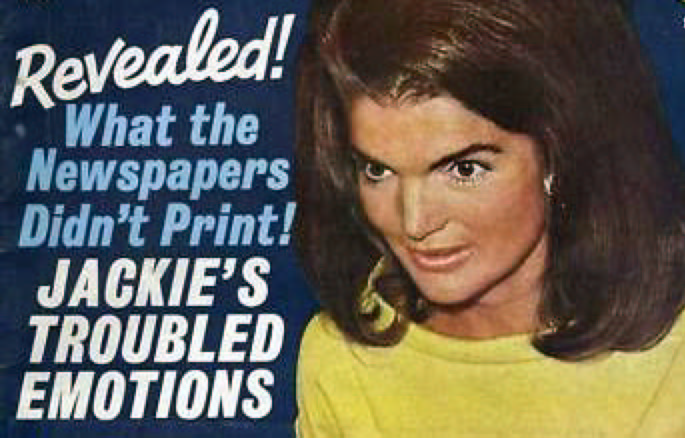
Just as Robert Kennedy’s attempts to stop the serialization had opened him up to accusations of censorship, so the lawsuit brought the former First Lady under attack in the press, particularly among the tabloids. In assessing the Manchester melodrama, the movie magazines were all over the board in their opinions. If this was to be the press’ first peek at the character “Jackie” was becoming—one who beneath the velvety surface was alarmingly avaricious—the press were not entirely sure what to do with her yet. And they were having a devil of a time assigning blame.

Some said “Jackie” was wronged by Manchester, by Look, by the press, while other publications dismissed her as “The big loser,” a selfish woman who’d pitched a public fit because she hadn’t gotten her way.

Perhaps the most fascinating article from this period is Screenland’s piece entitled “How JFK Would Have Stopped The Vicious Attacks,” wherein writer Judi R. Kesselman approaches the Death of a President controversy almost exclusively from the context of gender. Since it “was always the feminine hurts in the book that [“Jackie”] objected to,” “Jackie” “reacted purely femininely.” And, if anything, “Jackie’s” girlish impulse to protect her privacy only further endeared her to her female public: “We women understood why Jackie didn’t want a book to reveal whether they slept together or separately that last night [ . . . ] We women still love her, and feel she was right in wanting to keep her privacy.”

After a series of quotes that describe “Jackie’s hysteria” and her “unbalanced” behavior, we reach the conclusion that if John Kennedy were still alive, he would have deflected the attacks against his wife by reminding people that “Jackie acted like a typical woman [ . . . and] that it’s a fit and proper thing.” After all, “Only a husband can wink to the mass of men about him and say, ‘She’s my wife, poor, weak woman, and isn’t she a honey?”

To the 21st century reader, this is appalling. It’s hard to hold back, to resist the urge to launch into an academic discourse about how, by couching the argument in gender terms, Kesselman perpetuates stereotypes of feminine hysteria and reduces “Jackie’s” violated privacy to a feminine irrationality that would been prevented had a husband been present to calm her down, an assertion that strips “Jackie” of intelligence and reduces her actions to hormonal impulses.

But to readers of the time, this was nothing. In fact, it seems to have been, by and large, what they were looking for. In my correspondence with Judi Kesselman thirty-five years later, she still believed the article gave a realistic view of the prevailing attitudes: “Women who read the movie magazines liked to hear about hysteria and imbalance. It made them feel that their lives were better than they are, less hysterical and imbalanced. Believe me, a lot of women back then, stuck in unhappy marriages and consigned to drudge, felt they’d go crazy if they didn’t have the entertainment of reading a magazine whose women sometimes, for all their fame or wealth, were as unhappy as they.”

And what the women wanted, they got. In the coming years, this is who “Jackie” would become—a hysterical, imbalanced star. She would be put in an unlikely marriage and she would be unhappy. She would fight with her daughter and her husband and his mistress. She would become an insecure shopaholic. She would almost, almost become one of us. If the Manchester dramedy did anything, it was this—it shook up the tabloid formula and steered publishers down an editorial path in which their portrayals would become less positive, in which “Jackie,” the housewifely goddess divine, would be given clay feet.

Throughout “Vicious Attacks,” it is the men who are attacking our “Jackie,” but the great irony is that it was predominantly women who read the movie magazines and it was with the movie magazines in mind that Mrs. Kennedy had requested the deletions. As Manchester himself had noted, by May 1965 Jacqueline “couldn’t even take her daughter into a drug store, because every issue of every movie magazine carried her photograph.”

© faith e.


teddy

(26 august 2009)


teddy and i don’t go back very far. well, we do by default simply because he’s eulogized pretty much all of my biographical crushes, but i don’t have a big Teddy Anecdote beyond what i’ve said before:

i’ve dated teddys.

i feel sorry for teddys.

i want nothing to do with teddys.

teddys are bad, bad news.

teddy will be remembered for many, many things, but i think it is quite possibly teddy’s greatest accomplishment that he was able to overcome being a teddy and get something done. it was probably also his greatest sacrifice.

there was this moment on the evening january 20, 1961 when, in the grandstands of the national guard armory at his brother’s inaugural ball, the stunning joan kennedy leaned over to her husband teddy and asked if he was serious about moving to california to start a life completely apart from his family and their politics.

he was. but he didn’t. i shudder to think what america would be if he had.

fight club

(4 august 2008)

PART ONE


Just how awesome are literary throw-downs? That is the question. Because, really, literary throw-downs are effing unbelievably awesome.

Maybe simply because the centuries have afforded us so very few. We’re more accustomed to catty quill fights—Marlowe versus Shakespeare. Rimbaud versus Verlaine. Capote versus Vidal. Swell in their own right, yes, but bona fide, fisticuffs-and-all frays are few and far between. And infinitely awesomer.

On March 26, 1964, when Robert Kennedy’s office announced that the Kennedy family had anointed William Manchester to write the authorized account of the death of J.F.K., the Senator probably didn’t realize he was stepping into the ring for one of the greatest literary smack-downs of all time. It was an honest mistake. Hear the name Bobby Kennedy and bibliobrawler probably isn’t the first word that jumps to mind.

A former foreign correspondent for the Baltimore Sun, William Manchester seemed convivial enough and his greatest selling point was that he had written Portrait of a President, an idolatrous account of John Kennedy’s early presidency. The Kennedys always appreciated people who knew how to play the game, and back then Manchester had acted the dutiful courtier— submitting all proofs to the President’s press secretary and awaiting approval from the President himself before proceeding with publication.

Later, Manchester would consider his prior docility with the Kennedy administration the motivating factor in his appointment as authorized family scribe: “I think [Mrs. Kennedy] picked me because she thought I would be manageable.” He would be anything but.

Smart people sometimes do exceedingly stupid things. That is the only explanation for why the family would embark upon the literary equivalent of an autopsy to begin with, much less do so wielding little more than a flimsy contract whose most concrete sentiment was that the book could be released immediately or maybe later or maybe not at all. Such ambiguity guaranteed misunderstandings in the absence of stellar communication, and everyone was simply too busy and too emotional to be fully engaged.

They were going to a street-fight cloaked in gold lame. Manchester was sporting steel-toed boots.

Ultimately, the Kennedys and the author held fundamentally different views of what the book should be. Manchester wanted to make “a genuine contribution to history” and, presumably, some small donation to his bank account. Jacqueline Kennedy wanted a historical record— in no way sensational, in no way exploitative— as she later told Manchester, to be “bound in black and put away on dark library shelves.” It was, after all, the story of her husband’s death. Not exactly something she wanted on coffee tables all over the world.

William Manchester had once declared John Kennedy “the personification of most American’s daydreams,” and in revisiting the President’s murder, he was reliving a national nightmare day after day. After what Manchester later characterized as “three years of agony,” he completed the 380,000-word manuscript, writing Robert Kennedy: “I felt as though I had emerged from a long dark tunnel.”

All the interviews the author conducted were emotionally disturbing, but none more so than those with Mrs. Kennedy. Fueled by daiquiris and cigarettes, the pair talked late into the night.

At the time, historian and Kennedy family friend Arthur Schlesinger, Jr. was collecting oral histories for the Kennedy Library. Rather than subject Jacqueline to such an emotionally harrowing experience twice, Manchester conducted both the interview for the library and for the book simultaneously. Jacqueline believed the tapes would not be made public during her lifetime. Schlesinger told her to be as forthcoming as possible because she “was making a deposition for the historian of the twenty-first century.” In response, she was shockingly candid. Manchester himself admitted: “She had withheld nothing . . .”

Once the book was completed, it proved impossible for the family to read. Robert Kennedy tried on several occasions but barely finished the first few pages. His wife, Ethel, reportedly read portions at some point. Jacqueline sat on the sidelines, awaiting the go-ahead, assuring Manchester that she would eventually read it, “After R.F.K. and Evan Thomas have gone over this manuscript [. . . ] whenever they think I should.”

Thus, the task was delegated to assorted Kennedy minions. Evan Thomas (Manchester’s publisher), John Sigenthaler, (Robert Kennedy’s former administrative assistant) and Ed Guthman (editor of the Los Angeles Times), were summoned and given the mammoth job of taming the beast.

And tt was quickly apparent to all that there was much to be tamed. Sigenthaler and Guthman immediately pressed for 111 editorial changes and the removal of several viciously anti-Lyndon Johnson passages.

The primary criticism was that, in his fawning reverence and dewy prose, Manchester’s Kennedys were cardboard, albeit glittering, characters. Jacqueline is cold, detached and, after her husband’s death, almost macabre in her role as a master of funereal etiquette, while Kennedy— with his sore back and staid majesty— seems to have a foot in the grave the minute he first strides into the Texas sun.

Ironically, the venom that colors the portrait of Lyndon Johnson renders him the liveliest character of the lot. The Vice President, though villainized, is the one you remember. This was not how it was supposed to be.

In reality, no book could have measured up to the Kennedy camp’s expectations. It was far too early for any account of the President’s death, much less a sprawling historical narrative. As Time later noted, “What nobody seemed to take into account is that the assassination is still so fresh in people’s memories and has left so many exposed nerve ends that any painstakingly detailed, step-by-step retelling is premature at this point.”

To the Kennedy readers, Manchester’s effort to capture the whole “tragic sweep of that entire weekend” hit all of these nerves, most directly by obscuring the man himself. John Kennedy, though the impetus for the book, was not its focus and that was unacceptable.

Guthman, Thomas, and Sigenthaler all agreed there were serious problems with the manuscript, but they withheld the full extent of their misgivings for fear of the psychologically devastating impact upon the author.

According to Sigenthaler, Thomas suggested that Manchester had become increasingly unstable: “[Thomas] would say, ‘There’s no question but that he’s seen that [Zapruder] film seventy-five to a hundred times and if you’d seen the President’s brains fly that many times then something would happen to you, too.”

Even if Manchester weren’t mentally disturbed at this point, the Kennedy aides began handling him as though he were. Rather than speaking with him directly, they pussyfooted around, employing intermediaries, in essence turning the project into an elaborate game of “Telephone,” which only added further confusion to the cacophony.

The reviewers were pissed, but they had not dismissed the idea that the book could be published by year’s end. They thought that through extensive revisions Manchester’s manuscript could be brought back in line with their vision of what it should be.

The announcement that Jim Bishop’s The Day Kennedy Died would be published in the fall of that year left everyone quaking in their boots and lent the project a renewed sense of urgency. Manchester, who had been living off a small advance from Harper & Row, was understandably eager for events to move quickly. He had been told to expect a telegram from Robert Kennedy that would allow the publication process to go forward. Under the impression that a telegram of approval was forthcoming, Manchester began taking bids for magazine serialization.

Senator Kennedy knew serialization was Manchester’s only source of profit and had indicated to others that he would stay out of the negotiations. He simply stated a preference for Look over Life, which had recently published several articles critical of him, and left it at that.

There was a lingering fear that the project would be tainted by the slime of opportunism. To that end, the Kennedys had made it clear from the first that all profits from the book were to go to the Kennedy Library. There was to be no hint of exploitation here.

In a letter written to the Senator, Manchester reiterated this, crowing that he would have full editorial control over the serialization regardless of which magazine won the rights: “I’m holding the line on control of text and layouts, and, in fact, there have been no recent protests about that. I can guarantee you that it will be handled with not the faintest tinge of sensationalism. I can guarantee it because I’m the man who will be making the decisions.” He didn’t comprehend that with the magazines entrance, he would ultimately forfeit everything.

As bidding heated up, Manchester cooled his heels awaiting the telegram from Robert Kennedy. None came. Which didn’t matter much since no one really knew what the telegram would mean.

After a series of conversations on July 14th, the significance of the forthcoming note was only further muddied. According to Sigenthaler, Thomas had suggested the Kennedys send a reassuring telegram to the worried author. Thomas himself said he thought the telegram would say the book would be published that year rather than 1968. In contrast, Manchester emerged with the belief that the telegram would indicate a blanket endorsement of the book. Three men, three different stories. Still no telegram.

On July 27th, Manchester panicked, calling the home of Robert Kennedy’s secretary and begging for the letter he had been promised. Angie Novello summarized their conversation in a detailed memorandum to the Senator, noting that Manchester hadn’t “slept in 3 nights worrying about that letter.” Later that day, Robert Kennedy wired Manchester:

While I have not read William Manchester’s account of the death of President Kennedy, I know of the President’s respect for Mr. Manchester as an historian and a reporter. I understand others have plans to publish books regarding the events of November 22, 1963. As this is going to be the subject matter of a book and since Mr. Manchester in his research had access to more information and sources than any other writer, members of the Kennedy family will place no obstacle in the way of publication of his work.

This was what Manchester had been waiting for. Approval. The following day, he sold the American rights of The Death of a President to Look magazine for $665,000—at that time, the highest price ever paid for serialization. Instantly, the “no commercial exploitation” myth that had sanctified the project was besmirched.

In defense of the hasty contract, Manchester later explained to an interviewer: “When I saw ‘members of the Kennedy family will place no obstacle in the way’ of publication of the book, I thought it was all over.” It had only just begun.

It had always been Manchester’s belief that R.F.K. was acting as his sister-in-law’s representative. When the author approached Jacqueline Kennedy’s secretary, Pamela Turnure, with a copy of the manuscript, Turnure brusquely told him to “work through Bob, who is representing [her].” From then on, Manchester assumed R.F.K.’s approval was Jacqueline’s. Little did he know.

In late July of 1967, Jacqueline, who had not yet seen Manchester’s manuscript, returned from a Hawaiian vacation to find an effusive letter from the elated author in which he touted an “approved manuscript.” She had approved nothing.

At a cocktail party on July 31st, when Robert Kennedy informed her of the serialization and how much Look had paid for the rights, the shit hit the fan.

Faced with the imminent publication of a “highly personal account, an emotional retelling of the assassination,” Jacqueline, working through Turnure, supplied Manchester with a memorandum of passages to be revised. The list included at least 25 areas that would require substantial revision and also recommended that the book needed a new, less emotional tone— all fundamental textual problems that would require a ton of time to fix.

There was a sense that the situation was controllable so long as it revolved primarily around financial matters. To this end, Harper & Row hatched an elaborate plan in which Manchester would grandiosely divert a portion of the Look profit to the Kennedy Library and would be reimbursed on the sly by the publishing house so that there would not be publicly scene as having profited from the project.

On August 12th, during a tense flight from New York to Washington, Evan Thomas rehearsed his author on a speech to the Senator. Things quickly fell apart when, upon entering Robert Kennedy’s hotel room, Manchester, ever the poppycock, deadpanned, “I guess we should be facing each other with dueling pistols and swords.” With that, the meeting was effectively over.

The press would only further complicate matters. In early August, Evan Thomas alerted Robert Kennedy that Homer Bigart of the New York Times was poking around in the book and serialization deal. They knew it would just be a matter of time before the rest of the press came knocking.

On August 10th, Robert Kennedy cabled Thomas: “Under the present circumstances, with the situation as difficult as it is, I feel the book on President Kennedy’s death should neither be published nor serialized. I would appreciate it if you would inform Bill Manchester.”

In sending the telegram, Kennedy took a major political risk. He was censoring the author he had appointed himself, a situation that looked not only foolish but faintly unconstitutional. But his motivation was clear– Jacqueline Kennedy was raising hell…

© faith e.

(citations available upon request)
my harsh mistress and mariah carey

(21 september 2006)

i love writing. but sometimes writing is a mighty tough trick.

i’m supposed to be writing about faux2. it’s supposed to be me, right now, writing about faux2. i know this and all i can think about is mariah carey.

mariah carey as marilyn monroe. mariah carey and the american dream. mariah carey and tommy matolla. mariah carey and gangsta rap.

all i want to write about is mariah carey. or maybe elvis impersonators or tabloids or the fall or the cute dog in the park or how much snow we might get this winter. so really, right now, i want to write about everything in the world but faux2. but mostly, i just want to write about mariah carey.

because when i couldn’t sleep the other night, all i could think about was marilyn monroe and mariah carey. to me, there is no one in modern american life quite so monroe as mariah carey. the public image of monroe, a comic genius, reduced her to little more than an erotic freak. it would seem that’s the public image path mariah carey has either been pushed into or is plodding down. she has a truely astonishing vocal talent yet has, lately at least, been most often celebrated in the mainstream for her bosom and repeated weightloss/gain.

admittedly, this is partly her own doing- the woman has a weakness for some slutastic clothes and slutastic clothes, as we all know, can be unkind. but it’s unfortunate that someone talented to that degree should be limited to an image largely defined by physical change and unfortunate fashion. because though we forget it, images are so often almost always very wrong.

i wanted to write about mariah carey not just because of monroe, but because when i couldn’t write tonight, all i could listen to was mariah carey. i don’t know how this was supposed to be helpful but at least it didn’t hurt. it would have been far, far worse to have suffered a michael bolton relapse and gone flying into the arms of his greatest hits. mariah carey seemed the safest, most respectable indulgence.

but i thought i had gone beyond mariah carey. i didn’t believe she could possibly have anything for twenty-five-year-old me. then i listened to mariah carey again. and again and again and an embarrassing number of agains, and i realized maybe i was wrong. because when writing was a really, really tough trick of an essay, mariah carey was there, as she (and the jackson five) said she would be. and i know now, mariah’s got my back.