kitty kelley!

(c) Sean McCabe

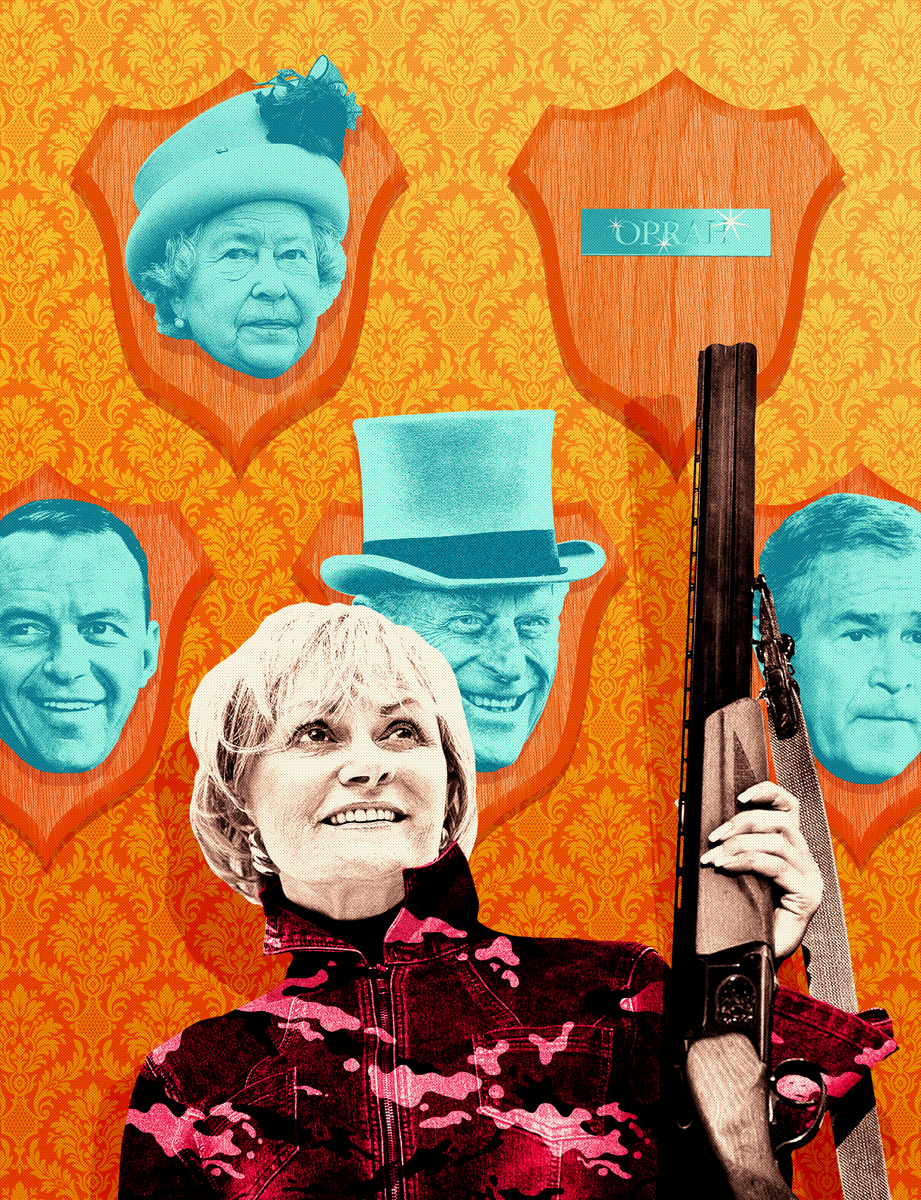
I’m writing about the irrepressible/fabulous Kitty Kelley over at Cheeky Chicago today:

The great tenet of biography is that it’s far simpler to write a biography when the subject of your biography is dead. But Kitty Kelley has never been one to take the easy way out…

Read it HERE.

And if you missed the interview on Oprah, you can still catch that HERE.

movie magazines: a brief history in several parts (part 4)

[Last week… How the dastardly editorial policy of the movie magazines infected the entirety of the mainstream media!]

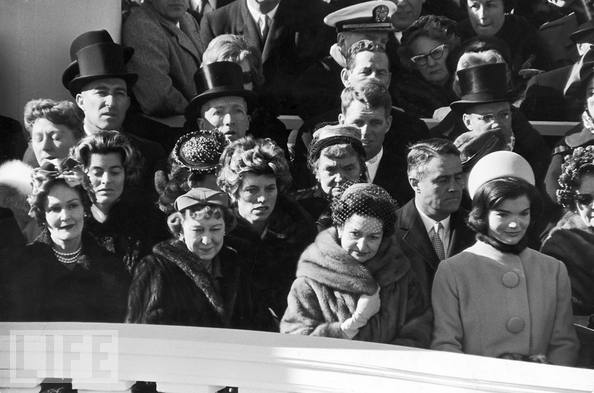
To understand the visual impact of the Kennedys—and, yes, their impact was more visual than anything else—you have to appreciate the aesthetic dullness of the political landscape into which they burst. In brilliant contrast to the contemporary politicos, with their grizzled visages and frumpy, mink-swathed wives, the Kennedys were unlike any political couple Americans had ever seen.

Just look at Jackie in the audience at the Inauguration. Situated in its historical context, her cream colored suit appears clean, crisp and vaguely futuristic. It shines like a hopeful beacon amid the sea of animal pelts.

Historian Gary Willis characterized theirs as a “rule by dazzlement,” a phrase that goes a long way in capturing the First Family’s stunning visual impact.

People simply could not get enough and they did not know why. Neither did the magazines. Any attempt to pin down the Kennedy appeal resulted in a laundry list of clichés. In 1962, the editors of TV Radio Album fumbled towards an answer in their attempt to attach the term “star” to Mrs. Kennedy: “The word is used in show business to describe a personality so warm and vital that we forget we know it only as a picture on a TV screen or a name in newsprint. We feel that we know the actual person, as someone close to us. And certainly Jacqueline Kennedy is all that!”

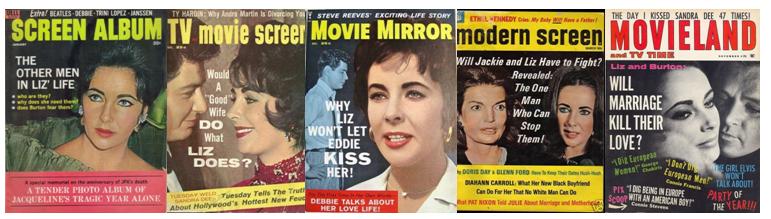
With the advent of television and the resulting drop in movie attendance, the fan magazines reached a crossroads. To remain relevant, they had to expand their gaze beyond the Hollywood hills.

In “Jackie!”: The Exploitation of a First Lady, Irving Shulman succinctly captures the magazines’ perception of their own role in the American media, circa 1961: “It had at last come to pass that the world’s longest and most exciting movie was being performed every hour of every day at the White House and in locales throughout the world related to this master set. To record this living movie and assure its proper critical place in American and international history was the contemporary historic dedication of the fan magazines.”

It was an admirable pursuit and herein lay the distinction between the fan magazines and the mainstream press. Though their coverage was similarly characterized by provocative images and personality-based narratives, their approach was markedly different. The “serious” publications covered the Kennedys as political personalities, while the movie magazines approached them as show business stars- which they were.

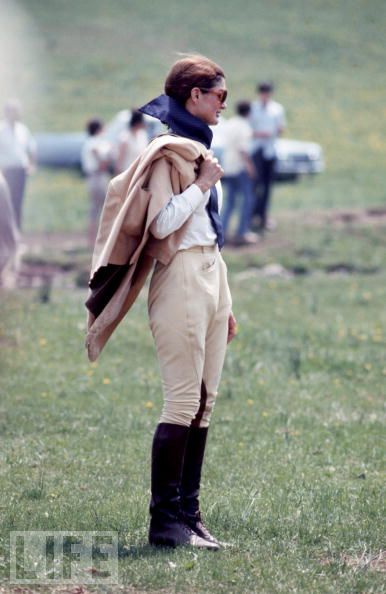
 (photo via LIFE)

movie magazines: a brief history in several parts (part 3)

[Last week… Hey Oline, who the heck is this Irving Schulman dude?]

In “Jackie”: The Exploitation of a First Lady, Irving Shulman—sociologist/misogynist— suggested that the movie magazines offered “uterine tidbits” and “a clitoral interpretation of life” to their largely female audience, a dastardly editorial policy that, in turn, infected the entirety of the mainstream media. Shulman uses the tabloids’ Jackie Kennedy coverage to illustrate this insidious trickle-down effect.

This is interesting, yes, but it is also wrong.

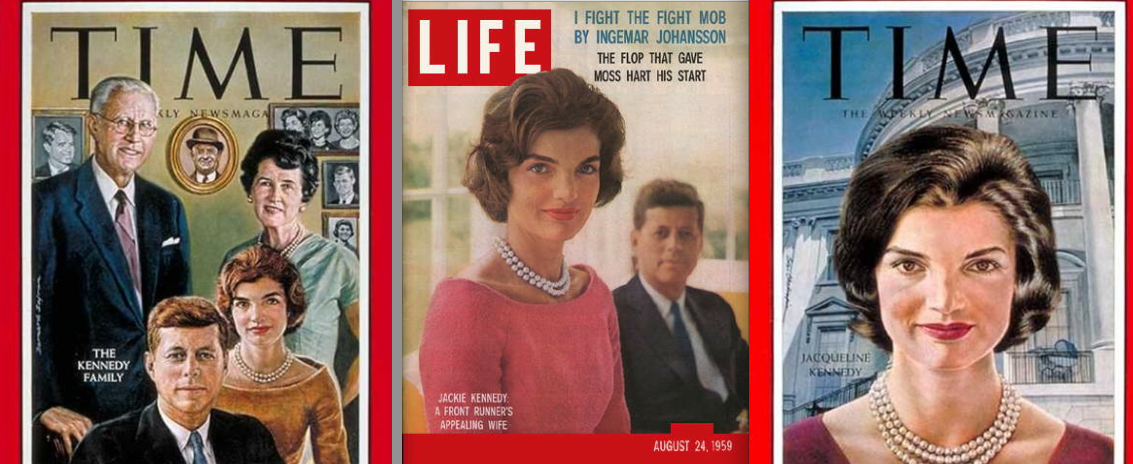
The mainstream press latched onto the Kennedys’ spectacular appeal early. The family had received regular press coverage since Joe Kennedy’s days in Hollywoodand his subsequent ambassadorship in the Court of St. James. They were no strangers to publicity and, in July 1953, before she was even married, Life ran a four-page spread on Senator Kennedy’s fiancé.

A similar cover feature appeared in 1958 and, a year later, the FRONTRUNNER’S APPEALING WIFE was front-and-center in a cover photograph, with JFK hovering in the background, curiously out of focus. In the fall of 1960, Look followed suit with an article on all the Kennedy women and a cover of the Senator’s 29 year old wife in a strapless dress with a hint of cleavage. At the time of the Inauguration, Ladies Home Journal was running serialized excerpts from Mary Van Rensselaer Thayer’s authorized biography, giving readers an intimate peek into the new First Lady’s life via singularly florid prose.  By the time the movie magazines began hesitantly running her on their covers in the winter of 1961, Jackie had been making regular appearances in Life and Look for nearly a decade.

The exposure in the mainstream magazines hinged on the notion of exclusive access to extremely private moments. Between the election and Inauguration, Life devoted a cover to JFK Jr.’s christening. In its February 28, 1961 issue, Look gave readers “exclusive” access to an “informal visit” with the new First Family, including photographs of Jackie swaddling the Kennedy’s newborn. The accompanying copy notes that, when the photographs were taken, the infant “had not long graduated from an incubator.”

Such reports were stylish, authorized and, often, in full-color, but they were also— at their core— fueled by provocative images and personality-based narratives. By 1961, the mainstream magazines were already strolling down the path upon which the tabloids were about to stumble.

movie magazines: a brief history in several parts (part 2)

[Last week… Hey, Oline, what are movie magazines?]


In 1969, the sociologist Irving Shulman published a landmark study of the movie magazines, using their Jackie Kennedy coverage as a case-study. And, yes, I use the phrase “landmark study” while readily acknowledging that its landmark status has gone largely unrecognized by most everyone in the world but me and “Celebrity Gossip, Academic Style” superstar Anne Helen Peterson, who notes that Shulman provides “The Most Sexist, Classist, Patently Offensive, and Incredibly Useful Research of All Time.”

Whether you love Jackie or movie magazines or not, Shulman’s “Jackie”: The Exploitation of a First Lady is worth reading. His assertion that the mainstream media has gone down the crapper is valid and it’s provocative that he finds the movie magazines entirely at fault. The thesis:

Fan magazines [are] considerably more than a trifling symptom of American malaise, and this symptom, could explain the American public’s conditioned acceptance of such obscenities as genocide, favorable kill ratio, nuclear fallout, murder, a geometric increase of violent felonies, starvation, slums, denigration of the human condition, fine print in consumer contracts, demagoguery, venality and stupidity in public office, and a spate of social violences which imprison juveniles in a delinquent society of adults.

Um… yeah. Any way we look at it that is an amazing assessment, never mind the way that Shulman goes about proving it.

“Jackie” is interesting because it offers a framework for analyzing the social impact of the movie magazines of yore that’s equally applicable to the celebrity magazines of today, and also because it is fantastically misogynistic.

Shulman’s argument is predicated on the notion that the movie magazines catered to their primarily female audience by offering “uterine tidbits” and a “clitoral interpretation of life,” an interpretation that, in turn, infected the entirety of the mainstream media.  So, what he’s saying is that the movie magazines (ie. “women’s magazines”) single-handedly lured the mainstream press (ie. “men’s magazines”) to drink from the tabloid trough.

He then uses the tabloids’ Jackie Kennedy coverage to illustrate the trickle-down effect.

This is interesting, yes, but it is also wrong…

[Next week… Hey, Oline, why was Schulman wrong?]

movie magazines: a brief history in several parts (part 1)

At the outset of the 1960s, the popular press generally divided into two camps. There were the respectable mainstream publications such as Life, Look, Time and The Saturday Evening Post, which covered contemporary news. And then there were the so-called “women’s magazines,” which included such varied publications as Vogue, Ladies Home Journal, Cosmopolitan and McCall’s. In contrast to the big boys, the lady mags covered soft news, frothy subjects such as celebrities, fashion and family.

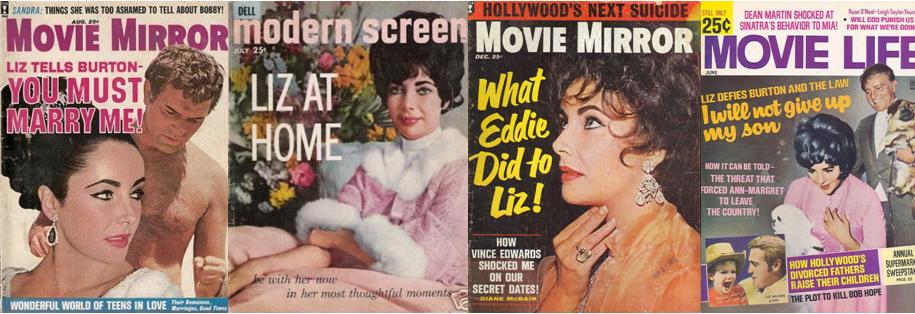
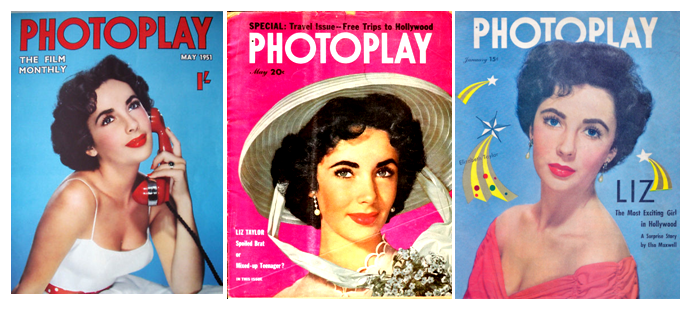
Because women comprised the bulk of their audience, the movie magazines were lumped in with the women’s magazines, though they were a distinct subset unto themselves. A special breed of magazines  invented by the film studios, the movie magazines were originally intended as a publicity tool. Providing a template upon which Us Weekly and In Touch would capitalize later, the movie magazines covered the misadventures, tribulations and lifestyles of television and film stars.

At the height of their popularity, there were upwards of forty publications, including Photoplay, Motion Picture, Modern Screen, and TV Radio Screen. They had little in common with Ladies Home Journal and Vogue.

Most often, the movie magazines were characterized as “tabloids,” but even this classification was misleading as the movie magazines were not tabloids in the truest sense. The term “tabloid” originally denoted periodical size but it had, by the 1960s, become synonymous with down-market sensationalized, special interest magazines.

In a report for the April 1969 issue of Playboy, Reginald Potterton cataloged the preoccupations of the mainstream tabloids: Justice Weekly “boasts an editorial obsession with just about every form of deviation known, short of bestiality and necrophilia; while Confidential Flash, the National Informer and Midnight range over as many bases as possible but incline toward ‘straight’ sex and horror-violence.”

While, in time, the movie magazines would push the boundaries of acceptable celebrity reporting, they never went to these extremes. The world they depicted was populated by glamorous stars seeking comfort in love, family and faith. Even back in the 1960s, celebrities seemed to want nothing more than to be normal. They longed to be Just Like Us.

things you never know if you never ask

the first legit biographer to ever read jackie was a pulitzer prize winner with whom my only in-person interaction had been the observation that there should be more stalls in the women’s restroom at the national press club.

because, during a panel, she had expressed liberal views about what constitutes a biographical liberty, i shipped eight questionable pages of jackie off to her to see if, in her estimation, i had sinned.

it’s hard to summon momentum. to keep up your energy over the long haul. because this- writing, biography, life- is a mighty long haul. what you need is some galvanizing force that- even if it leads nowhere, even if it’s fleeting at best- gets you going. it gets words on the page.

the pulitzer prize winner wrote back. her email opened with this line: “well, i must say i enjoyed that…”

as though she hadn’t expected to. as though she were genuinely surprised.

i’m tempted to print out this email and frame it as a reminder. because this is the response i’m writing for, this is the response jackie should get.

you think you know her story. you don’t. i’m going to tell it, though i do not yet know how.

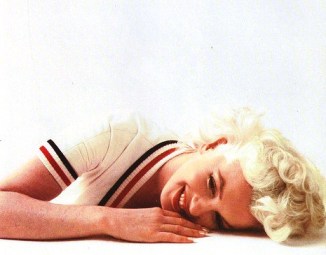
(photo by milton greene)

dated

in the spring of 2004, with the confidence one can only have as a graduate student straight out of undergrad, i wrote the eleventh chapter of a non-existent book.

because i had to read anna karenina in five days and my longing to compare the use of the first person plural narrators in a rose for emily and the virgin suicides never gained any traction, i wrote about jackie. i knew her life like the back of my hand. i figured writing about her would be a breeze.

it wasn’t. to this day, it isn’t.

i might’ve been a nicer person in graduate school had i known then that i would be wrestling that same chapter for that nonexistent book now. might’ve been less prideful, less hee, hee! you’re all trying to apply hegelian theory to the grapes of wrath while i’m reading tabloids and revising a chapter that i’ve finished three weeks before our thesis is due!

eight years later i am still revising that chapter. admittedly, it’s changed. there’s better characterization and structure, and it’s gone from the middle of the book to the beginning. but the guts are the same. and, much to my chagrin, it’s gotten a little dated.

way back in 2004, i made a mistake all rookie writers make. i assumed my book would be published immediately, to great fanfare. because of that, i opened with this sentence: “the fallout was instantaneous, the response was shock and awe.”

in my innocence, i didn’t realize an allusion to the war strategies of george w. bush might not be the way to go.

a gentle reminder re: Jacqueline Kennedy: Historic Conversation on Life with John F. Kennedy (the book i’ve not yet read/the tapes i’ve not yet heard)

there’s an account of jackie that stands out to me among all the others, if only because it’s irreconcilable with the woman the media portrays.

it comes from an old female acquaintance, who complained of jacqueline during the 1940s: “she had so many sides. she behaved very capriciously. she’d be very seductive to a man at a party, sitting next to him, and then stub her cigarette on his hand.”

this is the jackie i love. the ballsy bitch beneath the breathy voice. this is also, from the sound of it, the jackie that the world will be meeting through the jackie tapes. a woman both cuttingly perceptive and astonishingly catty.

the jackie tapes are fascinating, yes (i assume). they teach us many things we did not know (jackie disliked mlk! and degaulle! and lbj! and ted sorenson!) and remind us of others (she love loved andré malraux).

my one concern about these tapes is this: they represent jackie at one point in time. and, if jackie teaches us anything, it is that it’s dangerous to reduce anyone to a single story. we are all more complex, more nuanced than any interview or anecdote could ever convey.

explosions!

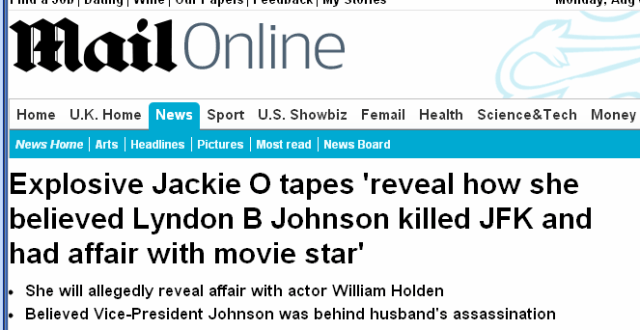
read THIS and then let’s talk.

i will now answer a series of questions you have not asked:

(1) did lyndon johnson kill JFK and have a love affair with a movie star as the sentence structure of this headline would lead us to believe? no.

(2) was lyndon johnson ever governor of the state of texas? no.

(3) did jackie gave arthur schlessinger a deeply revealing interview that was not to be released until 50 years after her death? yes.

(4) was this interview in any way ever “secret”? no.

(5) are the tapes “explosive”? YES!!!! or no.

(6) did jackie have a love affair with william holden? she cut her hair like audrey hepburn’s in sabrina, so the answer is obviously yes.

(7) did jackie find the panties of jfk’s teenaged lover in her white house bedroom? this has been a set-piece scene in every single kennedy made-for-tv movie of all time, so it’s clearly totally true.

the theory on which i’ve based nearly everything i’ve ever written about jackie is that we are all of us reading tabloids all the time. yes, you may not subscribe to u.s. weekly and you may not know jessica simpson’s age and the name of her hairdresser, and you can pretend you’re above this, but if you do, you’re sorely underestimating the american celebrity-industrial complex.

we’re all in this together. if you read a snippet of gossip anywhere online this morning, you are reading u.s. weekly just as good as if you subscribed.

the tabloids are everywhere. they are on fox news and cnn. they are usually cited, but their information is presented within a news report so it’s hard not to take it as truth.

case in point- on sunday, a british tabloid recycled a story that, in america, has fronted the national enquirer time and again. by monday, it had traveled across the pond into the american mainstream press and we were all wondering if jackie was sleeping around and promoting conspiracy theories better peddled by oliver stone. never mind that every article sourced the daily mail and abc promptly denied the reports- the story had wings and it took off.

and, as much as i love tabloids, this is what i hate about them: i hate that this is the narrative people will remember. people who have never read a book about jackie and will not listen to the “secret” “explosive” jackie tapes in the fall, people who won’t listen then and hear her say whatever it is she’s going to say in that crazy strange voice of hers, they will remember this.

they’ll remember her as that woman who slept around to get even, who thought a man that was never governor of texas did her husband in.

that’s what they’ll remember though it’s not who she was.