family time

(14 September 2010)


I returned from a vacation in Denmark with a million dirty clothes, a heap of right-wing British political magazines, the world’s largest lollipop, and a slew of Jackie-related voice messages.

Three of them do not count as they were from my father, who deployed the family Caroline Kennedy voice in a series of comical weeeeeeeeeeelcooooooooomes and plaudits for my dediiiiiiiiicaaaaaaaaaaaaatioooooon and sprawling pleas that I meet him in the liiiiiiiiiiiiiiiiiiiiibraaaaaaaaaaaaary.

(Yes, we have a family Caroline Kennedy voice and the family Caroline Kennedy voice is based solely on a speech Caroline Kennedy gave in 1979 welcoming people to the dedication of the JFK Library wherein the only thing she said was, Welcome to the dedication of this Library. Thus, the family Caroline Kennedy voice is strictly limited to topics surrounding libraries, dedications and welcomes- topics that, when one’s family has a family Caroline Kennedy voice, come up with surprisingly greater frequency than one would ever imagine.)

The remaining messages, however, were from actual Jackie-related people. Impeccably mannered with such sprawling WASPy vowels that every time this happens, every time I hear them, I almost want to cry. Because people talk like that no longer. Those voices, these accents, they are a dying breed.

The manners are of a different age as well. Even when they are unwilling to speak to me, still they call, their messages acknowledging receipt of my letters and asking that iI, kindly, leave them alone. A display of such politesse that it has on more than one occasion prompted my grandmother, a life-long republican, to commend the grand etiquette of “those dread Kennedy people.”

What we learn from these messages is that most people are, apparently, willing to speak to me. People who actually knew Jackie. People for whom she was not a tabloid construct or a character played by Roma Touched By An Angel Downey in a made-for-tv movie in 1992.

I assume they think I’m about 54. I imagine my youth will surprise them and that I will need to go easy on the eyeliner when we meet.

Because, by this point, I’m pretty sure we are destined to meet. So, you can see, it’s absolutely ideal that at this same point- thanks to an infelicitous rereading of Janet Malcolm’s The Silent Woman– the prospect of talking to these people would suddenly be totally revolting to me.

I should be more clear. It’s not so much the prospect of talking to them, as I’ve done that several times without a hitch so far. It’s more the prospect of groveling at their feet, begging for scraps of information. Above all, it is the prospect of hurting their feelings.

Admittedly, in the face of Janet Malcolm’s distaste for any biographical endeavor that prizes an investigation of the dead over the emotions of the living, it would be challenging for anyone with an inquiring mind and a soul and a desire to wrench the family treasures from Jackie’s loved one’s hands not to feel a world-weary sense of moral decay. But still.

It’s a terrible time to develop a biographical conscience.

My friends who are historians all have their people, but their people are all old. They are all safely dead and their friends are too. There is no need for approval. No relatives to rise up with pitchforks, incensed. No lingering sensation of impending familial fury, as though each and every sentence put on the page were a step forward into literary leprosy, a future forever constricted by kennedy condemnation.

There is no one with whom I can discuss this. The delicacy of not pissing off Jackie’s college roommate. The least offensive means of approaching Caroline Kennedy and abasing myself for the family treasures. I know no one who knows how to do this, and so I bumble along. And so I will keep bumbling along until it’s done and done well.

Because it is Jackie. Because there has always been Jackie. And because, I know, for whatever reason- the feelings of everyone else be damned- I must not disappoint this dead woman I never knew.

oh mother dear, we’re not the fortunate ones

(19 may 2010)

Like millions of former English majors working in borderline abusive secretarial jobs, I have written a book. It has not been published, which is pretty much the same as having not written anything at all.

There’s this book I’m meant to write. I’ve known it since before the other. And yet it is hard to ratchet up whatever it is that it’s going to take to write what’s next.

It is challenging to write a follow-up to something that has never been read.

That makes it sound far more important than it really is. It’s not the gospel or an epic or, heaven help me, Fiction. It’s just biography and it’s just Jackie- a subject that is the biographical equivalent to the beauty pageant answer “world peace.”

So in the large scheme of things like God and Franzen, it is relatively unimportant that there’s this Jackie book I’m meant to write. And it’s fairly inconsequential that this is THE Jackie book and that I really really don’t want to write it because it is an inferno of impossibles.

Because biography done well is a whole hard world of difficult and I’m not ready to fling myself in the abyss just yet.

These are all things I should have considered before mentioning this Jackie book to a fellow biographer; before casually tossing it out over the humus plate in the simple hope of garnering that amorphous credibility that comes from the respect writers have for one another’s as-yet-unexecuted Great Ideas.

It is a great idea so I was stupid not to have foreseen the explosion of enthusiasm its revelation would trigger. I should have anticipated the overpowering gung-ho.

There are three reasons why this project, this Jackie book- otherwise perfect- appalls me to no end:

1. It involves a language I do not speak.
2. It involves money I do not have.
3. It involves sources that do not exist.

Never mind that the few sources that do exist appear to be systematically dying as I approach them.

There’s an Elvis song entitled “It’s Impossible.” The actual opening lyric is “It’s impossible to tell the sun to leave the sky.” My family bastardized this line into the distinctly different yet equally truthy observation that “it’s impossible to stick a piano up your nose,” the sentiment that perhaps most accurately captures my feelings towards this project.

This Jackie book? It is a piano up my nose.

I do not say any of this to the fellow biographer when, three months later, she returns to the subject of the dreaded Jackie book. I do not tell her it’s a piano up my nose. Instead I nod and smile as she says Jackie book’s time has come. That it is a story that MUST be told. NOW.

It could be a documentary! A mini-series! A Sophia Coppola-directed feature film!

The fellow biographer tells me this and only then does she avert her gaze toward her falafel and drop the bomb for which I have been waiting all this time.

That it would be better were I an academic or an older, previously published white man (sadly, I am neither), Because there is no funding for girls like us.

A sentence that, just hearing it spoken, I know is going to be hell on earth to repeat to my parents.

When I do, a full week and a half later, my mother says- her voice fraught with the hope that her daughter is the reasonable, financially cautious young woman she was raised to be and an inkling that she probably isn’t-Well, maybe someday you can really do it, but the timing’s just all bad right now, right?

And I couldn’t help but laugh. Because though I’m a woman of few philosophies, the one I’ve held most dear is that one must imagine somewhat more boldly than may be socially acceptable and that when things are at their most inconvenient and impossible, that’s when they’d really best be done.

Which is essentially what the biographer meant when she said, We’re story-tellers and, really, nothing else matters when you’ve a story to tell.

So maybe this is it. Maybe Jackie’s time has come and it will be the year that- without French or funding and with sources dying right and left- I finally try to tell this story that all the older, previously published white men have inexplicably overlooked. This story that— I am quite sure— was left behind just for me.

pride & prejudice

(29 october 2010)

my motivations toward princess diana were never pure. i was never interested in her for her own sake. it was more a nostalgia for the present, an awareness that a historical moment might be unfolding about which i might later deeply care. there was always the possibility that she might be The Next Jackie. having already missed the real one, i was fully determined to experience the next.

and by the phrase “The Next Jackie,” i don’t mean that princess diana shared any of the traits for which mrs. onassis was known. even at the age of 13, the designation simply meant that she covered on a hell of a lot of magazines. because even as i sat at the center left front row of ms. boyd’s 9th grade geometry class reading lady colin campbell’s diana in private: the princess nobody knows, magazines were all that mattered to me.

i do not think princess diana was very important. SHOCKING, i know. there are many things you could say to try to convince me otherwise. i know them all because i’ve written them down here and deleted them again and again and finally shoved them into a separate post that i’m choosing to ignore for the moment because all those arguments miss the point. the point being that i don’t think princess diana was very important.

so, suffice it to say, we are discussing a historical figure about whom i really care very little and for whom i have very little respect. which makes it rather curious that i am fanatically obsessed with reading biographies about her. and not simply reading them mind you, but rereading them. with much the reverence one would typically associate with oft-viewed classic films.

it occurred to me the other day that because i have read it at least twice a year since the summer of 2003, there is a distinct possibility that i have read sally bedell smith’s diana in search of herself as many times as- if not more than- pride and prejudice.

please know that i am not proud of this. i wish it were not so and, since having this revelation, i have devoted a considerable amount of brain space to figuring out why it might be true.

the reason i have arrived at is this: the biographies of princess diana have- by and large- been written by women. this should not make a difference. in the end it really does. and so, in studying how to write a biography of a woman, i have read these books about diana again and again.

because diana has, at least since her death, warranted serious biographical study by serious female biographers. she is looked upon as a woman who is interesting in her own right. someone who’s marriage was an important part of her story but who did this brilliant, brave thing in standing up to the british monarchy and changing it for all eternity to come.

i, for one, do not believe that, but that’s irrelevant here. what i wonder is this: biographers write well and seriously about diana because she is supposed to have had this big impact. biographers- sometimes even those same biographers who wrote well and seriously about diana- write badly and flippantly about jackie. what are we to suppose of that?

from my place in the jackie bell jar, i think it comes from the general ambivalence that continues to surround jackie’s place in american life. she is eulogized as “america’s queen”- an extremely awkward thing to be in a democracy. nonetheless, i would argue that hers was the most important female life of the american twentieth century. and i would go to the mat on that. (realizing i am probably the only one.)

it’s acceptable to write seriously about diana- a figure who was legitimately royal, legitimately rebellious and legitimately ill. it is somehow less acceptable to write seriously about jackie- a well-dressed ordinary woman with a falsified french past, who married a president and ran off with a pirate.

i do not like that. i don’t know what to do about it, but be aware, for what it’s worth: i do not approve.

fight club


PART TWO

(miss PART ONE? go HERE)

First Ladies aren’t supposed to raise hell. Especially not widows. But Jacqueline Kennedy was no ordinary First Lady. When she beckoned William Manchester, her obstinate author, to the Cape that August of 1966, she greeted him with steely determination and in hot pink pants.

She had summoned Manchester in the hope of winning him to her side. She knew her charms and was adept at the soft sell. In Jacqueline’s view, if Manchester would agree that there was no genuine Kennedy-approved manuscript, Look magazine would be forced to cancel the serialization. The Kennedy camp, in turn, promised to compensate Manchester with a higher percentage of the royalties. Manchester just didn’t get it. He could not grasp that Jacqueline had wanted a book no one would see.

When Richard Goodwin, who was present, promised Death of a President would be published “with dignity,” Jacqueline amended that it would be published without “magazine hoopla and promotion.” Manchester was unmoved.

The talks rapidly devolved into a heated argument. Unable to dissuade the author from proceeding, Jacqueline fell into what Manchester later described as a “completely unrealistic” frame of mind, railing against Look, its publisher, and other books on President Kennedy: “She was going to fight, she said savagely, and she was going to win.”

In Jacqueline’s eyes, Manchester had failed. To make matters worse, he had betrayed her trust by including elements of the “frightfully emotional interview[s]” she had given and then denied her the cuts she requested. Suddenly, she had no control of a project that had initially been her’s.

Unable to garner Manchester’s cooperation, she invoked her last avenue of hope— the press— and flippantly boasted: “Anyone who is against me will look like a rat– unless I run off with Eddie Fisher.”

By mid-December, Jacqueline decided to sue. “I have to try,” she told a friend. “I can’t lose all that I’ve tried to protect for these years.” Thus, she set in motion what Time declared “the biggest brouhaha over a book that the nation has ever known.” Ultimately, Look capitulated and deleted 1,600 words. As Editor-in-Chief William Attwood boasted to the New York Post, “We gave up some slush; a little gingerbread’s off the top, but the structure’s intact.”

Jacqueline openly admitted that the deletions she requested were of no historic value, but that was precisely the motivating factor. She was taking pains to erase any detail that could be exploited by the popular press. Richard Goodwin made a note in the margins of the Manchester manuscript’s galley proofs that made this point. Around a passage in which the President and First Lady embraced before going to their separate bedrooms, Goodwin wrote: “Mrs. J.F.K. feels very strongly about this. Their sleeping arrangements, embracing, etc., will all be taken by Modern Screen, etc., sensationalized, cheapened. Asks if you will please take this out.”

The lawsuit was a hollow victory for Jacqueline. The passages she most violently objected to had long since filtered into the press. In December, Time published a bulleted list detailing half the passages that had been removed. As Cleveland Amory pointed out in Status and Diplomat: “Mrs. Kennedy . . . succeeded in publicizing the very things she did not want publicized, far beyond any publicity they would ever have had if she had not sued.”

The excerpts’ appearance in Look not only extended the book’s exposure to a much broader audience but also grievously commercialized the President’s death. The excerpts were printed on a high-quality paper to differentiate them from the rest of the publication, but advertisements were still included at the beginning and end of the passages, which, in the words of one commentator, created a sense that “This assassination has been brought to you by Goodyear Tires.”

Mrs. Kennedy strove to prevent the cheapening of her husband’s death, but she had inevitably become a participant in the very sensationalism she abhorred. Jacqueline later told Professor Joe B. Frantz, who interviewed her for the Lyndon Johnson Library’s oral history project, that the fight over the Manchester book was

the worst thing in my life . . . I’ve never read the book. I did my oral history with him in an evening and alone, and it’s rather hard to stop when the floodgates open. I just talked about private things. Then the man went away, and I think he was very upset during the writing of the book . . . Now, in hindsight, it seems wrong to have ever done the book at that time.

Publicly though, she treated William Manchester with extreme graciousness. Following the legal settlement, Jacqueline Kennedy released a laudatory statement to the press: “I think it is so beautiful what Mr. Manchester did . . . all the pain of the book and now this noble gesture of such generosity, makes the circle come around and close with healing.” A rosy view that wasn’t quite realized. Rather than closing the circle with healing, the Manchester controversy had, in fact, blown it wide open.

Just as Robert Kennedy’s attempts to stop the serialization had opened him up to accusations of censorship, so the lawsuit brought the former First Lady under attack in the press, particularly among the tabloids. In assessing the Manchester melodrama, the movie magazines were all over the board in their opinions. If this was to be the press’ first peek at the character “Jackie” was becoming—one who beneath the velvety surface was alarmingly avaricious—the press were not entirely sure what to do with her yet. And they were having a devil of a time assigning blame.

Some said “Jackie” was wronged by Manchester, by Look, by the press, while other publications dismissed her as “The big loser,” a selfish woman who’d pitched a public fit because she hadn’t gotten her way.

Perhaps the most fascinating article from this period is Screenland’s piece entitled “How JFK Would Have Stopped The Vicious Attacks,” wherein writer Judi R. Kesselman approaches the Death of a President controversy almost exclusively from the context of gender. Since it “was always the feminine hurts in the book that [“Jackie”] objected to,” “Jackie” “reacted purely femininely.” And, if anything, “Jackie’s” girlish impulse to protect her privacy only further endeared her to her female public: “We women understood why Jackie didn’t want a book to reveal whether they slept together or separately that last night [ . . . ] We women still love her, and feel she was right in wanting to keep her privacy.”

After a series of quotes that describe “Jackie’s hysteria” and her “unbalanced” behavior, we reach the conclusion that if John Kennedy were still alive, he would have deflected the attacks against his wife by reminding people that “Jackie acted like a typical woman [ . . . and] that it’s a fit and proper thing.” After all, “Only a husband can wink to the mass of men about him and say, ‘She’s my wife, poor, weak woman, and isn’t she a honey?”

To the 21st century reader, this is appalling. It’s hard to hold back, to resist the urge to launch into an academic discourse about how, by couching the argument in gender terms, Kesselman perpetuates stereotypes of feminine hysteria and reduces “Jackie’s” violated privacy to a feminine irrationality that would been prevented had a husband been present to calm her down, an assertion that strips “Jackie” of intelligence and reduces her actions to hormonal impulses.

But to readers of the time, this was nothing. In fact, it seems to have been, by and large, what they were looking for. In my correspondence with Judi Kesselman thirty-five years later, she still believed the article gave a realistic view of the prevailing attitudes: “Women who read the movie magazines liked to hear about hysteria and imbalance. It made them feel that their lives were better than they are, less hysterical and imbalanced. Believe me, a lot of women back then, stuck in unhappy marriages and consigned to drudge, felt they’d go crazy if they didn’t have the entertainment of reading a magazine whose women sometimes, for all their fame or wealth, were as unhappy as they.”

And what the women wanted, they got. In the coming years, this is who “Jackie” would become—a hysterical, imbalanced star. She would be put in an unlikely marriage and she would be unhappy. She would fight with her daughter and her husband and his mistress. She would become an insecure shopaholic. She would almost, almost become one of us. If the Manchester dramedy did anything, it was this—it shook up the tabloid formula and steered publishers down an editorial path in which their portrayals would become less positive, in which “Jackie,” the housewifely goddess divine, would be given clay feet.

Throughout “Vicious Attacks,” it is the men who are attacking our “Jackie,” but the great irony is that it was predominantly women who read the movie magazines and it was with the movie magazines in mind that Mrs. Kennedy had requested the deletions. As Manchester himself had noted, by May 1965 Jacqueline “couldn’t even take her daughter into a drug store, because every issue of every movie magazine carried her photograph.”

© faith e.


fight club

(4 august 2008)

PART ONE


Just how awesome are literary throw-downs? That is the question. Because, really, literary throw-downs are effing unbelievably awesome.

Maybe simply because the centuries have afforded us so very few. We’re more accustomed to catty quill fights—Marlowe versus Shakespeare. Rimbaud versus Verlaine. Capote versus Vidal. Swell in their own right, yes, but bona fide, fisticuffs-and-all frays are few and far between. And infinitely awesomer.

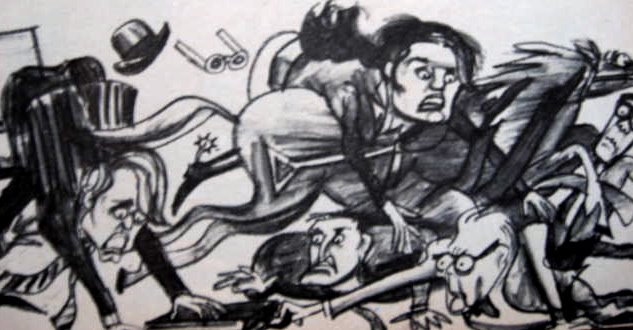
On March 26, 1964, when Robert Kennedy’s office announced that the Kennedy family had anointed William Manchester to write the authorized account of the death of J.F.K., the Senator probably didn’t realize he was stepping into the ring for one of the greatest literary smack-downs of all time. It was an honest mistake. Hear the name Bobby Kennedy and bibliobrawler probably isn’t the first word that jumps to mind.

A former foreign correspondent for the Baltimore Sun, William Manchester seemed convivial enough and his greatest selling point was that he had written Portrait of a President, an idolatrous account of John Kennedy’s early presidency. The Kennedys always appreciated people who knew how to play the game, and back then Manchester had acted the dutiful courtier— submitting all proofs to the President’s press secretary and awaiting approval from the President himself before proceeding with publication.

Later, Manchester would consider his prior docility with the Kennedy administration the motivating factor in his appointment as authorized family scribe: “I think [Mrs. Kennedy] picked me because she thought I would be manageable.” He would be anything but.

Smart people sometimes do exceedingly stupid things. That is the only explanation for why the family would embark upon the literary equivalent of an autopsy to begin with, much less do so wielding little more than a flimsy contract whose most concrete sentiment was that the book could be released immediately or maybe later or maybe not at all. Such ambiguity guaranteed misunderstandings in the absence of stellar communication, and everyone was simply too busy and too emotional to be fully engaged.

They were going to a street-fight cloaked in gold lame. Manchester was sporting steel-toed boots.

Ultimately, the Kennedys and the author held fundamentally different views of what the book should be. Manchester wanted to make “a genuine contribution to history” and, presumably, some small donation to his bank account. Jacqueline Kennedy wanted a historical record— in no way sensational, in no way exploitative— as she later told Manchester, to be “bound in black and put away on dark library shelves.” It was, after all, the story of her husband’s death. Not exactly something she wanted on coffee tables all over the world.

William Manchester had once declared John Kennedy “the personification of most American’s daydreams,” and in revisiting the President’s murder, he was reliving a national nightmare day after day. After what Manchester later characterized as “three years of agony,” he completed the 380,000-word manuscript, writing Robert Kennedy: “I felt as though I had emerged from a long dark tunnel.”

All the interviews the author conducted were emotionally disturbing, but none more so than those with Mrs. Kennedy. Fueled by daiquiris and cigarettes, the pair talked late into the night.

At the time, historian and Kennedy family friend Arthur Schlesinger, Jr. was collecting oral histories for the Kennedy Library. Rather than subject Jacqueline to such an emotionally harrowing experience twice, Manchester conducted both the interview for the library and for the book simultaneously. Jacqueline believed the tapes would not be made public during her lifetime. Schlesinger told her to be as forthcoming as possible because she “was making a deposition for the historian of the twenty-first century.” In response, she was shockingly candid. Manchester himself admitted: “She had withheld nothing . . .”

Once the book was completed, it proved impossible for the family to read. Robert Kennedy tried on several occasions but barely finished the first few pages. His wife, Ethel, reportedly read portions at some point. Jacqueline sat on the sidelines, awaiting the go-ahead, assuring Manchester that she would eventually read it, “After R.F.K. and Evan Thomas have gone over this manuscript [. . . ] whenever they think I should.”

Thus, the task was delegated to assorted Kennedy minions. Evan Thomas (Manchester’s publisher), John Sigenthaler, (Robert Kennedy’s former administrative assistant) and Ed Guthman (editor of the Los Angeles Times), were summoned and given the mammoth job of taming the beast.

And tt was quickly apparent to all that there was much to be tamed. Sigenthaler and Guthman immediately pressed for 111 editorial changes and the removal of several viciously anti-Lyndon Johnson passages.

The primary criticism was that, in his fawning reverence and dewy prose, Manchester’s Kennedys were cardboard, albeit glittering, characters. Jacqueline is cold, detached and, after her husband’s death, almost macabre in her role as a master of funereal etiquette, while Kennedy— with his sore back and staid majesty— seems to have a foot in the grave the minute he first strides into the Texas sun.

Ironically, the venom that colors the portrait of Lyndon Johnson renders him the liveliest character of the lot. The Vice President, though villainized, is the one you remember. This was not how it was supposed to be.

In reality, no book could have measured up to the Kennedy camp’s expectations. It was far too early for any account of the President’s death, much less a sprawling historical narrative. As Time later noted, “What nobody seemed to take into account is that the assassination is still so fresh in people’s memories and has left so many exposed nerve ends that any painstakingly detailed, step-by-step retelling is premature at this point.”

To the Kennedy readers, Manchester’s effort to capture the whole “tragic sweep of that entire weekend” hit all of these nerves, most directly by obscuring the man himself. John Kennedy, though the impetus for the book, was not its focus and that was unacceptable.

Guthman, Thomas, and Sigenthaler all agreed there were serious problems with the manuscript, but they withheld the full extent of their misgivings for fear of the psychologically devastating impact upon the author.

According to Sigenthaler, Thomas suggested that Manchester had become increasingly unstable: “[Thomas] would say, ‘There’s no question but that he’s seen that [Zapruder] film seventy-five to a hundred times and if you’d seen the President’s brains fly that many times then something would happen to you, too.”

Even if Manchester weren’t mentally disturbed at this point, the Kennedy aides began handling him as though he were. Rather than speaking with him directly, they pussyfooted around, employing intermediaries, in essence turning the project into an elaborate game of “Telephone,” which only added further confusion to the cacophony.

The reviewers were pissed, but they had not dismissed the idea that the book could be published by year’s end. They thought that through extensive revisions Manchester’s manuscript could be brought back in line with their vision of what it should be.

The announcement that Jim Bishop’s The Day Kennedy Died would be published in the fall of that year left everyone quaking in their boots and lent the project a renewed sense of urgency. Manchester, who had been living off a small advance from Harper & Row, was understandably eager for events to move quickly. He had been told to expect a telegram from Robert Kennedy that would allow the publication process to go forward. Under the impression that a telegram of approval was forthcoming, Manchester began taking bids for magazine serialization.

Senator Kennedy knew serialization was Manchester’s only source of profit and had indicated to others that he would stay out of the negotiations. He simply stated a preference for Look over Life, which had recently published several articles critical of him, and left it at that.

There was a lingering fear that the project would be tainted by the slime of opportunism. To that end, the Kennedys had made it clear from the first that all profits from the book were to go to the Kennedy Library. There was to be no hint of exploitation here.

In a letter written to the Senator, Manchester reiterated this, crowing that he would have full editorial control over the serialization regardless of which magazine won the rights: “I’m holding the line on control of text and layouts, and, in fact, there have been no recent protests about that. I can guarantee you that it will be handled with not the faintest tinge of sensationalism. I can guarantee it because I’m the man who will be making the decisions.” He didn’t comprehend that with the magazines entrance, he would ultimately forfeit everything.

As bidding heated up, Manchester cooled his heels awaiting the telegram from Robert Kennedy. None came. Which didn’t matter much since no one really knew what the telegram would mean.

After a series of conversations on July 14th, the significance of the forthcoming note was only further muddied. According to Sigenthaler, Thomas had suggested the Kennedys send a reassuring telegram to the worried author. Thomas himself said he thought the telegram would say the book would be published that year rather than 1968. In contrast, Manchester emerged with the belief that the telegram would indicate a blanket endorsement of the book. Three men, three different stories. Still no telegram.

On July 27th, Manchester panicked, calling the home of Robert Kennedy’s secretary and begging for the letter he had been promised. Angie Novello summarized their conversation in a detailed memorandum to the Senator, noting that Manchester hadn’t “slept in 3 nights worrying about that letter.” Later that day, Robert Kennedy wired Manchester:

While I have not read William Manchester’s account of the death of President Kennedy, I know of the President’s respect for Mr. Manchester as an historian and a reporter. I understand others have plans to publish books regarding the events of November 22, 1963. As this is going to be the subject matter of a book and since Mr. Manchester in his research had access to more information and sources than any other writer, members of the Kennedy family will place no obstacle in the way of publication of his work.

This was what Manchester had been waiting for. Approval. The following day, he sold the American rights of The Death of a President to Look magazine for $665,000—at that time, the highest price ever paid for serialization. Instantly, the “no commercial exploitation” myth that had sanctified the project was besmirched.

In defense of the hasty contract, Manchester later explained to an interviewer: “When I saw ‘members of the Kennedy family will place no obstacle in the way’ of publication of the book, I thought it was all over.” It had only just begun.

It had always been Manchester’s belief that R.F.K. was acting as his sister-in-law’s representative. When the author approached Jacqueline Kennedy’s secretary, Pamela Turnure, with a copy of the manuscript, Turnure brusquely told him to “work through Bob, who is representing [her].” From then on, Manchester assumed R.F.K.’s approval was Jacqueline’s. Little did he know.

In late July of 1967, Jacqueline, who had not yet seen Manchester’s manuscript, returned from a Hawaiian vacation to find an effusive letter from the elated author in which he touted an “approved manuscript.” She had approved nothing.

At a cocktail party on July 31st, when Robert Kennedy informed her of the serialization and how much Look had paid for the rights, the shit hit the fan.

Faced with the imminent publication of a “highly personal account, an emotional retelling of the assassination,” Jacqueline, working through Turnure, supplied Manchester with a memorandum of passages to be revised. The list included at least 25 areas that would require substantial revision and also recommended that the book needed a new, less emotional tone— all fundamental textual problems that would require a ton of time to fix.

There was a sense that the situation was controllable so long as it revolved primarily around financial matters. To this end, Harper & Row hatched an elaborate plan in which Manchester would grandiosely divert a portion of the Look profit to the Kennedy Library and would be reimbursed on the sly by the publishing house so that there would not be publicly scene as having profited from the project.

On August 12th, during a tense flight from New York to Washington, Evan Thomas rehearsed his author on a speech to the Senator. Things quickly fell apart when, upon entering Robert Kennedy’s hotel room, Manchester, ever the poppycock, deadpanned, “I guess we should be facing each other with dueling pistols and swords.” With that, the meeting was effectively over.

The press would only further complicate matters. In early August, Evan Thomas alerted Robert Kennedy that Homer Bigart of the New York Times was poking around in the book and serialization deal. They knew it would just be a matter of time before the rest of the press came knocking.

On August 10th, Robert Kennedy cabled Thomas: “Under the present circumstances, with the situation as difficult as it is, I feel the book on President Kennedy’s death should neither be published nor serialized. I would appreciate it if you would inform Bill Manchester.”

In sending the telegram, Kennedy took a major political risk. He was censoring the author he had appointed himself, a situation that looked not only foolish but faintly unconstitutional. But his motivation was clear– Jacqueline Kennedy was raising hell…

© faith e.

(citations available upon request)
Stars, Tabloids, + Sex Taboggons

(16 may 2006/23 september 2010)

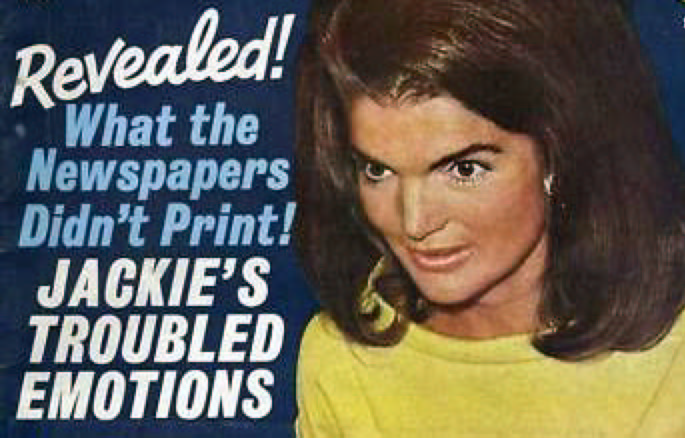
Long, long ago, back in the dark ages before US Weekly, the movie magazines reigned supreme. A special breed of tabloid that the film studios cunningly created in the 1920s as a publicity tool,  the movie mags spent their first 40 years offering puff pieces on everyone’s favorite stars. But, because it is often hard to make money being nice, in the late 1950s, the tone of their coverage took a salacious turn and veered towards the tantalizing cocktail of glamorous lives, naughty headlines and provocative photographs that beckons to us from newstands to this very day.

Tabloids, as a genre, engender little loyalty, so the industry has always depended upon newsstand sales to an extraordinary extent. To this end, movie magazine editors rushed to find celebrities who exercised broad appeal and would hold the public’s interest over long periods of time. Three months was considered an eternity. Thirty years had never before been done.

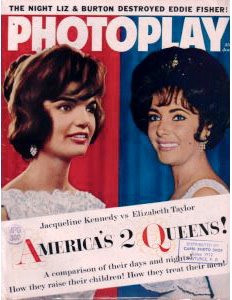
Much as popcorn kept movie theaters afloat after the advent of television, so Jackie Kennedy salvaged the movie magazines. She never starred in a movie but she featured in the movie magazines to such an extent that  in 1962, Variety enthusiastically hailed her as the “world’s top box office femme.” The prevailing editorial policy of all of the 40+ movie magazines then became this: to regularly feature the First Lady alongside “any lady or gentleman of the screen and television who misbehaved.”

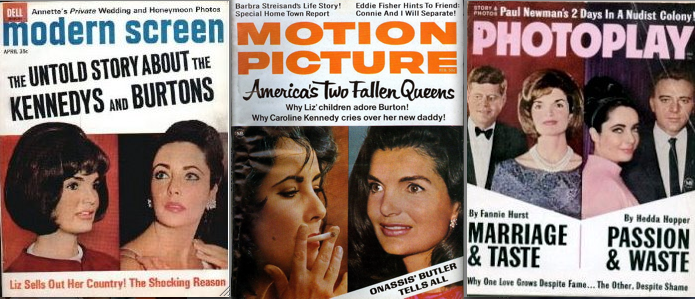
Among the ladies and gentlemen misbehaving at the time, Liz Taylor was queen bee. Thus, despite the absence of any legitimate connection, Liz and her then-husband Richard Burton would become Jackie’s “magazine relatives.” Ultimately, the Jackie-Burton-Liz tabloid triangle pervaded the national consciousness to such an extent that it created among magazine readers a Pavlovian response to the three principle players. According to sociologist Irving Schulman:

If new photographs worthy of inclusion at deadline were not to be had, art directors arranged jigsaw cutouts for Jackie-Burton-Liz, and in a very short time indeed a national conditioned response was established. Purchasers who saw a photograph of Jacqueline Kennedy would think immediately of Elizabeth Taylor and what she was doing; conversely a photograph of [ . . . ] Elizabeth Taylor would conjure up an image of Mrs. Kennedy.

The Jackie-Liz connection would become so integrated into the popular culture that in the Hollywood treatment of the Jackie story, The Greek Tycoon, the lead female character was named “Liz.”

In the beginning, particularly during the Kennedy administration, the movie magazine coverage remained somewhat circumspect. The couples served as simple foils for one another; the Burtons’ racy exploits emphasized the Kennedys’ elegance while Jack and Jackie’s élan exaggerated Burton and Liz’s decadence. In the fall of 1963,  the question of the Kennedys’ “Marriage & Taste” versus the Burtons’ “Passion & Waste” was of such critical social import that  Photoplay gave it major coverage.

In retrospect, it is not surprising that this circumspection ceased with the death of JFK. As Jackie marched into single womanhood, the tabloids switched course and focused on the remaining threesome- cropping cover photos and manipulating gossip to suggest romantic intrigues, clandestine meetings, and unorthodox sexual proclivities. Richard Burton and Jackie Kennedy may never have held hands, but thanks to clever editors and decoupage, on countless magazine covers they did.

The tabloids intentions here were completely pure: they sought to unite “Jackie” with the Burtons because “It would truly be a new, fun, fun world for Jackie– for the Burtons are fun, fun people.” And, really, who didn’t want Jackie to have fun?

Editors could not have created more different and more profitable characters to mash-up. Women loved to hate “Liz,” an actress who seemed constantly on the brink of personal disaster; they simply loved Mrs. Kennedy. In the words of pop-philosopher Wayne Koestenbaum, “Liz was trash; Jackie was royalty.” It was the perfect mix.

In the American consciousness, Jackie and Liz presented two entirely different versions of femininity in practice. What this translated into was Jackie being the woman everyone should aspire to be and Liz being the woman no woman would want to become (never mind that Liz seemed to always be having a hell of a lot more fun).

This dichotomy is nowhere more vividly exemplified than in the 1962 magazine, JACKIE and LIZ. The commemorative opens with a page that explains the editors’ reasons for comparing Jackie and Liz: “They shine in completely different constellations and exert a completely different emotional and moral effect upon us… To compare them [ . . . is] a way for us to examine the natures of the stars we create, and in the process discover something about ourselves.”

What we, the reader, should discover is clarified in a simple headline on the same page: “LIZ TAYLOR: A Warning To American Women; JACKIE KENNEDY: An Inspiration to American Youth.” Jackie was “WOMAN OF THE YEAR,” “Mistress of the Washington Merry Go-Round,” and “First in the Hearts of Her Countrymen.” She “KEEPS HER MAN HAPPY,” is “SURROUNDED BY LOVE” and only “Leaves Her Home For Service.”

In very stark contrast, “Liz” was the “SENSATION OF THE YEAR” and “STAR OF THE ROMAN SCANDALS.” “A Woman Without a Country” who was “Caught in the mad Marriage-Go-Round” and “SURROUNDED BY FEAR,” she faced “A THREATENING TOMORROW.”

I know no women who would welcome a threatening tomorrow. Life is hard enough as it is.

In JACKIE and LIZ, Jackie was lifted up as a shining paragon of virtue and good. To gossip columnist Fanny Hurst, her place in people’s affections was a barometer of the national well-being. So long as we all loved Jackie, the world would be ok.

In contrast, through “unsavory Taylor-Burton headlines, the shabby stories of shabby lies, of multiple marriages, infidelities, divorces, broken homes, displaced children,” Liz- heaven help her- had “steered her sex toboggan down a dangerous run.” A message that was, no doubt, not lost on readers whose own marriages might be lacking “the fire of passion” and women who might be tempted to follow Liz’s less traditionally feminine example by steering their own toboggans along her perilous path. Let there be no doubt, “Roman Scandals” were not welcome here.

Collectively, the tabloid narrative implies a sexual rivalry between the two women. When Jackie, allegedly rankled by Liz’s affair on the Cleopatra set, didn’t attend the movie’s Washington premier, TV Radio Mirror rushed to declare it: THE DAY JACKIE ‘SLAPPED’ LIZ! In the article, prudish Jackie frowns upon Liz’s amorous exploits and Liz’s doings appear spectacularly more whorish when on parade before Jackie’s puritanical restraint. Yes, Liz’s indiscretions were startling by contemporary standards, but she appears downright depraved beside Jackie’s sanctity.

In later years, all this would change.  With“Jackie’s” slide toward Greek decadance, the rivalry would continue to dominate newsstands but the headlines would grow increasingly sexual and provocative: AMERICA’S TWO FALLEN QUEENSONE NIGHT WITH JACKIE’S HUSBAND MAKES LIZ’ DREAM COME TRUETHE NIGHT ONASSIS TURNED TO LIZJACKIE DISGRACED AS ARI BOOZES IT UP WITH LIZ IN PUBLIC BARTWO DESPERATE WOMEN GAMBLE ALLLIZ’ PREMARITAL HONEYMOON PLANS INVOLVE JACKIE’S HUSBAND!


Jackie’s very appearance in the movie magazines suggested a massive shift from their original function as an advertising vehicle for motion picture stars. Both Liz and Jackie were exaggerated icons, however, Liz, an actress, was in fact selling a product– herself and her movies. Because Jackie had nothing to hawk, her life itself was turned into a movie for the public’s entertainment. By the early-1960s, it was playing out on newsstands all across the country.

In time, the differences in the unique relationships readers developed with both women would become more apparent. Liz’s connection to the public derived from total revelation. In Life the Movie, film and culture commentator Neal Gabler succinctly catalogs Liz’s shifting societal role:

Taylor’s early appeal as a life performer was her willingness to expose her private sexuality, first with [Eddie] Fisher and then with [Richard] Burton, and to provide a voyeuristic charge for those who read about her. Her later appeal, when she was no longer a sex symbol, was her willingness to expose her dysfunctions as melodramatic entertainment: her ballooning weight and subsequent diets, her drug problems, her vexed marriages and romances, her various illnesses.

In contrast, Jackie’s audience was tantalized by what she withheld. Her adamant refusal to reveal herself or her private life created a vast expanse of ignorance, which proved fertile ground for wildly speculative assertions and implausible fantasies. Because Jackie refused to participate in the tabloid pageant, the magazines reached out to readers—inviting them to select a wedding dress for Jackie’s remarriage, to suggest a hairstyle, and to pass judgment upon her hem lengths. In a manner eerily evocative of American Idol, the movie magazines fostered the public’s sense of interactivity in Mrs. Kennedy’s life. After her remarriage in 1968, Motion Picture even invited readers to vote to “BACK JACKIE,” as if their support would have a real effect upon the new Mrs. Onassis.

In American culture, Jackie acted as a tabula rasa, onto which everyone from little girls to frustrated housewives could project their fantasies of glamour and romance. As an Onassis acquaintance once said: “Jackie was nothing; an ordinary American woman with average tastes and some money. She was a creation of the American imagination.” Yet, within the tabloid culture, Jackie heralded a new age, in which “an ordinary housewife writ large” could become a star. And as that great arbiter of celebrity- and friend of both Jackie and Liz- Andy Warhol once said, “More than anything people just want stars.”

© faith e.

in the beginning

(19 may 2008)

this friday, it will have been 14 years since seventh grade oline sat in mrs. watson’s science class in a pair of white shorts and a green shirtfreezing because the AC was on high and it was a bit too early for said white shortsstraining to hear anderson cooper’s mournful channel one report on the death of Jacqueline Kennedy Onassis over the gaggle of sunflowers-scented blathering cheerleaders at the back of the room.

try as i might, deafO that i was and am, i couldn’t hear a word. i could only sit and watch the photos flicker past, a lifetime condensed into an eleven minute montage.

i knew nothing about her beyond what had been captured in a two-paragraph blurb on a badly xeroxed women’s history month handout distributed in mrs. pavlick’s english class the year before. so i knew she was on par with florence nightingale and madame curie. but these gals, with their ruffled blouses and bunsen burners, seemed at home on badly xeroxed handouts. jackie’s feathered bouffant and onassis earrings bespoke a modernity uncharacteristic of historical heroines. she seemed epochs away.

i paid her no attention at the time. she meant nothing to me then.

actually, that’s kind of a lie. because this was back when i went to bed at 8:30 every night and woke up early enough to crawl into my parents’ bed and watch the headline news hollywood minute at the bottom of the half hour and eight minutes of the real news at the top. so i heard things. i knew she was sick.

and i knew who she was. i’d been playing with tom tierney paper dolls since i was old enough to wield my mum’s manicure scissors and the kennedys were the apex of the presidential families series. so i knew caroline kennedydoll had a pony named macaroni, that JFKdoll had by far the best underwear of the presidents, and somehow i discerned that jackiedoll would’ve dumped JFKdoll and pursued teddy roosevelt’s scandalously younger son kermit, the dreamboat of the presidential paper dolls.

but this was not reality. it was a world in which jackie could party with rhett butler and lady di. so we’re going to ignore that whole history because it isn’t really history.

dolls don’t count.

so my real introduction to jackie was that soundless channel one report. that night, a riveting tribute on hard copy with more pictures set to an off-the-wall remix of copland and ravel further piqued my interest. jackie smoking while pregnant. jackie in pink chanel. jackie at funerals. jackie in jeans. she seemed such a renegade, in much the manner of drew barrymore or dr. quinn. i vividly remember the jarring transition between the somber hard copy closing credits to the beverly hills: 90210 season four finale. the loss of david silver’s virginity seemed so trivial now jackie was dead. two days later, TIME magazine’s tribute landed in our mailbox and i sat on the front lawnreclining against my bookbag, feet propped up on the collie of my childhooddevouring it.

within a matter of four days, i had met my jackieand this makes sense of so muchthrough a silent movie, magazines and tabloid tv.

with her typically impeccable timing, mrs. onassis expired just as the eaton family became antique-crazed. suddenly car trips that, in the months before, had been interminably dull, punctuated by stops at road-side stores filled with other people’s discarded pee-wee herman dolls, became treasure hunts. places like chattanooga and danville rivaled alibaba’s cave.

the magazine madness began, simply enough, with LIFE magazine. this was back in the days before al gore invented the internet. later, i would be armed with vast bibliographies and spreadsheets and photographic archives and ebay. then i was winging it. i was trixie belden on the hunt for what my dear macabre family dubbed “the jackie mausoleum.”

early in that summer of 1994, LIFE was kind of enough to feature all their jackie covers on the back of their special edition. hunched over it with a magnifying glass pilfered from my father’s desk, i eventually made out all 16 dates. this triumph of deciphering insanely small type left me elated. it felt titanic. in reality, it was terribly small.

it’s hard to realize the scope of something until you’re in it. really really in it. like, mired for years and years and years. there were 16 covers of LIFE. that seemed a reasonable pursuit. a hobby containable in a lone grocery bag. it didn’t seem obsessive. it didn’t seem like an interest that would prompt future boyfriends to grimace in embarrassment and make movers cringe in horror. 16 was a reasonable number.

this is probably how those women wind up with 87 cats. i didn’t see it coming. things just spiraled out of control after the first dozen…

to strut my math skills a moment, imagine this: in the american, english language mainstream tabloid press alonethus, excluding every publication produced everywhere else in the world, “respectable” mainstream u.s. mags like LIFE, LOOK, mccall’s, and also the tabloid-sized fringe tabloids like the enquirerthere were approximately 40 movie magazines circulating in any given month during the ’60s and ’70s. during every month in those 20 years, jackie would cover on at least half.

4,800 issues. at 30 cents an issue, give or take 750,000 copies sold of each, during her heydayin movie magazine sales aloneshe brought in $1 billion.

$54 million per annum.

which is interesting because it’s freaking unbelievable.

so my hobby has wound up a math problem. who saw that coming?

everything works out in the end. i believe this. the magazines i bought in the summer of 1994 meant nothing beyond pretty pictures. i never dreamed they’d have a use. much less that i’d spend the majority of 2004 poring over them as though their stories contained the key to finding Christ. i could never have imagined i would wind up discovering entire publishing empires built upon a literary playtime that didn’t deviate too very far from my paperdoll world in which jackiedoll went to the movies with greta garbo and had a fling with errol flynn. you just don’t think of these things in the beginning.

i don’t know where all this started. but that’s a lie. it started in mrs. watson’s 7th grade science class as i sat there straining to hear anderson cooper’s mournful channel one report over the gaggle of blathering cheerleaders at the back of the room. but i don’t know why it stuck with me or why it mattered. or why it still matters. i just know she does.