(28 september 2006)

Being a Memphis native, I love Elvis impersonators. They’re like friendly clowns. I’ve seen them picking out fruit at the grocery store, passed them walking down Beale, and cut off their Cadillacs in traffic. I’ve lived among them and they’re still a thrill. It’s a whole other slightly more embarrassing thing to admit that I love the entire genre of which Elvis impersonators are a subset—the cover band.
I rode on an airplane with an Elvis impersonator during Dead Week. His name was Irv Cass. I didn’t have to ask if he was an Elvis impersonator, because he was Elvis. He sat on the plane reading tabloids aloud in deep, rich, Presley (say it right: Prez…ley) tones and a sugary Memphis drawl, commenting on the moral lessons to be learned from the life of Pamela Anderson. An Elvis impersonator pontificating on Pam Anderson’s fake breasts. The irony.
Cover bands are the tabloids of the music world. Say you love The New Yorker and you’ll be pegged as an intellectual. Say you race home on Thursdays praying this week’s issue of Star has arrived, and you’ll be dismissed as a flake. Professing undying love for a U2 cover band yields much the same result as the naughty tabloid habit. People take a hasty step back. They make Stop Where You Are! hands. They avert their eyes. They shrug and say something unremarkable like, “Well, if that floats your boat…”
The common line of thought is this: the editors of In Touch aren’t up to producing legitimate news on a weekly basis so they manufacture unfounded gossip about celebrities that only ignorant people would believe. Similarly, cover bands aren’t up to writing original music so they crapily recycle the music of famous, much-beloved artists, a travesty that would appeal only to the musically ignorant.
This would be where the common line of thought is stupid.
Because the best arguments are always founded on the bedrock of Elvis impersonation, we begin with the Elvi.
I will admit that Elvis impersonators are inherently ridiculous. I love them, but I can’t help remembering the 1989 Bill Bixby-hosted television special Elvis, Where Are You?—two hours based on an impressive collection of Elvis phone recordings (ie. adolescent prank calls conducted with perfect Presley pitch) and Elvis sightings (ie. impersonators caught on tape by gullible Michiganders) that left me convinced the King was indeed alive and living in Kalamazoo. But this only represents the fringes of the Elvis cult. There’s more to impersonation than being caught leaving the Citgo and mistaken for the living King.
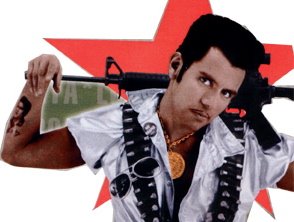
It may be a knock-off, but impersonation is far from simple. Beneath the pagentry and the kitsch lies a more sophisticated art. El Vez, “the Mexican Elvis,” uses Presley’s songs as a springboard, pilfering the music but including his own original lyrics about immigration, political empowerment, and racial dissent. He manipulates Presley as a metaphor of empowerment, superimposing Hispanic culture onto Elvis’ iconic life as the quintessential American Dream. If you can get beyond the cheesy album covers and the fact that he’s “The Mexican Elvis,” you’ll find the same sentiments that resonate through the entire catalogue of highly respected bands like U2.
Knock-offs aren’t always as superficial as they seem. Obviously, there’s much more to a cover band than the derogatory term implies. A cover band is a tribute, a celebration, an homage, an impersonation, a theatrical, a performative art. They represent the real thing, the genuine article. As the Elvis tribute artist, Irv Cass says, “It’s as close as you can come to reality.” In other words, impersonation is the realest fake.
And being this fake is a hell of a lot of hard work. Vertigo USA, a Chicago U2 tribute band, has shelled out its own money to buy gear worthy of Bono and the lads. Vertigo puts on a damn good U2 show. Juggling day jobs, side projects, and families, the band members tour the country on their own dime, because they love the music that much.
There’s something to be said for loving something that much, and I think an integral element of impersonation is that love, of either the music or the icon. Openly and loudly and unabashedly—regardless of the cultural validity, social acceptability, or the sheer cheesiness of what you’re doing—loving something that much. Because it’s a taxing job, one that demands the vocal skill, musical talent and stamina of a top-notch performer. The cover band is very much a case of tough love.
I interviewed Faux Bono (Alan Lewis) this summer. He didn’t come in character. Watching Faux Bono eating a pretzel, you wouldn’t have thought: BONO! Watching him onstage an hour later, you couldn’t think anything else. Faux Bono’s mimickry of Bono’s moves was without flaw. He clutched his shirt cuffs, thrust his hips, prowled the stage, strutted into the crowd, swaggered across the floor. He’d recently gone from playing Jesus in Godspell to being Bono. But he swore he didn’t have a messianic complex.
Faux Bono’s dead-on impersonation did not come naturally. It took a lot of hard work. The obsession started when he found a rogue copy of Achtung Baby in the bargain bin. From then on, Faux Bono screened U2 concerts, practicing the mannerisms, trotting out the stage moves at kareoke bars. He would snag someone’s sunglasses and sing his heart out. One night, a drunk guy leaned in and said, “Boy! I hope you’re able to do something with that one of these days.” At a Vertigo show, you wonder how he could have possibly done anything else. The kid is Bono through and through.
Faux Bono told me that as Bono, all he wants to do is to make people forget they’re not seeing the real thing. It’s an illusion very much complicated by the fact that Vertigo is, in reality, playing small pubs and bars, not 25,000 seat stadiums. Faux Bono says he gets through it by asking himself, “What would Bono do if he was playing here right now?” Watching him, you wouldn’t guess he had to think about it at all.
Done well, impersonation looks easy. Like modern art, we think: I could do that. Look. Watch me. I’ll do it right now. Truth is, very few of us could. Because we don’t love either the icon or the music that much. We don’t love U2 enough to stay home and drink tea and take care of our voices and practice. We don’t love Elvis’ “Suspicious Minds” enough to fork over our own money for tour expenses and advertising and rhinestone jumpsuits. Like any art—and it is an art—impersonation is demanding and difficult and the only reason it ever looks easy is because the artist is just that good.
Impersonation is deception. Faux Bono is not Bono. Irv Cass is not Elvis. But they almost are. They’re authentically fake. They’ve studied hard. The sugary Memphis drawl of Irv Cass lulled my thoughts back to sticky southern summer barbeques along the mighty Mississippi. It was a drawl so lilting, so smooth, so velvety, that it was shocking to know it came from a Detroit native.
But we overlook the deceit. I’ve seen two separate Neil Diamond tributes. One Faux Neil even carried on stage-banter about his “good friend Barry Manilow” before breaking into a cover of “Mandy.” Yes, a Neil Diamond cover band covering Barry Manilow’s “Mandy.” So meta. And no one stood up to accuse Faux Neil of being an evil liar and duping us all. We didn’t feel cheated that he didn’t really know Barry and that he might not even know a Faux Barry, because it’s implicit in the cover band viewing contract that there will be a pretty significant suspension of disbelief. And we were cool with that. We knew the rules.
Impersonation is inevitably a failed deception. Despite the effort at verisimilatude, there’s no escaping the fact that masquerading as another band or another person is an obliquely fake enterprise. This falsity is most often betrayed by anachronisms, which are, in turn, largely responsible for the fundamental kitschiness surrounding cover bands. Elvis died at 42, Irv Cass is now 53. Faux Neil, the dear friend of Barry Manilow, was decked out in glittery scarves and low-cut blouses, but sang accompanied onstage only by the saddest of boomboxes. Even Vertigo’s U2 tribute, of which I’m an ardent fan, is a little off. Sometimes Faux The Edge is dressed in Joshua Tree-era garb, while Faux Bono is decked out à la Zoo TV. So impersonation is not perfection. And that’s the one thing that those who can’t handle the kitsch will be the first to point out. That people no longer love “Mandy,” jumpsuits are not cool, and Elvis is dead.
But, ultimately, it’s the imperfections that are most interesting within cultural artifacts: the dissonance between interpretations, the stories we believe that turn out to be untrue. It is the fictions that best capture the overarching values and dramas of the society that created them. We can only see so far on our own, while fiction affords a sweeping, panoramic cultural view. Cover bands are a living interpretation of a cultural icon. The impersonator captures the sound, movements, and image of the icon, even after the individual behind that image has long since passed away. It’s tableaux vivant for the modern age.
To me, the most fascinating element of impersonation is that process of deceiving to recreate a reality or an image. Because in reality, if we deceive, we are condemned. What is acceptable on a stage will not be tolerated in life. And yet, we all pretend. To an extent, we are all fictitious, we are all performing. We pretend through friendships, marriages, careers, hope and fear. We pretend we’re happy when we’re sad. We laugh when we want to cry. We remain silent when we want to kick and scream. But unlike impersonators, we are not onstage. We are real, the impersonators are fake. And somehow they seem more honest.

 an alarming life