just like us

(21 may 2009)


i can no longer afford tabloids. yes, at long last, the economic downturn has hit home.

mind you, this does not imply that my financial fortunes, meager though they may be, have changed. just that magazine wholesalers have gone the way of the dinosaurs and the us weekly subscription that was once two years for $12 is now a preposterous $79.99 for one.

thus, an experiment upon which i embarked years ago comes to an end. you see, back in my naive youth, i had the noble idea of subscribing to various gossip magazines for the specific purpose of charting the development of characters, plots, archetypes, etc. over the course of several years and across different publications. i did this in the name of Research, knowing full well that i would enjoy it very much.

because tabloids, they are of the devil.

i knew this. i’d read irving schulman. i’d interviewed readers. i knew what i was getting myself into and i did it nonetheless.

i sensed there was trouble brewing sometime in early December 2006, when the InTouch screaming “NICK & JESS BUST UP!” landed at my door two days after i was dumped and the article on how jessica simpson was drowning her sorrows in six-packs of zima hit entirely too close to home.

it is never good when the advice of a “medical expert who has never treated her but is familiar with her case” resonates.

so as a rational person, i know it’s not an entirely bad thing that the tabloids are leaving my life. it’s probably even for the best. i should not relate to jessica simpson. i should not know jennifer aniston’s hair-dresser’s name. nor should i know the precise age of everyone in the public eye. but how to prepare for this life-change?

because it is a life-change. 6 years of tabloids. 312 weeks. sure, there were a couple dry spells here and there. lapsed subscriptions. issues that got stuck at the post office and were delivered five weeks late. but still. tabloids are what thursday is for.

so i steeled myself for that first thursday when us weekly would not come.

that thursday came this past thursday, when i opened my mailbox and was greeted by emptiness. it was sad, but i totally took it like a man. i even boasted to friends that i’d survived my first week without us weekly, like this was a triumph on par with brokering world peace.

stupid girl, i flattered myself that, in a mere week, i had totally kicked tabloid addiction’s ass.

the next day, my mailbox yielded what proclaimed itself to be the LAST ISSUE. the official final us weekly, with the “we’ll miss you” and everything.

and my first thought, my only thought was– much like when rose jumped out of the lifeboat and ran into jack’s arms– oh, thank God. i wasn’t ready to let you go.

long-forgotten fairytale

(31 october 2006)

once there was a lovely girl. your standard, average, lovely girl. we’re going to call her penelope. because that’s such an every(wo)man kind of name.

as a child, penelope was a commedienne. she was the queen of faces. a student of the lucille ball school of comedic facial distortion. her parents always admonished, someday your face will freeze like that. penelope did not believe them.

as a child, penelope was rather high-strung. she bit her nails nonstop. the warnings of her grandmother rang in her ears: there are worms under there. do you want to put worms in your mouth? penelope did not want to put worms in her mouth, but she didn’t want to give up the biting either.

the habit would persist into adulthood, when penelope would begin painting her nails garish colours in an effort to cease the barbarism. penelope’s mother frowned at the black lacquer. she said, you don’t want to get black stuff all in your teeth. penelope didn’t relish that idea, but she didn’t give up her nails.

penelope continued making faces and painting her nails and biting them. until one day.

on this day, penelope bit a black lacquered nail. sensing immediately that something had gone horridly wrong, penelope raced to the bathroom mirror. there it was. a rogue flake of nail polish on the number 9 central incisor. a simple thing to remedy, yes. but no.

this rogue flake of black nail polish had not been content to simply rest upon penelope’s number 9 central incisor. rather, it sought refuge within the gum tissue above. so that it was visible through the tissue yet entirely unreachable.

penelope promptly brushed her teeth. the rogue flake of black nail polish nestled within the gum tissue above her number 9 central incisor did not budge. she flossed as though her life depended upon it. if anything the rogue flake of black nail polish situated within the gum tissue above her number 9 incisor situtated itself more comfortably. penelope brushed her teeth six subsequent times to no effect.

she threw herself on the bed in exhaustion and frustration. and then it hit her.

penelope would go through the rest of her life with a rogue flake of black nail polish situated within the gum tissue above her number 9 incisor. as long as she lived, people would think she had something stuck in her teeth.

at all future christmases, penelope’s family would harken back to the days before that rogue flake of black nail polish became situated within the gum tissue above her number 9 incisor. the family photo albums would now be divided into the era before the rogue flake of black nail polish became situated within the gum tissue above penelope’s number 9 incisor and the era after. if penelope were so lucky to find a man who could love a woman with a rogue flake of black nail polish situated within the gum tissue above her number 9 incisor, the rogue flake of black nail polish situated within the gum tissue above her number 9 incisor would inevitably dominate her wedding pictures. every dental visit for the remainder of penelope’s life would prompt a gasp of what is that rogue flake of black nail polish situated within the gum tissue above your number 9 incisor? when her husband stared deeply into her teeth rather than her eyes, penelope would know- the rogue flake of black nail polish situated within the gum tissue above her number 9 incisor was driving a wedge between them. the adolescence of her children would be marred by the rumors that their mother never brushed her teeth. and penelope had no doubt that her future husband would leave her for a woman who did not have a rogue flake of black nail polish situated within the gum tissue above her number 9 incisor.

all this because penelope was a lovely girl who did not care whether her face froze or whether she put worms in her mouth.

lying on the bed in exhaustion and frustration, with the rogue flake of black nail polish still situated within the gum tissue above her number 9 incisor, penelope ruminated upon this tragic turn her life had taken. she instinctively went to her nails for solace, then detoured and grabbed the bag of fritos instead. she wiped her tears and bravely returned to the bathroom mirror to make peace with the rogue flake of black nail polish situated within the gum tissue above her number 9 incisor. but the rogue flake of black nail polish situated within the gum tissue above her number 9 incisor was no longer there.

penelope pulled a face and put the worms in her mouth.

and lo! we reuned

(2 june 2007)

our graduate school experience was very unique. or at least that’s what we MAPHers tell ourselves. for 9 months, we ran ammuck, dabbling through all the “humanities”- whatever the hell those really are. most graduate programs have 10 people. there were 100 MAPHers. there was The Core. there was always an open bar.

on friday night, lara and i ventured out into the pouring rain to the MAPH fifth anniversary reunion. we were soaked and we were none to thrilled. as we climbed the steps, she whispered, “i don’t want to do this.” “do what?” i asked. “what we’re doing right now.”

but did it we did. and thank God.

because had we not, i would never have balanced precariously atop tortoiseshell heels in the middle of the tasting room in a wet pink silk dress and had a most enlightening conversation with sensei.

nothing compares to the university of chicago alumni magazine. it’s like an AARP mag edited by louis menand. i had mistakenly believed the highlight of the may/june issue to be the supplemental publication devoted to the “living legacy” of The Core curriculum- a legacy typified by the cover girls, who sit among the stacks of the regenstein library staring at computer screens with what can only be described as expressions of apathetic doom.

i laughed and thought, that’s a fan-freaking-tastic summation of u of c life, and went on with my day. i didn’t even bother to check out the actual alumni magazine, CHICAGO. its cover was dominated by an unappealing ed asner clone hunched awkwardly over a hanging file. not exactly gripping so i blithely tossed it into the pile of tabloids and time outs.

because of this, i very nearly missed the tiny wonder that lay between pages 8 and 9. the tiny wonder that pointed out as i balanced precariously atop tortoiseshell heels in the middle of the tasting room in a wet pink silk dress. what tiny wonder, you may ask?

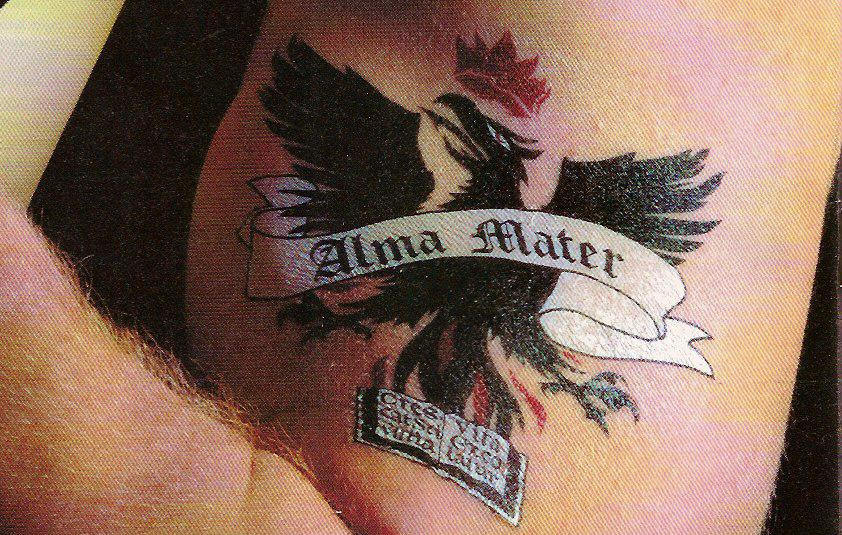
the temporary university of chicago alumni tattoo.

because yeah, everyone at the u of c has biceps like that.

fight club

(4 august 2008)

PART ONE


Just how awesome are literary throw-downs? That is the question. Because, really, literary throw-downs are effing unbelievably awesome.

Maybe simply because the centuries have afforded us so very few. We’re more accustomed to catty quill fights—Marlowe versus Shakespeare. Rimbaud versus Verlaine. Capote versus Vidal. Swell in their own right, yes, but bona fide, fisticuffs-and-all frays are few and far between. And infinitely awesomer.

On March 26, 1964, when Robert Kennedy’s office announced that the Kennedy family had anointed William Manchester to write the authorized account of the death of J.F.K., the Senator probably didn’t realize he was stepping into the ring for one of the greatest literary smack-downs of all time. It was an honest mistake. Hear the name Bobby Kennedy and bibliobrawler probably isn’t the first word that jumps to mind.

A former foreign correspondent for the Baltimore Sun, William Manchester seemed convivial enough and his greatest selling point was that he had written Portrait of a President, an idolatrous account of John Kennedy’s early presidency. The Kennedys always appreciated people who knew how to play the game, and back then Manchester had acted the dutiful courtier— submitting all proofs to the President’s press secretary and awaiting approval from the President himself before proceeding with publication.

Later, Manchester would consider his prior docility with the Kennedy administration the motivating factor in his appointment as authorized family scribe: “I think [Mrs. Kennedy] picked me because she thought I would be manageable.” He would be anything but.

Smart people sometimes do exceedingly stupid things. That is the only explanation for why the family would embark upon the literary equivalent of an autopsy to begin with, much less do so wielding little more than a flimsy contract whose most concrete sentiment was that the book could be released immediately or maybe later or maybe not at all. Such ambiguity guaranteed misunderstandings in the absence of stellar communication, and everyone was simply too busy and too emotional to be fully engaged.

They were going to a street-fight cloaked in gold lame. Manchester was sporting steel-toed boots.

Ultimately, the Kennedys and the author held fundamentally different views of what the book should be. Manchester wanted to make “a genuine contribution to history” and, presumably, some small donation to his bank account. Jacqueline Kennedy wanted a historical record— in no way sensational, in no way exploitative— as she later told Manchester, to be “bound in black and put away on dark library shelves.” It was, after all, the story of her husband’s death. Not exactly something she wanted on coffee tables all over the world.

William Manchester had once declared John Kennedy “the personification of most American’s daydreams,” and in revisiting the President’s murder, he was reliving a national nightmare day after day. After what Manchester later characterized as “three years of agony,” he completed the 380,000-word manuscript, writing Robert Kennedy: “I felt as though I had emerged from a long dark tunnel.”

All the interviews the author conducted were emotionally disturbing, but none more so than those with Mrs. Kennedy. Fueled by daiquiris and cigarettes, the pair talked late into the night.

At the time, historian and Kennedy family friend Arthur Schlesinger, Jr. was collecting oral histories for the Kennedy Library. Rather than subject Jacqueline to such an emotionally harrowing experience twice, Manchester conducted both the interview for the library and for the book simultaneously. Jacqueline believed the tapes would not be made public during her lifetime. Schlesinger told her to be as forthcoming as possible because she “was making a deposition for the historian of the twenty-first century.” In response, she was shockingly candid. Manchester himself admitted: “She had withheld nothing . . .”

Once the book was completed, it proved impossible for the family to read. Robert Kennedy tried on several occasions but barely finished the first few pages. His wife, Ethel, reportedly read portions at some point. Jacqueline sat on the sidelines, awaiting the go-ahead, assuring Manchester that she would eventually read it, “After R.F.K. and Evan Thomas have gone over this manuscript [. . . ] whenever they think I should.”

Thus, the task was delegated to assorted Kennedy minions. Evan Thomas (Manchester’s publisher), John Sigenthaler, (Robert Kennedy’s former administrative assistant) and Ed Guthman (editor of the Los Angeles Times), were summoned and given the mammoth job of taming the beast.

And tt was quickly apparent to all that there was much to be tamed. Sigenthaler and Guthman immediately pressed for 111 editorial changes and the removal of several viciously anti-Lyndon Johnson passages.

The primary criticism was that, in his fawning reverence and dewy prose, Manchester’s Kennedys were cardboard, albeit glittering, characters. Jacqueline is cold, detached and, after her husband’s death, almost macabre in her role as a master of funereal etiquette, while Kennedy— with his sore back and staid majesty— seems to have a foot in the grave the minute he first strides into the Texas sun.

Ironically, the venom that colors the portrait of Lyndon Johnson renders him the liveliest character of the lot. The Vice President, though villainized, is the one you remember. This was not how it was supposed to be.

In reality, no book could have measured up to the Kennedy camp’s expectations. It was far too early for any account of the President’s death, much less a sprawling historical narrative. As Time later noted, “What nobody seemed to take into account is that the assassination is still so fresh in people’s memories and has left so many exposed nerve ends that any painstakingly detailed, step-by-step retelling is premature at this point.”

To the Kennedy readers, Manchester’s effort to capture the whole “tragic sweep of that entire weekend” hit all of these nerves, most directly by obscuring the man himself. John Kennedy, though the impetus for the book, was not its focus and that was unacceptable.

Guthman, Thomas, and Sigenthaler all agreed there were serious problems with the manuscript, but they withheld the full extent of their misgivings for fear of the psychologically devastating impact upon the author.

According to Sigenthaler, Thomas suggested that Manchester had become increasingly unstable: “[Thomas] would say, ‘There’s no question but that he’s seen that [Zapruder] film seventy-five to a hundred times and if you’d seen the President’s brains fly that many times then something would happen to you, too.”

Even if Manchester weren’t mentally disturbed at this point, the Kennedy aides began handling him as though he were. Rather than speaking with him directly, they pussyfooted around, employing intermediaries, in essence turning the project into an elaborate game of “Telephone,” which only added further confusion to the cacophony.

The reviewers were pissed, but they had not dismissed the idea that the book could be published by year’s end. They thought that through extensive revisions Manchester’s manuscript could be brought back in line with their vision of what it should be.

The announcement that Jim Bishop’s The Day Kennedy Died would be published in the fall of that year left everyone quaking in their boots and lent the project a renewed sense of urgency. Manchester, who had been living off a small advance from Harper & Row, was understandably eager for events to move quickly. He had been told to expect a telegram from Robert Kennedy that would allow the publication process to go forward. Under the impression that a telegram of approval was forthcoming, Manchester began taking bids for magazine serialization.

Senator Kennedy knew serialization was Manchester’s only source of profit and had indicated to others that he would stay out of the negotiations. He simply stated a preference for Look over Life, which had recently published several articles critical of him, and left it at that.

There was a lingering fear that the project would be tainted by the slime of opportunism. To that end, the Kennedys had made it clear from the first that all profits from the book were to go to the Kennedy Library. There was to be no hint of exploitation here.

In a letter written to the Senator, Manchester reiterated this, crowing that he would have full editorial control over the serialization regardless of which magazine won the rights: “I’m holding the line on control of text and layouts, and, in fact, there have been no recent protests about that. I can guarantee you that it will be handled with not the faintest tinge of sensationalism. I can guarantee it because I’m the man who will be making the decisions.” He didn’t comprehend that with the magazines entrance, he would ultimately forfeit everything.

As bidding heated up, Manchester cooled his heels awaiting the telegram from Robert Kennedy. None came. Which didn’t matter much since no one really knew what the telegram would mean.

After a series of conversations on July 14th, the significance of the forthcoming note was only further muddied. According to Sigenthaler, Thomas had suggested the Kennedys send a reassuring telegram to the worried author. Thomas himself said he thought the telegram would say the book would be published that year rather than 1968. In contrast, Manchester emerged with the belief that the telegram would indicate a blanket endorsement of the book. Three men, three different stories. Still no telegram.

On July 27th, Manchester panicked, calling the home of Robert Kennedy’s secretary and begging for the letter he had been promised. Angie Novello summarized their conversation in a detailed memorandum to the Senator, noting that Manchester hadn’t “slept in 3 nights worrying about that letter.” Later that day, Robert Kennedy wired Manchester:

While I have not read William Manchester’s account of the death of President Kennedy, I know of the President’s respect for Mr. Manchester as an historian and a reporter. I understand others have plans to publish books regarding the events of November 22, 1963. As this is going to be the subject matter of a book and since Mr. Manchester in his research had access to more information and sources than any other writer, members of the Kennedy family will place no obstacle in the way of publication of his work.

This was what Manchester had been waiting for. Approval. The following day, he sold the American rights of The Death of a President to Look magazine for $665,000—at that time, the highest price ever paid for serialization. Instantly, the “no commercial exploitation” myth that had sanctified the project was besmirched.

In defense of the hasty contract, Manchester later explained to an interviewer: “When I saw ‘members of the Kennedy family will place no obstacle in the way’ of publication of the book, I thought it was all over.” It had only just begun.

It had always been Manchester’s belief that R.F.K. was acting as his sister-in-law’s representative. When the author approached Jacqueline Kennedy’s secretary, Pamela Turnure, with a copy of the manuscript, Turnure brusquely told him to “work through Bob, who is representing [her].” From then on, Manchester assumed R.F.K.’s approval was Jacqueline’s. Little did he know.

In late July of 1967, Jacqueline, who had not yet seen Manchester’s manuscript, returned from a Hawaiian vacation to find an effusive letter from the elated author in which he touted an “approved manuscript.” She had approved nothing.

At a cocktail party on July 31st, when Robert Kennedy informed her of the serialization and how much Look had paid for the rights, the shit hit the fan.

Faced with the imminent publication of a “highly personal account, an emotional retelling of the assassination,” Jacqueline, working through Turnure, supplied Manchester with a memorandum of passages to be revised. The list included at least 25 areas that would require substantial revision and also recommended that the book needed a new, less emotional tone— all fundamental textual problems that would require a ton of time to fix.

There was a sense that the situation was controllable so long as it revolved primarily around financial matters. To this end, Harper & Row hatched an elaborate plan in which Manchester would grandiosely divert a portion of the Look profit to the Kennedy Library and would be reimbursed on the sly by the publishing house so that there would not be publicly scene as having profited from the project.

On August 12th, during a tense flight from New York to Washington, Evan Thomas rehearsed his author on a speech to the Senator. Things quickly fell apart when, upon entering Robert Kennedy’s hotel room, Manchester, ever the poppycock, deadpanned, “I guess we should be facing each other with dueling pistols and swords.” With that, the meeting was effectively over.

The press would only further complicate matters. In early August, Evan Thomas alerted Robert Kennedy that Homer Bigart of the New York Times was poking around in the book and serialization deal. They knew it would just be a matter of time before the rest of the press came knocking.

On August 10th, Robert Kennedy cabled Thomas: “Under the present circumstances, with the situation as difficult as it is, I feel the book on President Kennedy’s death should neither be published nor serialized. I would appreciate it if you would inform Bill Manchester.”

In sending the telegram, Kennedy took a major political risk. He was censoring the author he had appointed himself, a situation that looked not only foolish but faintly unconstitutional. But his motivation was clear– Jacqueline Kennedy was raising hell…

© faith e.

(citations available upon request)
time after time

(8 april 2009)

i’ve been watching saved by the bell in the mornings lately. primarily because every episode has been seared into my brain, thus obviating the need to wear contacts or glasses. but i was struck by something today.

how devastating is zack and kelly’s breakup?

you know, the one where they sit on the picnic table outside the costume ball while slater and jessie (I’M SO EXCITED!!!) spano lip-sync that sad, sad michael bolton song about how can you possibly go on living when the person you love no longer wants you.

let’s think about that for a minute, because that is awful.

a truth the gravity of which i think we were spared in our youths because saved by the bell unfolded largely outside of time.

most of us grew up with it in syndication (tbs from 3:05-4:05 and wgn from 4:00-5:00) so we’re accustomed to the patchwork sequencing. slater and zack would be best friends at 3:05 and then the knives would be out come 3:35. zack and kelly were dating one hour then just friends the next. tori was everywhere and then she wasn’t. and at 4:30 zack would kiss lisa, something no one would ever mention again.

since it was a show set outside any logical order, it’s appropriate that the dvds reflect a similar chronological disarray. there, the episode of zack coping with the kelly breakup actually precedes the breakup itself. which is nice in a way, because watching them break-up, you already know that, after acting out with screech’s strangely attractive cousin and getting a lecture from the gang, zack will recover and he and kelly will reunite as friends at lisa’s birthday party and zack will admit that the college guy kelly dumped him for is actually kind of cool.

it is when you make the sadistic effort to watch these episodes in logical order that you realize how completely ridiculous an interpretation of a post-breakup this really is.

because this is an awful breakup.

they are sitting on a picnic table in full elizabethan dress. because kelly’s parents apparently practiced the rhythm method and consequently have 800 kids, kelly couldn’t afford to buy a dress of her own, thus, she is wearing a dress that zack has bought her and which, in a surprising touch of realism, exposes way more bosom than is probably right for a saturday morning kids show. her breasts seem to be taunting him as he, in a move that seems the final emasculating blow, wears tights- tights!- for her and yet still she has just called him by the name of another man as they win the bayside equivalent of Couple of the Year.

as if that weren’t devastating enough, as they sit together on the picnic table, serenaded with the lyrics “how am i supposed to carry on/when all that i’ve been living for is gone,” zack asks kelly for a last dance

ouch, my heart.

of course, zack morris would do this. because zack morris could be nothing less than a gentleman. he would have to do the honorable thing.

but i like to think there’s an alternate universe. one where kelly goes out dancing and catches jeff the douche with a college girl and realizes she made a horrible mistake.

but then, that can’t happen now. that happened eight episodes earlier.

Review: Black Sun

(5 march 2007)

Upon its initial publication in 1976, Geoffrey Wolff’s Black Sun: The Brief Transit and Violent Eclipse of Harry Crosby was dismissed by The New York Times as “a three ring circus of scandal and anti-social behavior.” Perhaps the Times was right—but, seriously, what a show.

The nephew of the bazillionaire J.P. Morgan, the eccentric poet Harry Crosby scandalized Boston society by marrying a divorcee and fleeing to Paris to establish the renegade Black Sun Press. He flirted with Romanticism, Decadence, and Surrealism only to settle for a combination of narcotic experimentation and sun worship vividly manifested in wretched verse: “The Sun! The Sun! / a fish in the aquarium of sky.”

A “minor” poet, Crosby ran with the “major” literary figures of 1920s Paris. He drank with Hemingway and Cummings, published Joyce and Lawrence, pissed off Wharton, and was eulogized by Eliot and Pound. He was the quintessential dabbler—manically tarting his writing in every available shade of literary dress. According to Wolff, “during five working years Harry duplicated a century of complicated aesthetic traditions.”

And what better way to conclude such an earnest, unimaginative career than with a typically clichéd bang? In December 1929, the thirty-one year old married Crosby was found shot dead—his toenails lacquered red and his feet tattooed—alongside the corpse of his married girlfriend and with a letter from another woman in his front pocket. Contemporaries considered Crosby’s murder/suicide his best poem. Wolff considers it his final literary experiment.

Wolff’s background in fiction and his narrative approach to biography lend Black Sun the feel of a splendidly executed novel, which is appropriate given the performative nature of Crosby’s entire life. Though Wolff is clearly fascinated by Crosby, he knows his subject is nutters and he’s astute enough to capitalize upon that as Crosby’s greatest charm. It’s a shrewd move, and Wolff’s snide jokes and witty asides strut memorably alongside Crosby’s maverick conformity and appalling verse.

Though the 2003 edition of Black Sun features no textual changes, Wolff includes an intriguing new afterward. Responding to the question “Why [write about] Crosby,” he explains his interest in this man who was reduced to a footnote by most 20s scholars. Wolff rejects Crosby’s reputation as a Lost Generation archetype and finds him interesting simply because “What Crosby said he’d do he did, exactly.” He was “not merely some posturing dandy of the boulevards. He acted everything out—everything; there was no lag for him between thought and experiment.” Crosby’s shoddy, suicidal poetry made his intentions quite clear.

Harry Crosby is not an important literary figure. He was, after all, only famous by association and his own poetry never developed beyond the subject matter of adolescent angst. But, as Wolff admits and Black Sun proves, there is “something about [the poem’s] very badness”– something about Crosby’s very badness– that is haunting: “Like Icarus, of whom [Crosby] wrote, he flew toward the sun till it melted his wings of wax [ . . . ] unlike Icarus, however, he was forewarned.”

Geoffrey Wolff, Black Sun: The Brief Transit and Violent Eclipse of Harry Crosby. New York Review: NY, 2003.

tall, dark and deadly

(24 june 2010)

my beloved dear friend lara ehrlich has written a book. a phenomenally wonderful and amazing book. and when we gathered last weekend to review over mimosas and tots, i had one word of caution- that she needed to consider the book’s message about women and violence. because in a dark, dark book, that seemed to me the darkest part.

i said that then and i’m not so sure now. because i was thinking, at the time, only of the parents and the press. never once did i worry about the kids. because i think kids should be allowed to read whatever they want. and i think writers have an obligation to their young readers to- for lack of a less melodramatic phrase- take them into darkness.

because this is where we learn our lessons. these books of our youth.

i began reading sweet valley high at the ripe old age of nine. when, after a 4th grade field trip to the atlanta zoo, a friend handed me a copy of #7: dear sister.

knowing nothing of the motorcycle accident in #6: dangerous love that had put elizabeth wakefield into a coma and caused her amnesia and personality change in #7, my enthusiasm was largely motivated by a discrete notation in the front of each book announcing that it was intended for “age 12 and up.” i had been secretly listening to madonna’s true blue for months, but reading SVH three years before it’s publishers had deemed suitable seemed spectacularly more rebellious.

spurred by the same nostalgia for the recent past that inspired me to re-watch the entirety of dr. quinn and weep violently at nearly every episode’s astonishingly hokey yet unbearably heartwarming end, last summer i returned to sweet valley high. and like a reunion pre-facebook, i was shocked to the core by how everyone had changed.

the emotions and dramas of youth seem so indulgent when one knows how seldom high school relationships pan out. but the wakefields, they do not know this. and so by page 49 of #1: double love, jessica is crying “tears of angry frustration” and 66 pages later, even perfectly pulled-together elizabeth is “filled with despair.”

by the time #5: all night long– in which jessica stays out ALL NIGHT LONG with an older (read: 19) mustached man- rolled around, i realized my under-aged self had, to some extent, been oblivious to the dark side of sweet valley.

yeah, yeah, elizabeth is in an accident and tricia martin dies of leukemia, but what i absolutely did not remember was how terrible some of the boys were and how violent were their ends.

for instance, good old john pfeifer. in the awesomely titled #90: don’t go home with john, lila goes home with john and is nearly raped. but then john dies…

ronnie edwards, the first boyfriend of elizabeth’s bff enid, is characterized on wikipedia as “a highly scheming and very selfish troublemaker.” but then an earthquake hits sweet valley and he dies…

liz’s friend luke lives in london and is- inexplicably- a werewolf. until he dies…

poor jessica’s boyfriends fare the worst. sam woodruff is in a drunk driving accident. christian gorman is in a fight with kids from a neighboring school. inevitably, both die.

[dear wikipedia, thank you for having a surprisingly extensive sweet valley high listing and The Greatest Plot Summary Of All Time- “#122. A Kiss Before Dying The feud between Palisades and SVH reaches a deadly conclusion when Christian Gorman is accidentally killed, and Jessica wins the surfing contest.”]

in the face of all this death and squandered youth, i- like carrie bradshaw- couldn’t help but wonder… what does this mean? the fact that i loved a series of books in which- aside from todd wilkins- the recurring male characters who escaped violent death can be described as an “often drunk bad boy,” “a handsome jerk who was disliked by almost everyone,” and “a rich, handsome snob”?

ultimately, i’m pretty sure it means nothing and is useful only as an indicator of how uninterested i was in boys at the time and how much that has changed now.

because it was for different reasons that francine pascal’s sweet valley high was the most significant literature of my young life. namely, #40.

#40.

on the edge.

wherein regina, the deaf girl who just moved to town and had surgery to restore her hearing, is dumped by her boyfriend, gets in with a bad crowd, overdoses on cocaine and dies.

i was a deaf girl.
i had just moved to town.
i’d had surgery to restore my hearing.

O.M.G.

i didn’t know it then but this would be the penultimate reading experience of my life. the ribbonless typewriter in extremely loud and incredibly close and the last three pages of the knight of maison-rouge were almost as impactful but only almost. and, really, nowhere near.

because nothing is ever so fresh or scary or vivid as when you are young and don’t yet have the words for it. when you are experiencing it for the very first time. the only first time. presumably that is why this silly book has stuck with me all these years.

before #40, i had not known i could die.

“i’m not ready. i have no makeup on… but things are getting better!”

(21 may 2006)

three nights ago, after much hoopla and an unprecedented “very very long wait” on netflix, i made some fry rye, kept the diet cokes coming, curled up on the red couch and prepared to be dazzled. at long last i saw grey gardens. and now i know: this is the film they show in hell.

it’s a “cult classic.” apparently people in artsy circles laugh over and love this movie. in the special features, there’s todd oldham beaming as he joyously recalls his first 15 viewings. but beneath the camp, lie extremes of familial desperation and devotion on a tragic, alarmingly intimate scale that nearly sapped my will to live. as the mayles brothers’ cameras follow little edie’s fishnet clad legs up the darkened, trash-filled stairwell- the cats scattering out of her way- it’s hard not to remember but for a twist of fate, this could be your grandmother, your aunt, you.

i don’t exactly relish stark portraits of explicitly female eccentricity- most especially in documentaries. we’re supposed to laugh and be charmed but it’s not particularly charming or funny. feminine regret is even worse. it’s fatal. everything you live through makes you you, as you are today. even the accidents, the bad choices, the things you did as well as the things you didn’t. everything. it falls together into you.

grey gardens is an unflinching hour and a half of two women trapped alone together in regret. obsessive, oppressive, life-long, inescapable regret. a dramedy unfolding within a decaying mansion drenched in cat pee. fun times.

big edie was once a gorgeous singer. now her voice is scratchy, her glassy blue eyes are dulled by cataracts. little edie wanted to be an actress, a dancer, a star. now she’s little more than a zany caretaker. big edie says little edie made the choice to return to her, while little edie makes it clear she’d rather be anywhere else: “in here i’m just, you know, mother’s little daughter.” out there, who knows what she might have become.

just tacking up a picture, little edie concludes: “i’ve got the saddest life.” it’s supposed to be evidence of her cutting wit, but in light of her self-consciousness- the constant tugging on her headcovering and checking of her cleopatra make-up and primping of her painted-on eyebrows- it isn’t funny. we’re watching a thwarted actress acting her heart out. yet, because she looks incredibly uncomfortable in the camera’s glare, it doesn’t seem like acting. it seems real. which is terribly sad.

but the edies love one another and despite her fierce anger, little edie admits that the woman who just told her “everything is perfectly disgusting on account of you,” is actually “a lot of fun.” she says, “i hope she doesn’t die.” we know she died less than a year later. we know that edie would live on for 26 years. alone. and even with music, art, and dance, in little edie’s words, “raccoons and cats become a little bit boring. i mean for too long a time.”

so just for a glimmer of a moment, grey gardens kind of scared me. i thought: i have a cat! i could easily have 27! i think raccoons are cute! i wear florals with plaids! i’m single! i love my mum! am i doomed? i know i’m not. but the next morning, just after stepping out of the shower and donning pink leopard-print houseshoes, a red kimono, and wrapping my hair in a lime green towel, a telemarketer called. he cheerily inquired, “ma’am, may i please speak with the male head of the household?” alarmed by this unexpected discrimination, i indignantly replied- a little too loudly and in an unexpectedly spitfire tone- “i’m the only head in this household!” and promptly hung up.

i stood there, a staunch woman in a revolutionary outfit, laughing. my cat smiled. in the end, it’s probably worth the very very long wait.

i do not want this

(20 november 2007)

i have this little thing for alexandre dumas. little isn’t quite the right word. enormous literary crush is probably more appropriate.

but i do not want this.

i’m supposed to be having a torrid, raging love affair with mr. shelby foote. we’re fighting the “wawah.” have been since april 2006. having learned nothing from the johnny rebs, i said i’d be through in a couple weeks and the years have dragged on and on and on and we aren’t even to perryville yet. mcclellan’s still sitting on his ass and hundreds more bazillions of men have to die before shelby and i are rid of each other. and that’s only volume 1.

this seemed kind of awesome in the beginning. what with the “rebellion” and the “rebels” and the “war of aggression,” it was all very star wars and there were all these people with fancy names toting sabers, taking hills and commanding cannon-bearing boats. kind of hot. but now, not so much. war’s fine and all, but, really, it lacks glamour. glamour and velvet. and a girl really needs glamour and velvet from time to time.

you know who has glamour and velvet ALL THE TIME? yep. that good old boy dumas. but i can’t be having enormous literary crushes nor dalliances with dumas. shelby foote holds my keeping for volumes 1-3.

but still…

shelby’s dead so he’s not producing much these days, which is only to be expected. most authors cease writing after they die. most authors are mortal. but then most authors are not dumas.

as if it weren’t enough, as if it weren’t plenty that i have this enormous literary crush, dumas couldn’t be content with that. no, he had to go and write another book. from the grave. never mind the fact that he’s been dead for centuries, he had to go and have a long-lost manuscript (because, i ask you, what on earth is sexier than a long-lost manuscript?!) suddenly unearth itself as if by magic. obviously, specifically to torture me.

as was to be expected, it was an enormous manuscript that was subsequently published in an enormous hardback book. and that’s kind of a dealbreaker.

i do not want this.

there are so many reasons why this is not feasible, why this absolutely will not work. why we are doomed- dumas and i and his big-ass book. chief among them the many reading-related injuries i would sustain attempting to balance a 750-page hardback while standing amidst a crowded, careening train.

i do not want this.

but that hasn’t stopped me from visiting it (and we shall have to call it “it” for now because the name is so enrapturing i swoon at the bare mention) in various bookstores across our fine town, just to caress its spine and flutter its pages, teasingly savoring the aura of the anticipated awesomeness therein (because it’s dumas- it will be awesome). it didn’t prevent me from dragging multiple friends over to genuflect before barnes & noble’s dumas section.

nor did it keep me from reading the black tulip and the three musketeers as a distraction, which, in turn, intensified my lust and sent me scouring reviews so that i stumbled across this sentence: “it’s full of melodrama and coincidence, shamelessly studded with every possible romantic cliché and period flourish.” because melodrama and coincidence are one thing, but oh to be studded with romantic cliché. throw in some glamour and velvet and be still my heart.

but i do not want this.

i can live, i must live without meeting the last cavalier: being the adventures of count sainte-hermine in the age of napoleon, though the title make me weak in the knees. i can content myself with shelby. i can wait it out. the interminable 12-17 months before the count sainte-hermine deigns to make his appearance in paperback. that’s plenty of time in which to fight a wawah. i can do this. i will do this.

i do not want this book.

but, by God, isn’t it the sexiest thing you’ve ever seen?

desperate characters

(19 march 2009)

every spring/summer, i become mildly obsessed with historical romances. something about the rising temperatures just sends me running to the pile of petticoat paperbacks.

but i think it imperative we establish a definition.

first and foremost, this is not chick lit.

chick lit involves a young woman living in new york on a salary of approximately $15,000 per year, working as a junior something-or-other at (a) a publishing house or (b) an advertising agency alongside an unrealistically attractive (i) boss, (ii) co-worker or (iii) client whom she initially finds repulsive, but with whom she will eventually fall in love and have mad, passionate sex and a wedding after her (1) burdensome financial debt, (2) past history with her own and/or a sibling’s eating disorder, (3) disastrously ended affair with a richer, older man or (4) success in a theatrical adaptation of a jane austen novel make him fall in love with her. that is chick lit.

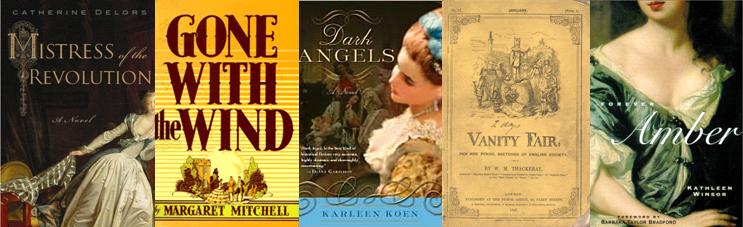
we’re talking historical fiction. by which i also do not mean harlequin romance, but rather the mighty gone with the wind and vanity fair, the epically sexy forever amber, and their less literary sisters from contemporary writers like karleen koen, et al.

like any type of literature, historical fiction has its conventions. the story will require no less than 500 pages. sex will take place in an unplowed field at least once. ribbons, fans, and carriages will abound. there will be dancing and there will be wigs.

but then that just sounds like chick lit in full make-up and fancy dress. and this is not chick lit.

the difference is a matter of character. in chick lit, the protagonists are a product of our times. they are whiny, cloying messes with drinking problems, dysfunctional relationships and credit card debt. i know these people. we don’t hang out.

historical fiction is altogether different. the heroines are peasants or country girls or irish or orphaned. naïve sprites or cunning bitches (it depends) who somehow wind up at the center of everything, be that versailles, restoration london, or the crumbling old south.

unlike bridget jones– who can screw up every interview and still get a job in tv– there is no room for error here. these women have to fight for what they get, have to claw their way through the intricacies of court, through the overthrow of governments, through southern manners and sherman’s army, to survive.

these are girls with real problems. and yes, it’s ridiculous. yes, it’s overblown. yes, there are sex scenes that should probably be read aloud in high school english classes to educate kids on things not to say while having sex and how not to write but, ultimately, this is not about sex or writing. it’s about characters.

there is something more honest here, in these stories of women who have to work to get to where they are. of women who actually want to wind up somewhere different from where they began. i say this as a woman who is often restless and wants to go somewhere. who would like to believe that marriage is more than a means to an end and that there is more to life than weddings and husbands, which is where chick lit usually bids us adieu.

historical fiction is peopled with mistresses, wives and mothers who are characterized not by the men they are with but what they are doing themselves. they are far from helpless. they are often on the run.

it is a genre characterized by a swiftness that belies the fact its members are usually over a thousand pages long.

ambition is seldom a motivation in chick lit. bridget left her job because she slept with her boss. becky bloomwood deals with her problems only after the fact that she has the debt of a developing nation has been exposed to the whole wide world. in chick lit, women wait. they shop. they keep diaries. they are content to bide their time.

in historical fiction, our girl will claw the face of anyone who stands in her way. becky sharpe would’ve. amber st. clare did. scarlett o’hara shot him dead.

and i think that is why i return to these books again and again, silly as they may oftimes seem. because, beyond the heaving bosoms and hiked petticoats, there is extraordinary substance here. hunger and violence, dirt and blood.

these are not the delicate, helpless girls chick lit would have us believe we should be. they are fierce. they are tough. they are women.