heavy lifting

(19 january 2011)

so there was this little while last spring when i was all OMG, i, like, totally don’t have the time to work on jackie in paris, because jackie in paris is going to be soooooooooooo hard and i’ll, like, have to ratchet up the wherewithal to work hard. and that is, like, simply expecting too much.

then, as all times do, that time passed and for a brief shining moment there was a clearly illuminated path of how things were going to go.

i was going to write people letters. people were going to respond to them. and the book that i’d put off all along because it was so difficult was going to be the easiest thing in the world to do.

that clarity lasted about a week. then, as most always happens in cases of clarity, everything was muddled again.

because jackie in paris is, indeed, so hard, in the effort to unmuddle, i have flailed about grasping after anything i can find. essays! blogs! short stories! sex toboggans! huzzah!

i realized today that i am sloppily steering six ships at once.

this isn’t as fool-hearty as it might seem. short stories on sexy dancing provide an effective antidote to the sense of hilarifying fraudulence produced by being an unmarried, childless woman discoursing on the subject of “mothering.” and the amount of reading required to have something to blog about every day gives one a surprisingly odd lot to say outside that context as well.

so there is movement. these are, however, micromovements.

and when every movement is a micro-movement, it’s difficult to gain momentum.

i’m in this writing group. we meet in a bar with paintings of naked famous people on the walls. and so, in the naked lady bar last week, in the midst of what i like to call The Great “Footnotes: Friend or Foe” Smackdown, sensei asked me to take the ring to mordor. to essentially do with jackiebook, ver. 1, what i had originally set out to do, which was to make it a biography about writing biography.

this sounds easy.

it is not.

and yet, as i recently mined through jackiebook 1 looking for topics that would work as stand-alone features, i confronted the reality of how far it still needs to go. and i felt, for the first time, almost ready to pick it up again and push it there.

there is one tiny hindrance.

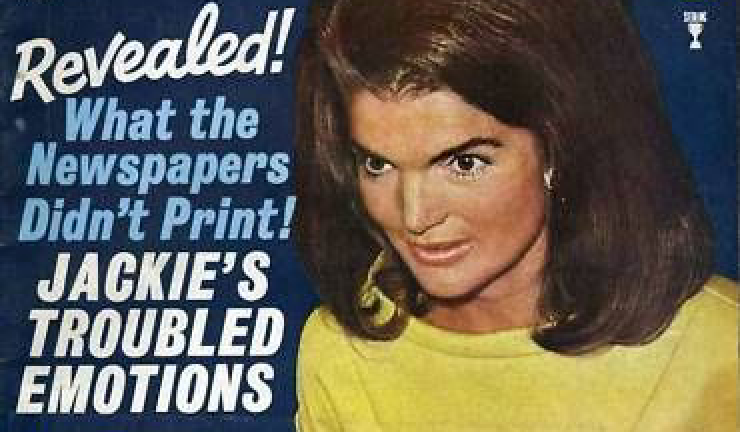
i have not needed the jackie magazines for the last five years. i was done with them and, accordingly, modified my renters insurance policy so they are a part of it and then stuck them away in the darkest corner of the top of my closet in nine boxes that weigh a solid forty pounds each.

the problem is this: i need those magazines. now.

all wrong

(17 january 2011)

i wonder sometimes if i’ve got it all wrong. made up a series of elaborate meanings where there are, in fact, none.

these are the scary days.

on the good days, it makes perfect sense and most days are good days.

gossip is a socially useful device. other people have proven that.

human beings are naturally self-centered. people have proven that as well.

and so, on the good days, it doesn’t seem such a leap to say that human beings take in gossip and apply it to their own lives. it’s only on the bad days that i realize this leap is enormous.

i am standing on a mountain of proven facts shouting something no one else has said. at least not in writing.

i would argue jackie’s was the most significant female life of the 20th century. i would argue the 1970s were the most important years of that life. i would argue that for reasons no one would ever guess and most everything ever published would argue that my argument is wrong.

i don’t really know what to do with that. except maybe shout a bit louder.

breakthrough

(12 january 2011)

i am alarmingly resistant to different ways of thinking. not necessarily in life in general, but when it comes to jackie, i take an extraordinarily limited view and subscribe to the age-old paradigm that one must write a book, find an agent, find a publisher, get published.

this has not worked for me in the past so Lord only knows why i cling to it still.

the problem with this, with the narrowness of my expectations, is that it makes it that much harder to ever get off the ground. there are too many impossibles, too many ifs. and if you never begin, you go nowhere.

for six years, i have been sitting on a book. a book that is written and which contends that jackie is an empty vessel. that she is an icon that encompasses every aspect of the mid-century female experience. a symbol that can take on any set of meanings we want her to have.

i have been sitting on this completed work since june 23, 2005, and i have only just now realized that, with this research, i can write papers on nearly every topic known to man.

jackie and motherhood. jackie and marriage. jackie and religion. jackie and wealth. jackie and racial relations. jackie as advertisement. jackie as self-help. jackie and sex. jackie and see-through tops.

i am only just now seeing i can take this show on the road.

it seems so stupidly obvious now. to be putting into practice the point i have been making all along. and yet, because the word “academic” most often translates as a pejorative, i have held back. i have been ridiculous.

because i have complained time and again that biographers hand down faulty information from one book to the next as though jackie’s story were a handmade quilt with which we must never mess. i have said this is wrong and yet i have done the same thing.

i have the missing piece of a puzzle no one has begun to put together. and i have kept that puzzle unused, unopened and in its original box.

lara said it was going to be the year we get published.

i didn’t believe her.

i was wrong.

here, kitty, kitty

(23 december 2010)

there is a convention of biographers convening in the middle of may.

thanks to some tantalizing press materials, it has long been known that the pre-conference reception will be held at the “washington d.c. home of a prominent biographer.”

the biographical community is fairly small and it’s safe to say that the number of biographers who own multiple homes is infinitesimal. so i was pretty sure i knew whose home this would be and i knew if i was right, then the answer was pretty, to quote lourdes leon, vair vair awesome.

there’s this biographer. she wrote a book about jackie. it has no bibliography and it contends jackie had electro-shock.

thanks to this book, the subject of my biographical quest has been, from the get-go, referred to by my grandmother as “that appalling jackie woman.”

this book is memorable and catchy and all-powerful. it laid the foundational myths that every subsequent jackie biographer has had to go to great lengths to debunk. for this, i should hate this biographer, but i don’t.

for thirty years, she was the only woman writing about jackie. i’ve barely got the balls to say i’m a biographer, but this woman has taken on both oprah and the royal family, bibliographies be damned. there is something to be said for such courage and for that she gets my respect.

when news came yesterday that the pre-conference reception was indeed being held at this biographer’s home, it was a revelation that pleased me much. that is until my father weighed in with a warning: if caroline finds out you’re consorting with such bad characters, she’ll never give up the family treasures.

i have not known what to make of this project from the beginning. it has been simultaneously underwhelming and too big to be believed.

all along, i have been waiting for a moment when what i am doing will suddenly hit me. a moment like this, like when my father reminds me that my actions could have long-lasting effects upon my relationship with caroline kennedy, and i think, oh, so this is for real.

the sexpert

(7 january 2011)

i may or may not be delivering a paper at a conference.

i say may or may not because my acceptance to deliver said paper at said conference was conveyed through a forwarded email from the biography, autobiography, memoir, personal essay area chair that mentioned nothing of my paper but simply stated that i had been “approved” and that she looks forward to seeing me there. since this echoes the sentiments of all people everywhere half-heartedly welcoming visitors whom they do not want, i take it with equal parts salt and hope.

so i may or may not be delivering a paper. a state of circumstances that i am nearly entirely certain is due solely to the fact that the paper i may or may not be delivering has the unlikely phrase “sex toboggan” in its title.

much like my uneasy worldwide affiliation with michael landon’s loins, i do not know if the sex toboggan is something for which i want to be known. principly, i do not know what one wears when positioning oneself as an expert in sex toboggans. and that seems somehow monumentally more important than the fact that i’m not even entirely certain what a sex toboggan is.

sister, sister

(16 december 2010)

i am still writing letters. and, blessedly, getting letters in return. it is a struggle to comprehend that these letters are, in fact, progress. i put that down to the fact that they inevitably arrive in my life at points of extreme banality.

it is 6 p.m. on a tuesday. i am wearing a nightgown and kneesocks waiting on pasta to boil when i notice the sister has written me back.

oddly, it is news that i keep to myself for several days.

it’s a measure of how spoiled i have become that, upon receiving this letter, i assume it is from the daughter. that it is from the sister is somewhat of a surprise.

thanks to the myriad scope of things one reads when searching for the addresses of famous people on the internet, i know that the sister routinely takes upwards of six months to return autographed photos to her fans. since my letter went out into the world sans a zip code and to an unverified location that was an odd conglomerate of an address the step-brother had given me and one mistyped on fundrace.org, i expected that it was being sent forth into an abyss, never to be heard from again. but just twelve days later, here is a response.

a response that says very little, mind you, but a response nonetheless. the only thing of particular note being that the sister says i am right.

i have explained my project to the sister and she has said, “i think you are certainly right.”

while i kind of already knew that- it being generally accepted historical fact and all- it’s a tremendous relief to have it acknowledged. it feels terribly good to be right, for certain.

i immediately imagine how this can be best incoroporated into my letter of introduction.

voilà!

i gently set this letter from the sister atop the pile of important papers on the floor, approximately six inches from the liter box. satisfied, i hike up my kneesocks and take the pasta off the stove.

let’s talk about sex, baby

(6 december 2010)

i am reading baby, let’s play house: elvis presley & the women who loved him. it is written by a woman who is writing about a man’s sexual relationships with women. the book’s central revelation is that elvis had sex with every woman in the western world, except mary tyler moore.

betcha didn’t know that. i sure didn’t.

that’s the problem with reading a lot about one person. you begin to think you know them. and then, after all these years, you read something so shocking, so out-of-character that you realize you never knew them at all. a truth that should be evident all along but somehow isn’t.

my dad talks about this quite a bit. about how you can never really know another person. about how he and my mom have been married forever and yet she shocks him still. like, the fact that she hates mr. rogers.

finding out that elvis bed-hopped is a lot like my mother hating mr. rogers. both of those truths make me want to curl up under an afghan and weep for the state of our world.

they do not make sense. they are impossible to reconcile with what i already know. my mother is a good person. how could she hate mr. rogers? elvis was a good mississippi boy. how could he have possibly had that much sex? (never mind that he was a man who did not bathe.)

i am tremendously skeptical of this skanky elvis business, though deep deep down i know it is likely true. it’s doubly hard to accept, however, because out of all the other elvis biographies i’ve read, all of them written by men, none of them have dealt at length with this. they have focused on his career and his music. they have regarded him as a serious historical figure.

this book is different. it is a woman writing about a famous man and all the action he got, a story underscored with a faint breathy horror that makes it very, very clear that the biographer does not approve.

as a reader, i’m being horribly sexist. i am reading this as a book written by a woman when it should simply be a book. i certainly wouldn’t want someone to be reading me this way and yet, much as i’m loathe to admit it, reading this book has made me only want one thing as a writer. it has made me want to write like a man.

the sister

(17 november 2010)

writing biography is like being blanche dubois. you’ve nothing except the kindness of strangers upon which to rely.

you hope they will remember. that they will talk. to you. that they will not die and take their secrets with them.

i’m writing a letter to the sister. the brother and the sister did not get along and the brother does not have the sister’s address and so i am sending this letter to the sister to an address the brother gave me at which the sister’s daughter may or may not still live in the hopes that it will reach the sister’s daughter who will then pass my letter along to the sister and the sister will then write me back.

that’s a whole heap of contingencies. particularly for a letter on which i forgot to include a return address.

i’ve written the sister before. seven years ago, i wrote her about this very thing. with my letter i included a list of 27 questions, most of them featuring separate bullet points. i pray she does not remember that. at this point, 10 seems a brazen liberty to take with someone’s time.

the sister is endlessly fascinating. she inspires an admixture of slight pity and extreme awe.

i do not expect she will write back. but i’ve gotten rather accustomed to the receipt of famous mail and there’s a part of me that’s getting cocky, spoiled by the people who have written back, even if only to say they don’t remember.

i want her to write back because she’s The Sister and she may have biographically important things to say and blah blah blah.

but mostly, i want her to write back so i can have a piece of paper with that handwriting. the handwriting that is just a few genetic degrees removed from jackie’s, which i know better than my own.

oh yeah.

(8 november 2010)

I am meant to be researching a Jackie book. I forgot this. Like, seriously, for a full week it was wiped from my mind.

I’m pretty sure this would not happen to a real biographer. No real biographer would be so engrossed in writing blog posts for an audience of 12 and reading Cold Mountain that she would completely forget about a project that has been rolling around in her head for the last 10 years.

It is hard not to be discouraged.

Because I need to go to Newport and yet I have no questions to ask once I get there. I have impressive letters. I am authorized(ish). And yet I have nothing.

An email from The Famous Artist’s wife has sat for two weeks in my inbox. They are waiting to answer questions. Sadly, I have none.

I am writing about something about which no one has written. Something no one who was involved and is still alive seems to remember.

I am tempted to call The Brother just to chat. He told me she loved parades. I know her so well and I did not know that.

I have written a book. Way back in 2004. I was 23 and didn’t know any better. I worked all day and would go home and write from 5 to 10. I remember nothing about living in Memphis beyond sitting before a 1999 Dell Dimension XPS T500 and a pile of magazines.

This was back before I had friends and parties and Chicago and wine.

That is why I did not want to do this. Writing is great, but living is so much more fun.

And I wonder sometimes if there is no point.

In 1949, Jacqueline Bouvier went to France. She lived at 76 avenue mozart. She was seen riding a motorcycle. She dated a diplomat’s son. She later said of the experience, “I loved it more than any year of my life.”

This is what we know. And maybe that’s enough.

snapshot


Socialite Alexandra Webb provides the most vivid portrait of Jack and Janet Bouviers’ relationship: “Janet married him because his name appeared in the [Social] Register. He married her because her father operated a bank. She was a bitch and he was a bastard, and in the end both were disillusioned.”

An entire marriage cannot be adequately encapsulated in a pithy paragraph, but Webb’s is an assessment in which the elements that would define the life of the Bouvier’s eldest daughter are all present: society, power, money. This is what she would be born into, a world where, particularly for women, the attainment and the keeping of social status, power, and money were one’s raison d’etre. That was the fundamental lesson to be distilled from the lives of Janet and “Black Jack” Bouvier.

Jacqueline– pronounced Zhak-leen (“rhymes with Queen,” the Kennedys would tease)– adored her father, a dashing rake with matinee idol looks and a year-round tan. He was to have the greatest impact upon her early life, but his influence had a dark side. Black Jack was obsessed with the superficial, profligately spent money he did not have, and was always, always an incorrigible letch. From him, Jacqueline inherited her widely-spaced eyes, a propensity for retail therapy, and an indefatigable love of sexual gossip. At school or social functions, much to his daughter’s amusement, Black Jack would point out the women in attendance whom he had bedded.

Is it any wonder she went on to marry one of the century’s great bed-hoppers? As John “Demi” Gates, an early admirer, later admitted: “She had all the wrong standards, all the wrong standards, and yet she became something very special in spite of this.”

For all his faults, Black Jack lavished Jacqueline with praise. In his memoir of her youth, Jacqueline’s cousin John Davis wrote: “At Bouvier family gatherings it was almost embarrassing to hear Jack extol Jacqueline’s qualities before everyone.” In her father’s eyes, she could do no wrong. This came in stark contrast to Jacqueline’s relationship with her mother.

Janet Bouvier has not fared well with biographers. Thanks in large part to the damning testimony of a former maid, she emerges as little more than a money-grubber, bitch-slapping everyone who got in her way. But, if we’re being objective, Janet was in an impossible situation. With two young children, she found herself married to a broke, womanizing alcoholic. This was not what she had signed up for. After a newspaper published a photograph of Black Jack holding hands with another woman while Janet stood ignorantly by, blithely beaming, the couple separated. After the divorce– a shocking, ostracizing action for anyone, much less a Catholic, in the 1930s– Janet had to solicit financial help from her parents, a humiliating experience for a woman already reputed for her sense of dignity and implacable pride.

A meticulously mannered, socially ambitious woman, Janet demanded perfection from her daughters– particularly her eldest. Janet’s daughter Lee later mused: “I don’t think [Jacqueline] ever disliked my mother as you’ve heard. I think that she was always grateful to her because she felt that she had intentionally enlarged her world– our world– for our sake.” If Black Jack had failed her, Janet would not fail them. She knew the pressures her daughters would face as they grew up in Society and she tried, in her own way, to equip them to meet those challenges, drilling into them, both in words and by example, a belief that would underpin their actions from then on: that, for a woman, financial security was foremost. Janet had been forced to crawl back to her parents and admit her failure. She hoped to protect her daughters from ever having to endure such an indignity by instilling in them an almost pathological fear of penury.

While Janet’s aims were benevolent, her methods were not always kind. Jacqueline’s eerie resemblance to Jack Bouvier inevitably provoked Janet’s temper. The young girl was berated for her “messy” hair, large hands and feet, and broad shoulders, which were perceived early on as liabilities in the marriage game. During the divorce, a disgruntled Bouvier maid testified on Black Jack’s behalf that she had seen Janet hit her daughters. Even Jacqueline’s sister Lee, considered by many to be the family beauty, admitted: “there was an awful lot of criticism.”

By the time she was a teenager, the young Miss Bouvier had absorbed the lessons of her parents—the longing for lovely things, the craving for cash, the need to catch a husband— and established a rigid, protective distance from the world. There were pieces of herself she refused to share, instead retreating into what one acquaintance characterized as “a world of manufactured dreams.” She formed a nearly impenetrable persona, cultivating a seductive, breathy voice that lent her the air of a simpleminded flirt. It was a convincing act, but the stage whisper hid an archly intelligent, imaginative woman.

Acquaintances do not recall Jacqueline as warm and friendly, but the words “sympathetic,” “understanding,” and “thoughtful” crop up with surprising frequency. A picture emerges of a gentle, tenacious girl, both deeply sensitive and alarmingly tough. A classmate later recalled, “She was so striking. She had such a spirit, such a dignity, and a bearing, and a feeling, that while none of us would come up and speak to her, we all knew who she was.” She would go on to attend Vassar, spend a year at the Sorbonne, tour Europe twice, graduate from George Washington University, win and decline Vogue’s prestigious Prix de Paris prize, and land a job as the “Inquiring Photografer” at the Washington-Times Herald. All by the age of 23. It was a daring route: “For a young woman of our background and time,” recalled Jacqueline’s friend Vivian Crespi. “It was still considered almost revolutionary to go to college, let alone have a career.”

Jacqueline did all of this and yet, still she was floundering. On January 21, 1952, the Times-Herald reported Miss Bouvier’s engagement to John Husted. Before the engagement was even announced, she had doubts and began distancing herself; by March, the couple had split. She later admitted, “I knew I didn’t want the rest of my life to be [in Newport]. I didn’t want to marry any of the young men I grew up with– not because of them but because of their life.” She did not know what she wanted and such reflections belied the increasing pressure to marry and to marry well. In the intervening years since the Bouvier’s divorce, her father had only suffered further financial losses, and since Janet’s remarriage to Hugh Auchincloss, Jacqueline was merely wealthy by proxy. She had no money of her own.

Though Jacqueline’s choices up to this time—college, travel, a newspaper job—had diverted from the typical debutante trajectory, in the end there seemed to be but one path. No matter how long she deferred it, she had to marry and she would likely marry someone from her class. But, as evidenced by the busted up Husted engagement, she would not settle. She wanted excitement and adventure and love. And she had already set her sights on someone else.

Congressman John Kennedy had casually entered Jacqueline’s life a few times before. In a 1948 letter, penned on a bumpy rail car, the Vassar sophomore wrote home that a “tall thin young congressman with very long reddish hair, the son of a [former] ambassador” had been insistently flirtatious with her. It would be the spring of 1951 before John and Jacqueline were finally introduced at a dinner party hosted by Charles and Martha Bartlett. The Bartletts hosted another party on May 8, 1952, which both Jacqueline and John Kennedy would cite as the advent of their relationship. Kennedy later told Time magazine that Jacqueline had impressed him that evening, “So I leaned over the asparagus and asked her for a date.”

Theirs would be a frantic courtship, unfolding as Kennedy jetted back and forth between Washington and Boston during his Senate campaign. “He’d call me from some oyster bar up on the Cape with a great clinking of coins,” she said,  “To ask me out to the movies the following Wednesday . . .” She loved him, but she wasn’t sure she wanted to marry, a quandary the Senator shared. Aileen Bowdoin Train mused: “I don’t think it was indecision about him. She was worried about being taken over by politics and another family, because she always wanted to be herself, and I think that losing her own personality was what she was most worried about.”

In his own way, Jack Kennedy was a radical choice. The Bouviers themselves didn’t have the fanciest of family trees, but they flattered themselves they were Old Money. And though the Kennedy social stature had been improved by a decade of civic duty, theirs was still a fortune tainted by the nouveau riche entrepreneurial stink of bootlegging and Hollywood. A matter not helped by the fact that Jack Kennedy was an Irish Catholic politician. He wasn’t from Tammany Hall, but he wasn’t quite far enough from it for Newport society. Thus, it was a marriage someone like Janet Auchincloss would have seen as a decided step down. And perhaps, to Jacqueline, that just made it all the more appealing.

At the time she said, “Since Jack is such a violently independent person, and I, too, am so independent, this marriage will take a lot of working out.” Though Kennedy was deeply attracted to her intelligence and wit, his compulsive unfaithfulness and the “violently conflicting signals” he sent further eroded Jacqueline’s self-image and deepened her emotional defenses. She made every effort to impress her new husband, reinventing herself as an elegant, Givenchey-clad political consort, but try as she might, Jacqueline could not capture his undivided attention. In a 1968 letter to Cecil Beaton, Jacqueline’s sister admitted: “Jack used to play around & I knew exactly what he was up to & I would tell him so. And he’d have absolutely no guilty conscience & said, ‘I love her deeply & have done everything for her. I’ve no feeling of letting her down because I’ve put her foremost in everything.’”[18] Jacqueline hid the full extent of her unhappiness. Chuck Spaulding, a friend of the couple, observed: “She has a toughness, like a fighter who doesn’t go down, but gets hurt. I think she probably suffered to beat the band, but nobody ever saw the hurt.”

The complexity of the Kennedys’ relationship has become legendary. In January 1961, even Time had to admit that “[i]n the gossipy circles they moved in, it was an open secret that the Kennedys’ married life was far from serene.” It didn’t help that within months of their wedding the couple were beset by the first in a string of difficulties that would have tested even the most solid relationship: John Kennedy’s eight-month incapacitation from back surgery in 1954, a series of miscarriages, a still birth in 1956, the subsequent brief separation, and the sudden death of Jacqueline’s father, who had spiraled into a dismal tailspin of bankruptcy and booze. The 1957 birth of their daughter, Caroline, solidified the Kennedys’ shaky bond, but their relationship would always be fraught. Following his high-profile appearance at the 1956 Democratic Convention, John Kennedy spent the years prior to the 1960 election traversing the country, campaigning on behalf of fellow Democrats and laying the foundation for his presidential bid. Jacqueline once complained that she rarely saw him for more than two days in a row. When she found herself six seats down from him at a campaign function, she quipped: “This is the closest I’ve come to lunching with my husband in four months.”

Jacqueline once characterized herself and her husband as icebergs, “with the greater part of their lives invisible. She felt they both sensed this in each other and that this was a bond between them.” It was also an obstacle. In the mid-1950s, according to one of John Kennedy’s female confidants, “He just couldn’t stand her. That’s all I got. I mean he couldn’t understand or stand her at all at that stage.” And yet, he was still fascinated. At a Washington birthday party, Kennedy confided to Priscilla Johnson Macmillan that he only got married because he was thirty-seven, and if he remained a bachelor people would think he was “queer.” As Macmillan recalled,

He was saying this to me sotto voce all through dinner, [ . . . ] and across the table was [Jacqueline], being a perfect spellbinder as always, and he was eyeing her the whole time [ . . . ] And I think the impression I got that night– and I think it was the first time he overtly made a play for me– was that because of her extreme attractiveness [sic] that he didn’t compete with it, he assimilated it and it made him more refulgent. He wasn’t eating any food and he was eating her up with his eyes and she somehow enhanced him and made him more of a sun god in his own eyes.

Throughout their marriage, the couple would struggle to overcome what Jacqueline once referred to as “an emotional block” between them, a block that arose because “his love had certain limitations and hers was total.”Jacqueline would later say that in her mind she could “drop this curtain” over unpleasantness, blocking out pain through sheer willpower. Kennedy’s ascension to the Presidency would only further test her resilience.

It’s dangerous to reduce a person to a single story. We are all more complex, more nuanced than any handful of anecdotes could convey, but there are two accounts that stand out among the rest to capture the extremes of Jacqueline’s personality. The first comes from a female acquaintance, who once complained of Jacqueline: “She had so many sides. She behaved very capriciously. She’d be very seductive to a man at a party, sitting next to him, and then stub her cigarette on his hand.” The second, from Jacqueline’s housemate during her year at the Sorbonne: “Jacqueline had enormous strength of character, but she also had her weaknesses. It wasn’t always easy for her. When you’re the kind of person who wants only to be strong– well, she suffered from this. She couldn’t accept her own frailties.”

One story captures the hidden audacity, the downright grittiness of the woman the world would later know as “Jackie O”; the other, the sensitive fragility of a woman who was never nearly as tough as she looked.