condoms! diaphragms! dildoes in the halls of congress! new (um… SCANDALOUS) New Books in Biography interview with Dr. Jean H. Baker discussing “Margaret Sanger: A Life of Passion,” plus obscenity laws and the contraceptive powers of crocodile dung. omg, perfect holiday listening.
Author Archives: oline

philosophies
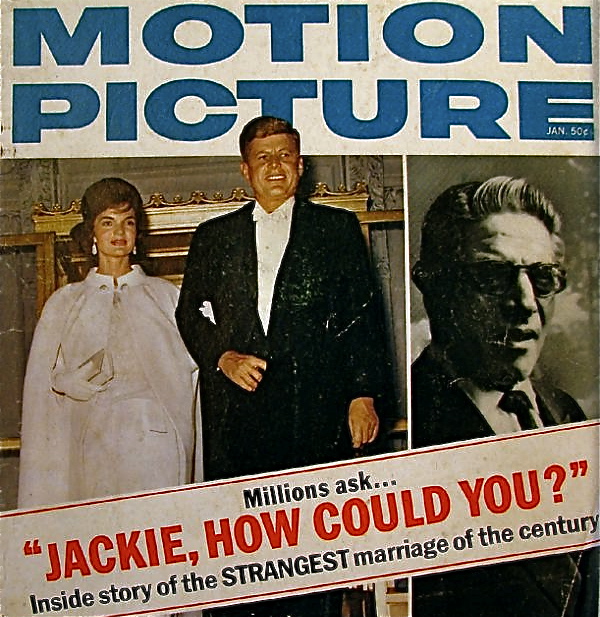
the common thought is this: jackie married onassis for his money.
and that was totally ok. because she was scared after the assassination of robert kennedy and so it’s completely understandable and almost commendable that she would be desperate for the security onassis’s money could provide.
this notion- this idea that she married for money- is preferable to the opposite. it’s easier to swallow. it was totally acceptable if she married for money. it was morally reprehensible if she married for love.
dear world, that makes no sense.
that she would be forgiven her avariciousness but not her poor choice in men.
this bizarre inversion of the moral code perplexes me to no end. it’s massively important and, as is usually the case with massively important things, i don’t know what to do with it.
sometimes the process of writing doesn’t involve actual writing. this is hands down the most frustrating part. because when you’re writing, you’re moving forward. when you’re not writing, it’s hard to view the situation as anything other than, at best, a stand-off and, at worst, a standstill.
jackie and i are in a stand-off. it’s gonna go one of two ways.
the whole morality business is either indicative of the general messedupness of jackie’s relationships or the general messedupness of the world’s relationship with her.
my money’s on the later.
mortified

so this is interesting to maybe only me
it’s from the comments section of a gawker post about the 60 minutes interview with angelina jolie (so… y’know… a direct source)…
That said: I’ve read at least a couple interviews now where Aniston says Brad Pitt did NOT cheat. So are we hating on Jolie forever more because she was ‘next?’ Because she ‘exists’ for Pitt to fall in love with? Are we assuming she ‘led Brad astray,’ and CAUSED him to leave Aniston? According to reports that pre-date Jolie, Aniston and Pitt were not the golden couple their PR managers who hooked them up as Pitt was rebounding from his busted engagement to Gwyneth Paltrow want you to believe. Several months after Pitt officially separated from Aniston, I never heard or saw Angelina hanging in Malibu, smoking doobs with the Cox-Arquettes. I didn’t see Jolie, riding around Beverly Hills on the back of his bike.
What I saw, was Brad Pitt in remote African villages with Diane Sawyer, on the beaches of Kenya playing with Maddox, at Jolie’s UK estate where she lived with her son, promoting ONE with Bono, traveling to Ethiopia with Jolie to adopt HER daughter. I know it pains you to admit, but that shows HE was pursuing HER. He was out to change FOR HER. HE wanted to emulate her, because he admired HER. I know, THAT possible truth, is painful for some women. It’s easier for us to believe some SIREN stole our man against his will, than ADMIT, a man may have walked away due to incompatibility issues, boredom, and/or misery with us. “She stole him,” goes down a LOT better than HE CHOSE HER AFTER LEAVING YOU. Somehow, giving the man free will, and autonomy in deciding what the rest of his life will look like is frightening…
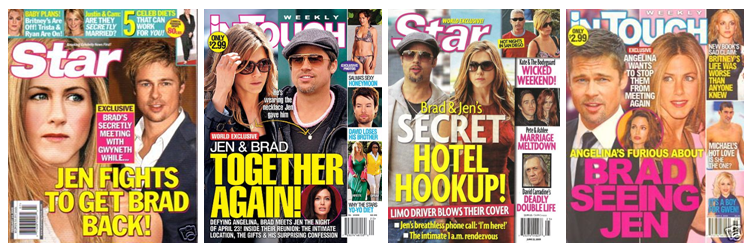
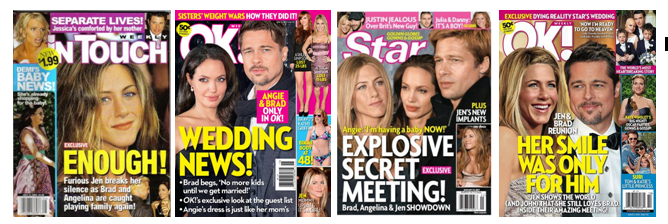
obviously, the whole lover/scorned wife/adulteress thing is not unique to pitt/aniston/jolie. it’s just fisher/reynolds/taylor or burton/fisher/taylor all over again. but what is interesting is that nearly seven years after aniston and pitt’s divorce and the beginning of pitt’s relationship with jolie, the notion of a love triangle is still the driver of the tabloid press coverage for all three.
(admittedly, this is in no way helped by the fact that for the last seven years, they have all of them have made a host of compellingly stupid comments that either directly or cryptically reinforce the connection the tabloids are trying to forge.)
gossip is narrative, not truth. yes, there may be truths within the narrative, but the narrative is the key. that isn’t to say it’s logical or consistent, but rather that editors will, without fail, push the narrative in the direction of the most drama, because that is what sells magazines.
this is really, really hard to remember. even when you have set up camp in the magical realm of celebrity studies, it is still really, really hard to remember.
yesterday, there was an article about how khloe kardashian is doing IVF. i forwarded it to a friend who’s doing research on the role of reality tv in the destigmatization of infertility. she wrote back that kardashian was likely just taking the preliminary step of consulting a fertility doctor.
this blew my mind.
i have set up camp in the magical realm of celebrity studies and yet, still, i assumed the kardashian story was 100% true. i should’ve known better. it was the kardashians, after all, and gossip.
and if we’re going to take gossip as narrative and not truth, that has got to hold across the board.
this is difficult because (a) the pitts and jolies and anistons of the world do press junkets and say provocative things, and (b) their friends and publicists are, in turn, all blabbing to the magazines. nearly all modern celebrities are actively engaged in shaping their own narratives, so there is a veneer of truth. it’s just not the whole truth and it’s couched within a highly subjective version of events.
pitt may very well have left aniston because he was bored and unfulfilled, and then hooked up with jolie later on and that may have been what he was trying to communicate during the moneyball rollout when he wound up producing a string of damningly insensitive soundbites instead. but from a storytelling perspective, that story is très dull.
the magazines are in the business of writing stories. stories that are provocative enough that they’ll be picked up and repeated on the daily beast or CNN, where we will consume them as though they were news and, maybe, one day buy one of the magazines.
the trick is they are not news. they’re just stories. it’s shocking how readily we’ll accept them as truth.

jackie! the authorized biography

John Kennedy’s victory in the 1960 presidential election raised interest in his wife to a fevered pitch. But, Jackie was adamant that she would do things on her own terms. She detested the prying and made a preemptive move to thwart conjecture about her private life.
At her mother’s suggestion, Mrs. Kennedy appointed Mary Van Rensselaer Thayer— Janet Auchincloss’ friend and a former editor of the Washington Post—as her authorized biographer. The (flawed) thought being that if an authorized version of her life were presented to the public, it would be taken as pure fact, the public curiosity would be saited and interest would wane.
As her authorized biographer, Thayer was given exclusive access to Mrs. Kennedy’s voluminous scrapbooks, photo albums, and letters, as well as access to the future First Lady herself. And though it was Thayer’s name that appeared on the book’s jacket, Jackie was closely involved in its production and the final product heavily bore her imprimatur. Mary Bass Gibson, who later purchased the serialization rights for Ladies Home Journal, recalled that Mrs. Kennedy “did a lot of the writing in bed and then Molly [Thayer] would take it over and rewrite it.” Thus, the resulting text, published in the winter of 1961 as Jacqueline Bouvier Kennedy, remains the closest we have ever come to having Jackie’s memoirs. Jackie herself is believed to have penned the first draft.
So why isn’t Thayer’s book beloved by millions and in its 8,000th edition? Here’s why…
Jacqueline Bouvier Kennedy is an authorized biography in the strictest sense—meaning it is totally safe. In accordance with Jackie’s wishes, Thayer produced a saccharin treatment of the Kennedys’ life that breezily glossed over any unpleasantries and laid the foundation for the myths that followed. It says very little that people didn’t already know about Jackie in 1961. Much less things we don’t know about her now.
(Jackie was obviously pleased as she rehired Thayer in the mid-1960s to write a companion book on her White House years.)
But there is one passage that’s worth mentioning. The Kennedys’ marital struggles were an open secret in Washington by this point, and Thayer makes a brief nod of acknowledgement towards them, presumably with Jackie’s tacit approval. She writes of Jackie, contemplating marriage to Jackie Kennedy in 1953:
[S]he realized that here was a man who did not want to marry. She was frightened. Jacqueline, in this revealing moment, envisaged heartbreak, but just as swiftly determined such heartbreak would be worth the pain.
Peel back the language of Harlequin romance and this statement tantalizes. I think it also plays up the element of Jackie’s character that is so often overlooked and yet one that her children evoked time and time again: her spirit of adventure.
She knew he didn’t want to marry. She knew it was going to be difficult. And yet, she picked the challenge— the adventure— nonetheless.
kitty kelley!
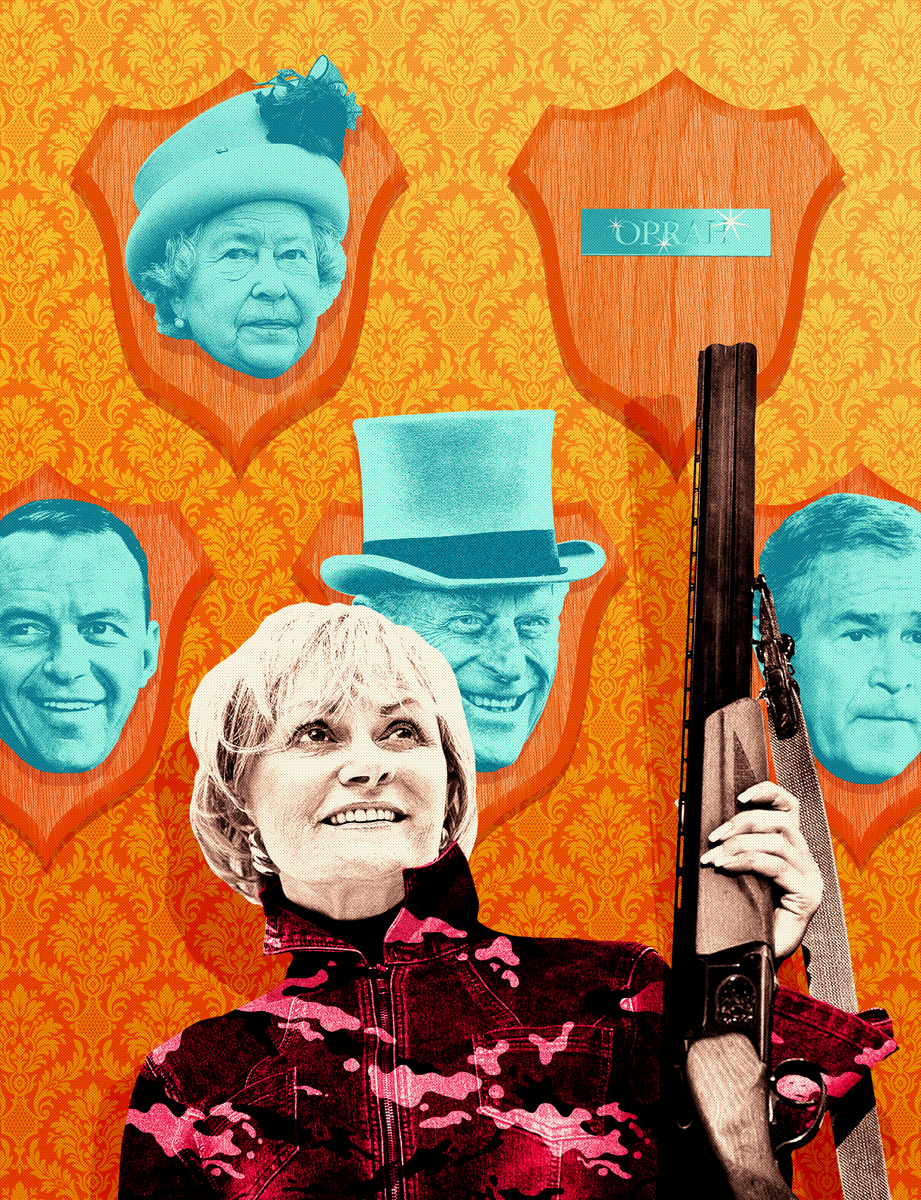
(c) Sean McCabe
I’m writing about the irrepressible/fabulous Kitty Kelley over at Cheeky Chicago today:
The great tenet of biography is that it’s far simpler to write a biography when the subject of your biography is dead. But Kitty Kelley has never been one to take the easy way out…
Read it HERE.
And if you missed the interview on Oprah, you can still catch that HERE.
movie magazines: a brief history in several parts (part 4)

To understand the visual impact of the Kennedys—and, yes, their impact was more visual than anything else—you have to appreciate the aesthetic dullness of the political landscape into which they burst. In brilliant contrast to the contemporary politicos, with their grizzled visages and frumpy, mink-swathed wives, the Kennedys were unlike any political couple Americans had ever seen.
Just look at Jackie in the audience at the Inauguration. Situated in its historical context, her cream colored suit appears clean, crisp and vaguely futuristic. It shines like a hopeful beacon amid the sea of animal pelts.
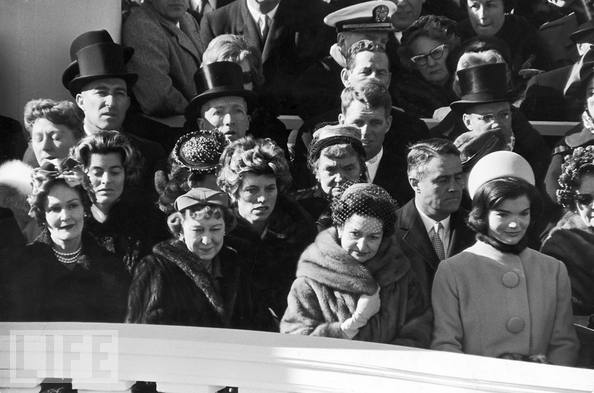
Historian Gary Willis characterized theirs as a “rule by dazzlement,” a phrase that goes a long way in capturing the First Family’s stunning visual impact.
People simply could not get enough and they did not know why. Neither did the magazines. Any attempt to pin down the Kennedy appeal resulted in a laundry list of clichés. In 1962, the editors of TV Radio Album fumbled towards an answer in their attempt to attach the term “star” to Mrs. Kennedy: “The word is used in show business to describe a personality so warm and vital that we forget we know it only as a picture on a TV screen or a name in newsprint. We feel that we know the actual person, as someone close to us. And certainly Jacqueline Kennedy is all that!”
With the advent of television and the resulting drop in movie attendance, the fan magazines reached a crossroads. To remain relevant, they had to expand their gaze beyond the Hollywood hills.
In “Jackie!”: The Exploitation of a First Lady, Irving Shulman succinctly captures the magazines’ perception of their own role in the American media, circa 1961: “It had at last come to pass that the world’s longest and most exciting movie was being performed every hour of every day at the White House and in locales throughout the world related to this master set. To record this living movie and assure its proper critical place in American and international history was the contemporary historic dedication of the fan magazines.”
It was an admirable pursuit and herein lay the distinction between the fan magazines and the mainstream press. Though their coverage was similarly characterized by provocative images and personality-based narratives, their approach was markedly different. The “serious” publications covered the Kennedys as political personalities, while the movie magazines approached them as show business stars- which they were.
(photo via LIFE)
movie magazines: a brief history in several parts (part 3)
[Last week… Hey Oline, who the heck is this Irving Schulman dude?]
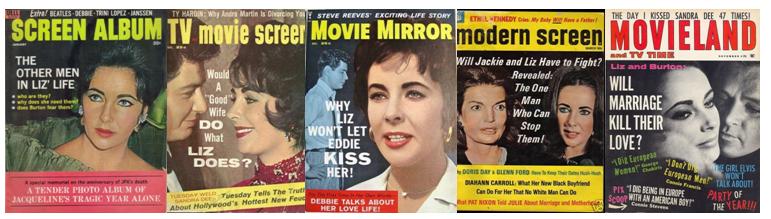
In “Jackie”: The Exploitation of a First Lady, Irving Shulman—sociologist/misogynist— suggested that the movie magazines offered “uterine tidbits” and “a clitoral interpretation of life” to their largely female audience, a dastardly editorial policy that, in turn, infected the entirety of the mainstream media. Shulman uses the tabloids’ Jackie Kennedy coverage to illustrate this insidious trickle-down effect.
This is interesting, yes, but it is also wrong.
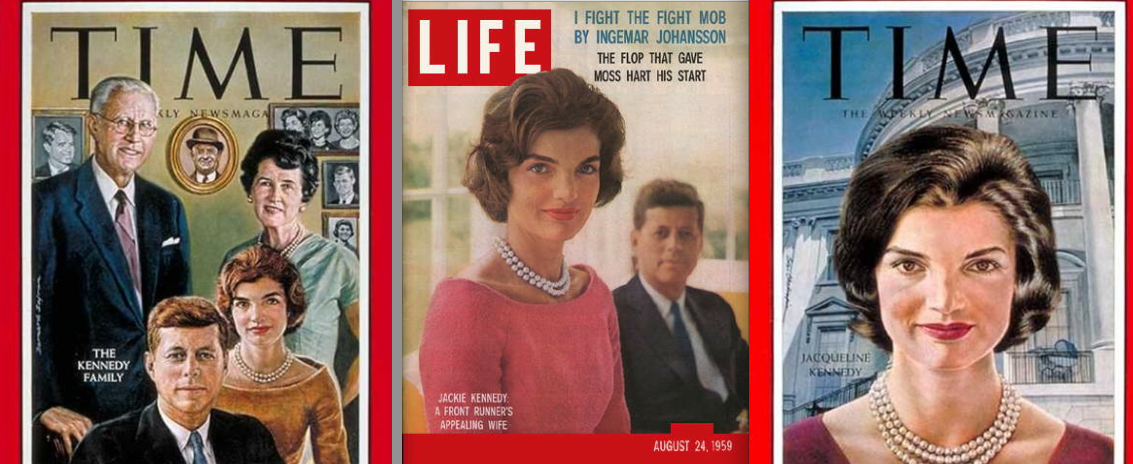
The mainstream press latched onto the Kennedys’ spectacular appeal early. The family had received regular press coverage since Joe Kennedy’s days in Hollywoodand his subsequent ambassadorship in the Court of St. James. They were no strangers to publicity and, in July 1953, before she was even married, Life ran a four-page spread on Senator Kennedy’s fiancé.
A similar cover feature appeared in 1958 and, a year later, the FRONTRUNNER’S APPEALING WIFE was front-and-center in a cover photograph, with JFK hovering in the background, curiously out of focus. In the fall of 1960, Look followed suit with an article on all the Kennedy women and a cover of the Senator’s 29 year old wife in a strapless dress with a hint of cleavage. At the time of the Inauguration, Ladies Home Journal was running serialized excerpts from Mary Van Rensselaer Thayer’s authorized biography, giving readers an intimate peek into the new First Lady’s life via singularly florid prose. By the time the movie magazines began hesitantly running her on their covers in the winter of 1961, Jackie had been making regular appearances in Life and Look for nearly a decade.
The exposure in the mainstream magazines hinged on the notion of exclusive access to extremely private moments. Between the election and Inauguration, Life devoted a cover to JFK Jr.’s christening. In its February 28, 1961 issue, Look gave readers “exclusive” access to an “informal visit” with the new First Family, including photographs of Jackie swaddling the Kennedy’s newborn. The accompanying copy notes that, when the photographs were taken, the infant “had not long graduated from an incubator.”
Such reports were stylish, authorized and, often, in full-color, but they were also— at their core— fueled by provocative images and personality-based narratives. By 1961, the mainstream magazines were already strolling down the path upon which the tabloids were about to stumble.
movie magazines: a brief history in several parts (part 2)
[Last week… Hey, Oline, what are movie magazines?]
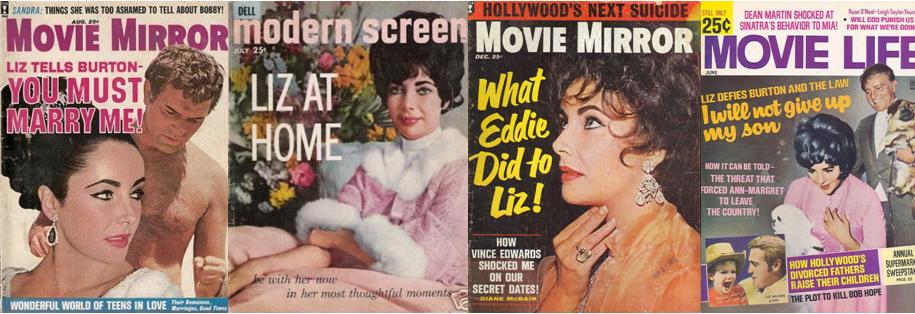
In 1969, the sociologist Irving Shulman published a landmark study of the movie magazines, using their Jackie Kennedy coverage as a case-study. And, yes, I use the phrase “landmark study” while readily acknowledging that its landmark status has gone largely unrecognized by most everyone in the world but me and “Celebrity Gossip, Academic Style” superstar Anne Helen Peterson, who notes that Shulman provides “The Most Sexist, Classist, Patently Offensive, and Incredibly Useful Research of All Time.”
Whether you love Jackie or movie magazines or not, Shulman’s “Jackie”: The Exploitation of a First Lady is worth reading. His assertion that the mainstream media has gone down the crapper is valid and it’s provocative that he finds the movie magazines entirely at fault. The thesis:
Fan magazines [are] considerably more than a trifling symptom of American malaise, and this symptom, could explain the American public’s conditioned acceptance of such obscenities as genocide, favorable kill ratio, nuclear fallout, murder, a geometric increase of violent felonies, starvation, slums, denigration of the human condition, fine print in consumer contracts, demagoguery, venality and stupidity in public office, and a spate of social violences which imprison juveniles in a delinquent society of adults.
Um… yeah. Any way we look at it that is an amazing assessment, never mind the way that Shulman goes about proving it.
“Jackie” is interesting because it offers a framework for analyzing the social impact of the movie magazines of yore that’s equally applicable to the celebrity magazines of today, and also because it is fantastically misogynistic.
Shulman’s argument is predicated on the notion that the movie magazines catered to their primarily female audience by offering “uterine tidbits” and a “clitoral interpretation of life,” an interpretation that, in turn, infected the entirety of the mainstream media. So, what he’s saying is that the movie magazines (ie. “women’s magazines”) single-handedly lured the mainstream press (ie. “men’s magazines”) to drink from the tabloid trough.
He then uses the tabloids’ Jackie Kennedy coverage to illustrate the trickle-down effect.
This is interesting, yes, but it is also wrong…
[Next week… Hey, Oline, why was Schulman wrong?]
ps.
much like jessie spano, i am SO EXCITED to be the new host of the New Books in Biography podcast. for starters, a discussion with Charles J. Shields, author of the insightful/provocative/definitive new kurt vonnegut biography, “and so it goes.”
the podcast can be accessed HERE on the New Books Network or on iTunes.
 an alarming life
You must be logged in to post a comment.